Search


Citations & References (15)
Gibco™
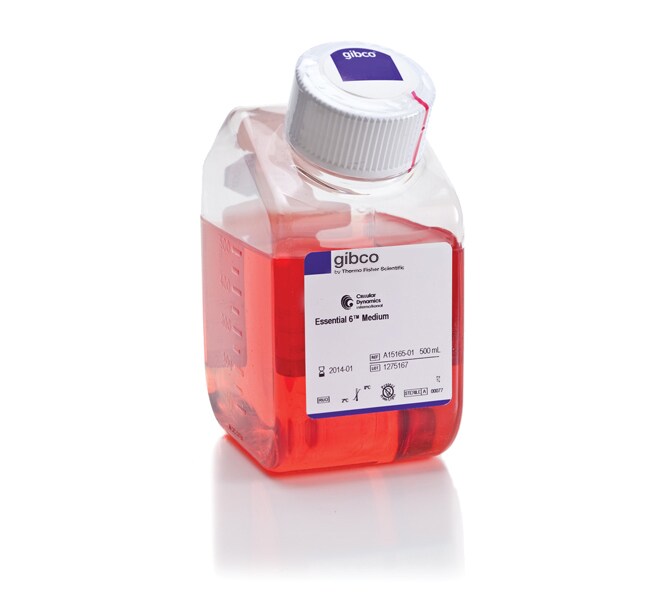
Essential 6™ Medium
Essential 6 Medium is a feeder-free and xeno-free medium that supports the reprogramming of somatic cells and the spontaneous or directed differentiation of human pluripotent stem cells (PSCs).
| Catalog Number | Quantity |
|---|---|
| A1516401 | 500 mL |
Catalog number A1516401
Price (USD)
280.00
Each
Quantity:
500 mL
Price (USD)
280.00
Each
Essential 6 Medium is a feeder-free and xeno-free medium that supports the reprogramming of somatic cells and the spontaneous or directed differentiation of human pluripotent stem cells (PSCs). With only six essential components, Essential 6 Medium helps minimize variability and can be used as a base for custom media for the culture of PSCs. The formulation is based on a medium originally developed by Guokai Chen et. al. (1) in the laboratory of James Thomson and published as 'E6'. To complete your workflow with a matching reduced-variability PSC culture medium developed by the same lab, use Essential 8 Medium.
Essential 6 Medium enables:
- Differentiation—does not contain bFGF, which inhibits differentiation
- Reprogramming—does not contain TGFβ, which has a negative effect on reprogramming efficiency
- Flexibility—provides a flexible format where the levels of TGFβ and bFGF can be adjusted and additional components can be added to match a given application
Differentiation
Unlike other media used in PSC culture, Essential 6 Medium does not contain bFGF or TGFβ. As such, Essential 6 Medium can support the formation of embryoid bodies. It has also been used as a base for the directed differentiation of various cell types in the endodermal, mesodermal, and ectodermal lineages (2), including motor neurons (3).
Reprogramming
Essential 6 Medium allows for defined and feeder-free reprogramming when used with bFGF. The formulation supports somatic cell reprogramming using a variety of methods, including episomal vectors (4) and CytoTune (Sendai virus), and is optimized to help ensure maximum cell health and pluripotency with minimal variability.
Flexibility
Essential 6 Medium is xeno-free and contains only the essential components needed for stem cell culture, minus bFGF and TGFβ. This provides a basal medium that will maximize cell health and pluripotency while allowing levels of TGFβ and bFGF to be adjusted and additional components to be added to match a given application.
Commercialized in partnership with Cellular Dynamics International.
References
- Chen G, Gulbranson DR, Hou Z, Bolin JM, Ruotti V, Probasco MD, Smuga-Otto K, Howden SE, Diol NR, Propson NE, Wagner R, Lee GO, Antosiewicz-Bourget J, Teng JM, Thomson JA. Chemically defined conditions for human iPSC derivation and culture. Nat Methods. 2011 8(5):424-9.
- Lippmann ES, Estevez-Silva MC, Ashton RS. Defined human pluripotent stem cell culture enables highly efficient neuroepithelium derivation without small molecule inhibitors. Stem Cells. 2014 32(4):1032-42.
- Lippmann ES, Williams CE, Ruhl DA, Estevez-Silva MC, Chapman ER, Coon JJ, Ashton RS. Deterministic HOX patterning in human pluripotent stem cell-derived neuroectoderm. Stem Cell Reports. 2015 4(4):632-44.
- Yu J, Hu K, Smuga-Otto K, Tian S, Stewart R, Slukvin II, Thomson JA. Human induced pluripotent stem cells free of vector and transgene sequences. Science. 2009 324(5928):797-801.
For Research Use Only. Not for use in diagnostic procedures.
Specifications
Cell LineEmbryonic Stem Cells (ESCs), Induced Pluripotent Stem Cells (iPSCs)
Cell TypeEmbryonic Stem Cells (ESCs), Induced Pluripotent Stem Cells (iPSCs)
Manufacturing QualitycGMP for medical devices, 21 CFR Part 820 and ISO 13485
Product LineEssential 6
Product TypeStem Cell Media
Quantity500 mL
Shelf Life12 Months
Shipping ConditionAmbient
SpeciesHuman
ClassificationXeno-free
Culture TypeAdherent Cell Culture, Feeder-free Stem Cell Culture (Human, iPS - Induced Pluripotent Stem, Embryonic), Stem Cell (Human, iPS - Induced Pluripotent Stem, Embryonic)
FormLiquid
Serum LevelSerum-free
SterilitySterile-filtered
Sterilization MethodSterile-filtered
With AdditivesPhenol Red
Unit SizeEach
Contents & Storage
Store at 2 to 8°C and protect from light.
Frequently asked questions (FAQs)
Can I store Gibco Essential 6 Medium (Cat. No. A1516401) at -20 degrees C?
Is it possible to reprogram somatic cells using Essential 7 or Essential 8 medium and transition them into StemFlex Medium upon harvest?
When should I use the full length Human FGF-basic (FGF-2/bFGF) Recombinant Protein or the truncated variant, Human FGF-basic (FGF-2/bFGF) (aa 10-155) Recombinant Protein?
What are induced pluripotent stem cells?
Citations & References (15)
Citations & References
Abstract
Long-term xeno-free culture of human pluripotent stem cells on hydrogels with optimal elasticity.
Journal:
PubMed ID:26656754
'The tentative clinical application of human pluripotent stem cells (hPSCs), such as human embryonic stem cells and human induced pluripotent stem cells, is restricted by the possibility of xenogenic contamination resulting from the use of mouse embryonic fibroblasts (MEFs) as a feeder layer. Therefore, we investigated hPSC cultures on biomaterials
Stable enhanced green fluorescent protein expression after differentiation and transplantation of reporter human induced pluripotent stem cells generated by AAVS1 transcription activator-like effector nucleases.
Journal:
PubMed ID:24833591
'Human induced pluripotent stem (hiPS) cell lines with tissue-specific or ubiquitous reporter genes are extremely useful for optimizing in vitro differentiation conditions as well as for monitoring transplanted cells in vivo. The adeno-associated virus integration site 1 (AAVS1) locus has been used as a '
Advanced feeder-free generation of induced pluripotent stem cells directly from blood cells.
Journal:
PubMed ID:25355732
Generation of validated human induced pluripotent stem cells (iPSCs) for biobanking is essential for exploring the full potential of iPSCs in disease modeling and drug discovery. Peripheral blood mononuclear cells (PBMCs) are attractive targets for reprogramming, because blood is collected by a routine clinical procedure and is a commonly stored
Analysis of essential pathways for self-renewal in common marmoset embryonic stem cells.
Journal:
PubMed ID:24649403
Common marmoset (CM) is widely recognized as a useful non-human primate for disease modeling and preclinical studies. Thus, embryonic stem cells (ESCs) derived from CM have potential as an appropriate cell source to test human regenerative medicine using human ESCs. CM ESCs have been established by us and other groups,
Proneural transcription factor Atoh1 drives highly efficient differentiation of human pluripotent stem cells into dopaminergic neurons.
Journal:
PubMed ID:24904172
Human pluripotent stem cells (PSCs) are a promising cell resource for various applications in regenerative medicine. Highly efficient approaches that differentiate human PSCs into functional lineage-specific neurons are critical for modeling neurological disorders and testing potential therapies. Proneural transcription factors are crucial drivers of neuron development and hold promise for