Search


인용 및 참조 문헌 (15)
Invitrogen™
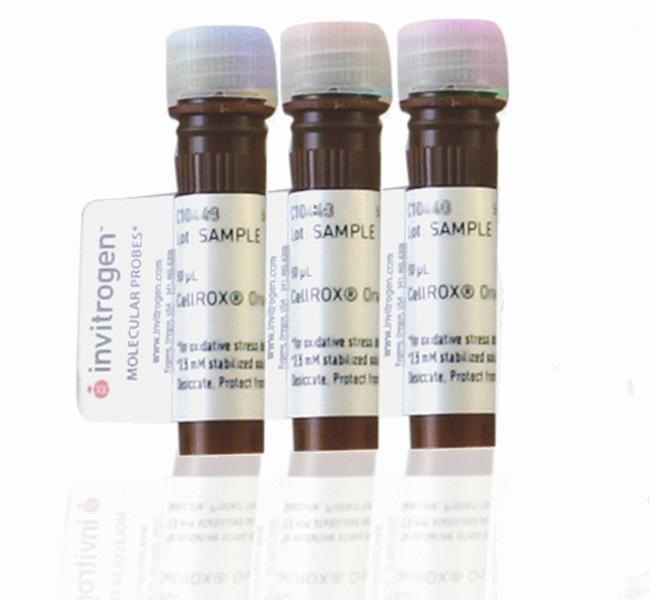
CellROX™ Reagent for oxidative stress detection
CellROX™ Reagents are novel fluorogenic probes for measuring cellular oxidative stress in both live and fixed cell imaging.
Have Questions?
보기 방식 변경

| 카탈로그 번호 | 색상 |
|---|---|
| C10448 | Orange, Far-Red, Green |
| C10444 | Green |
| C10443 | Orange |
| C10422 | Deep Red |
카탈로그 번호 C10448
제품 가격(KRW)
677,000
온라인 행사
Ends: 31-Dec-2026
773,000할인액 96,000 (12%)
Each
색상:
Orange, Far-Red, Green
제품 가격(KRW)
677,000
온라인 행사
Ends: 31-Dec-2026
773,000할인액 96,000 (12%)
Each
The CellROX™ Reagents are novel fluorogenic probes for measuring cellular oxidative stress in live cells. These cell-permeant dyes exhibit bright fluorescence upon oxidation by reactive oxygen species (ROS). (See table below for details of each reagent.)
The CellROX™ reagents are:
- Optimized for detection of oxidative stress in live cells and may be added directly to serum-containing growth media
- Provided as a stable, ready-to-use DMSO solutions with simple protocols, compatible with standard workflows in fluorescence microscopy
- Compatible with a variety of detection platforms, including traditional fluorescence microscopy, high content screening (HCS), and flow cytometry
Oxidative stress results from an imbalance between the production of reactive oxygen species (ROS) and the ability of cells to scavenge them. ROS play an important role in the progression of several diseases, including inflammation, atherosclerosis, aging, and age-related degenerative disorders.
For Research Use Only. Not intended for any animal or human therapeutic or diagnostic use.
For Research Use Only. Not for use in diagnostic procedures.
사양
색상Orange, Far-Red, Green
형식Frozen
수량1 kit
Unit SizeEach
자주 묻는 질문(FAQ)
What dyes can I use to detect reactive oxygen species (ROS) in my bacteria?
인용 및 참조 문헌 (15)
인용 및 참조 문헌
Abstract
Mechanisms of programmed cell death signaling in hair cells and support cells post-electrode insertion trauma.
Journal:
PubMed ID:25761716
'Programmed cell death (PCD) initially starts in the support cells (SCs) after electrode insertion trauma (EIT), followed by PCD in hair cells (HCs). Activation of caspase-3 was observed only in SCs. Protecting both SCs and HCs with selective otoprotective drugs at an early stage post implantation may help to preserve
Highly specific in vivo gene delivery for p53-mediated apoptosis and genetic photodynamic therapies of tumour.
Journal:
PubMed ID:25739372
Anticancer therapies are often compromised by nonspecific effects and challenged by tumour environments' inherent physicochemical and biological characteristics. Often, therapeutic effect can be increased by addressing multiple parameters simultaneously. Here we report on exploiting extravasation due to inherent vascular leakiness for the delivery of a pH-sensitive polymer carrier. Tumours' acidic
A tryptophanol-derived oxazolopiperidone lactam is cytotoxic against tumors via inhibition of p53 interaction with murine double minute proteins.
Journal:
PubMed ID:25814188
Inactivation of the p53 tumor suppressor protein by interaction with murine double minute (MDM) proteins, MDM2 and MDMX, is a common event in human tumors expressing wild-type p53. In these tumors, the simultaneous inhibition of these interactions with MDMs, for a full p53 reactivation, represents a promising anticancer strategy. Herein,
Oxidative stress triggers cytokinesis failure in hepatocytes upon isolation.
Journal:
PubMed ID:25744598
Primary hepatocytes are highly differentiated cells and proliferatively quiescent. However, the stress produced during liver digestion seems to activate cell cycle entry by proliferative/dedifferentiation programs that still remain unclear. The aim of this work was to assess whether the oxidative stress associated with hepatocyte isolation affects cell cycle and particularly
DNA Damage: A Sensible Mediator of the Differentiation Decision in Hematopoietic Stem Cells and in Leukemia.
Journal:
PubMed ID:25789504
In the adult, the source of functionally diverse, mature blood cells are hematopoietic stem cells, a rare population of quiescent cells that reside in the bone marrow niche. Like stem cells in other tissues, hematopoietic stem cells are defined by their ability to self-renew, in order to maintain the stem