Search


Citas y referencias (3)
Invitrogen™
ProcartaPlex™ Rat Cytokine & Chemokine Panel, 22plex
El panel ProcartaPlex 22-Plex de citocina y quimiocina de rata permite el estudio de la función inmunitaria mediante el análisisMás información
| Número de catálogo | Cantidad |
|---|---|
| EPX220-30122-901 | 96 pruebas |
Número de catálogo EPX220-30122-901
Precio (CLP)
5.683.096
Each
Cantidad:
96 pruebas
Precio (CLP)
5.683.096
Each
El panel ProcartaPlex 22-Plex de citocina y quimiocina de rata permite el estudio de la función inmunitaria mediante el análisis de 22 proteínas diana en un solo pocillo a través de la tecnología Luminex xMAP. El panel se compone de dos subpaneles modulares que disponen de una amplia pantalla inicial para determinar los elementos diana de interés, así como estudios posteriores que analizan los subconjuntos funcionales específicos de citocinas y que pueden adquirirse por separado. Los subpaneles son totalmente combinables entre ellos o con los ensayos individuales simples correspondientes a los objetivos del panel.
Los paneles preconfigurados ProcartaPlex se han probado exhaustivamente para determinar la capacidad combinatoria, la interferencia y la reactividad cruzada de los analitos con el fin de proporcionar el mayor nivel de validación y precisión. Todos los paneles ProcartaPlex se suministran con los reactivos necesarios para realizar el ensayo.
Los paneles multiplex ProcartaPlex están disponibles en múltiples formatos en seis especies (humano, ratón, rata, primate no humano, porcino y canino). Visite nuestra página de inmunoensayos ProcartaPlex para obtener más información y consultar los productos disponibles.
Lista de objetivos [región de gránulos]:
Citocinas: G-CSF (CSF-3) [12], GM-CSF [42], IFN gamma [25], IL-1 alfa [14], IL-1 beta [19], IL-2 [20], IL-4 [21], IL-5 [27], IL-6 [18], IL-10 [15], IL-12p70 [39], IL-13 [35], IL-17A (CTLA-8) [53], TNF alfa [45]
Quimiocinas: Eotaxin (CCL11) [62], GRO alfa (CXCL1) [43], IP-10 (CXCL10) [22], MCP-1 (CCL2) [51], MCP-3 (CCL7) [48], MIP-1 alfa (CCL3) [47], MIP-2 [13], RANTES (CCL5) [44]
Acerca de los ensayos ProcartaPlex para la plataforma Luminex
Los inmunoensayos ProcartaPlex se basan en los principios de un ELISA tipo sándwich y utilizan dos anticuerpos altamente específicos que se enlazan a los diferentes epítopos de una proteína para cuantificar todas las proteínas diana simultáneamente mediante un instrumento Luminex. Para los ensayos multiplex ProcartaPlex se requieren tan solo 25 µl de plasma o suero, o 50 µl de sobrenadante del cultivo celular, y solo se necesitan cuatro horas para obtener los resultados analizados.
Las características incluyen:
• Resultados reproducibles y fiables: validados como panel según el estándar más alto del sector, incluidas las pruebas de combinación de proteínas diana y reactividad cruzada
• Más resultados por muestra: permite medir múltiples proteínas diana simultáneamente en una única muestra de 25–50 µL
• Tecnología Luminex consolidada: plataforma de multiplexing de referencia para detección y cuantificación de proteínas
Los ensayos ProcartaPlex utilizan la tecnología Luminex xMAP (método multianálito) para la detección y cuantificación simultáneas de hasta 65 proteínas diana en una única muestra de 25–50 µL de plasma, suero, sobrenadantes del cultivo celular y otros fluidos corporales.
Las microesferas de Luminex del ensayo de ProcartaPlex se tiñen internamente con proporciones precisas de fluoróforos rojos e infrarrojos para crear firmas específicas que pueden ser identificadas por los sistemas de detección Luminex xMAP (por ejemplo, Luminex 200, FLEXMAP 3D y MAGPIX). El ensayo ProcartaPlex, similar a un ELISA tipo sándwich, utiliza pares de anticuerpos emparejados para identificar la proteína de interés. En un ensayo multiplex, cada gránulo espectralmente único se etiqueta con anticuerpos específicos para una sola proteína diana, y las proteínas vinculadas se identifican con anticuerpos biotinilados y estreptavidina-R-ficoeritrina (RPE). La conjugación de anticuerpos específicos de proteínas en un gránulo distinto permite el análisis de varios elementos diana en un solo pocillo.
La diferencia más significativa entre un ensayo ProcartaPlex y uno ELISA es que el anticuerpo de captura del ensayo ProcartaPlex se conjuga en un gránulo y no se adsorbe en el pocillo de la microplaca, por lo que los reactivos del ensayo ProcartaPlex flotan en la solución. Para la detección, el instrumento Luminex 200, por ejemplo, contiene dos láseres, uno para distinguir la firma espectral de cada partícula y el segundo para cuantificar la cantidad de fluorescencia RPE, que es proporcional a la cantidad de proteína presente en la muestra. Los ensayos multiplex ProcartaPlex pueden determinar el perfil de más proteínas diana con mucha menos muestra en el mismo tiempo que se tarda en realizar un ELISA tipo sándwich tradicional.
Los paneles multiplex ProcartaPlex están disponibles en múltiples formatos en seis especies (humano, ratón, rata, primate no humano, porcino y canino). Visite thermofisher.com/procartaplex para obtener más información y consultar los productos disponibles.
Los paneles preconfigurados ProcartaPlex se han probado exhaustivamente para determinar la capacidad combinatoria, la interferencia y la reactividad cruzada de los analitos con el fin de proporcionar el mayor nivel de validación y precisión. Todos los paneles ProcartaPlex se suministran con los reactivos necesarios para realizar el ensayo.
Los paneles multiplex ProcartaPlex están disponibles en múltiples formatos en seis especies (humano, ratón, rata, primate no humano, porcino y canino). Visite nuestra página de inmunoensayos ProcartaPlex para obtener más información y consultar los productos disponibles.
Lista de objetivos [región de gránulos]:
Citocinas: G-CSF (CSF-3) [12], GM-CSF [42], IFN gamma [25], IL-1 alfa [14], IL-1 beta [19], IL-2 [20], IL-4 [21], IL-5 [27], IL-6 [18], IL-10 [15], IL-12p70 [39], IL-13 [35], IL-17A (CTLA-8) [53], TNF alfa [45]
Quimiocinas: Eotaxin (CCL11) [62], GRO alfa (CXCL1) [43], IP-10 (CXCL10) [22], MCP-1 (CCL2) [51], MCP-3 (CCL7) [48], MIP-1 alfa (CCL3) [47], MIP-2 [13], RANTES (CCL5) [44]
Acerca de los ensayos ProcartaPlex para la plataforma Luminex
Los inmunoensayos ProcartaPlex se basan en los principios de un ELISA tipo sándwich y utilizan dos anticuerpos altamente específicos que se enlazan a los diferentes epítopos de una proteína para cuantificar todas las proteínas diana simultáneamente mediante un instrumento Luminex. Para los ensayos multiplex ProcartaPlex se requieren tan solo 25 µl de plasma o suero, o 50 µl de sobrenadante del cultivo celular, y solo se necesitan cuatro horas para obtener los resultados analizados.
Las características incluyen:
• Resultados reproducibles y fiables: validados como panel según el estándar más alto del sector, incluidas las pruebas de combinación de proteínas diana y reactividad cruzada
• Más resultados por muestra: permite medir múltiples proteínas diana simultáneamente en una única muestra de 25–50 µL
• Tecnología Luminex consolidada: plataforma de multiplexing de referencia para detección y cuantificación de proteínas
Los ensayos ProcartaPlex utilizan la tecnología Luminex xMAP (método multianálito) para la detección y cuantificación simultáneas de hasta 65 proteínas diana en una única muestra de 25–50 µL de plasma, suero, sobrenadantes del cultivo celular y otros fluidos corporales.
Las microesferas de Luminex del ensayo de ProcartaPlex se tiñen internamente con proporciones precisas de fluoróforos rojos e infrarrojos para crear firmas específicas que pueden ser identificadas por los sistemas de detección Luminex xMAP (por ejemplo, Luminex 200, FLEXMAP 3D y MAGPIX). El ensayo ProcartaPlex, similar a un ELISA tipo sándwich, utiliza pares de anticuerpos emparejados para identificar la proteína de interés. En un ensayo multiplex, cada gránulo espectralmente único se etiqueta con anticuerpos específicos para una sola proteína diana, y las proteínas vinculadas se identifican con anticuerpos biotinilados y estreptavidina-R-ficoeritrina (RPE). La conjugación de anticuerpos específicos de proteínas en un gránulo distinto permite el análisis de varios elementos diana en un solo pocillo.
La diferencia más significativa entre un ensayo ProcartaPlex y uno ELISA es que el anticuerpo de captura del ensayo ProcartaPlex se conjuga en un gránulo y no se adsorbe en el pocillo de la microplaca, por lo que los reactivos del ensayo ProcartaPlex flotan en la solución. Para la detección, el instrumento Luminex 200, por ejemplo, contiene dos láseres, uno para distinguir la firma espectral de cada partícula y el segundo para cuantificar la cantidad de fluorescencia RPE, que es proporcional a la cantidad de proteína presente en la muestra. Los ensayos multiplex ProcartaPlex pueden determinar el perfil de más proteínas diana con mucha menos muestra en el mismo tiempo que se tarda en realizar un ELISA tipo sándwich tradicional.
Los paneles multiplex ProcartaPlex están disponibles en múltiples formatos en seis especies (humano, ratón, rata, primate no humano, porcino y canino). Visite thermofisher.com/procartaplex para obtener más información y consultar los productos disponibles.
Para uso exclusivo en investigación. No apto para uso en procedimientos diagnósticos.
Especificaciones
Intervalo del ensayoVer certificado de análisis
Sensibilidad del ensayoMenos del 15 %
Para utilizar con (equipo)Instrumentos Luminex™
FormatoKit multiplex
Línea de productosProcartaPlex
Tipo de muestraSobrenadantes de cultivo celular, suero y plasma, Plasma, Cell Culture Supernatants
Volumen de muestraSuero, plasma: 25 μl; CCS: 50 μl
Condiciones de envíoHielo húmedo
CombinabilityCombinable
Tipo de productoPanel
Cantidad96 pruebas
Research AreaImmunology, Cytokines, Chemokines
EspecieRata
Unit SizeEach
Contenido y almacenamiento
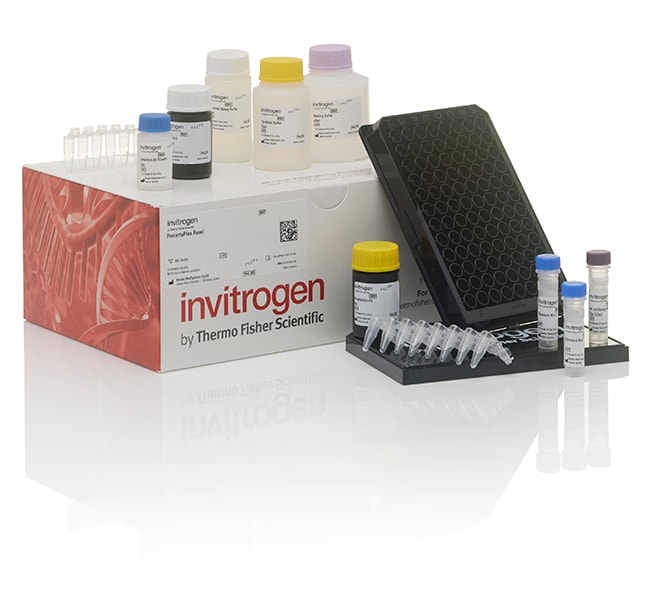
- 2 viales de mezcla estándar de rata A (liofilizada)
- 1 vial de mezcla de gránulos de captura de citocinas (50X)
- 1 vial de mezcla de gránulos de captura de quimiocinas (1X)
- 1 vial de mezcla de anticuerpos de detección biotinilada de citocinas (50X)
- 1 vial de mezcla de anticuerpos de detección biotinilada de quimiocinas (50X)
- 1 frasco de tampón de lectura (1X)
- 1 frasco de tampón de lavado (10x)
- 1 frasco de estreptavidina-PE (1X)
- 1 frasco de tampón de ensayo universal (1 X)
- 1 frasco de diluyente de anticuerpos de detección (1X)
- Tira de 8 tubos
- Película adhesiva
- Placa de 96 pocillos de fondo plano, negra
- Almacenar entre 2 °C y 8 °C
Preguntas frecuentes
What is the size of the Luminex beads you currently use?
I am interested in performing Luminex assays using BioSource kits, and I have a Luminex xMAP system. Besides the kits and system, what other reagents and equipment will I need?
Do the Luminex beads require special care in handling?
Why would the Luminex acquisition software display "Sample Empty" messages during analysis?
What are the Luminex beads made of?
Citations & References (3)
Citations & References
Abstract
HE4 Overexpression by Ovarian Cancer Promotes a Suppressive Tumor Immune Microenvironment and Enhanced Tumor and Macrophage PD-L1 Expression.
Journal:J Immunol
PubMed ID:33903172
'Ovarian cancer is a highly fatal malignancy characterized by early chemotherapy responsiveness but the eventual development of resistance. Immune targeting therapies are changing treatment paradigms for numerous cancer types but have had minimal success in ovarian cancer. Through retrospective patient sample analysis, we have determined that high human epididymis protein
In-depth characterization of the neuroinflammatory reaction induced by peripheral surgery in an animal model.
Journal:J Neural Transm (Vienna)
PubMed ID:30039507
Delirium is a common complication seen after surgery and anesthesia, in particular in older patients. Although the etiology of postoperative delirium is only incompletely understood, various lines of evidence suggest that proinflammatory signaling from the peripheral site of inflammation to central nervous system results in a decrease of cerebral acetylcholine
Subcutaneous administration of a neutralizing IL-1ß antibody prolongs limb allograft survival.
Journal:Am J Transplant
PubMed ID:29633557
Cytokine-expression profiles revealed IL-1ß highly upregulated in rejecting skin of limb allografts. We investigate the effect of intragraft treatment with a neutralizing IL-1ß antibody in limb transplantation. Following allogenic hind-limb transplantation, Lewis rats were either left untreated or treated with anti-lymphocyte serum + tacrolimus (baseline); baseline immunosuppression + anti-IL-1ß (1 mg/kg