Search


Citations & References (21)
Invitrogen™
ProcartaPlex™ Human Cytokine & Chemokine Panel 1A, 34plex
The ProcartaPlex Human Cytokine & Chemokine Panel 1A 34plex enables the exploration of immune function by analyzing 34 protein targetsRead more
| Catalog Number | Quantity |
|---|---|
| EPX340-12167-901 | 96 Tests |
Catalog number EPX340-12167-901
Price (USD)
6,920.00
Each
Quantity:
96 Tests
Price (USD)
6,920.00
Each
The ProcartaPlex Human Cytokine & Chemokine Panel 1A 34plex enables the exploration of immune function by analyzing 34 protein targets in a single well using Luminex xMAP technology. The panel is comprised of four modular sub-panels that are a subset of the Human Cytokine/Chemokine/Growth Factor Panel 1 45plex (Cat. No. EPX450-12171-901). This kit is fully combinable with the other sub-panels or individual simplex assays corresponding to the targets in the 45-plex panel. The same targets can be found in the Human Cytokine & Chemokine Convenience Panel 1A 34plex (Cat. No. EPXR340-12167-901) that is in a ready-to-use format that requires less pipetting.
ProcartaPlex preconfigured panels are extensively tested for analyte combinability, interference, and cross-reactivity to provide the highest level of validation and precision. All ProcartaPlex panels are supplied with the necessary reagents to perform the assay.
ProcartaPlex multiplex panels are available in multiple formats across six species (human, mouse, rat, nonhuman primate, porcine, and canine). Visit our ProcartaPlex Immunoassays page for more information and available products.
Target list [bead region]:
Th1/Th2: GM-CSF [44], IFN gamma [43], IL-1 beta [18], IL-2 [19], IL-4 [20], IL-5 [21], IL-6 [25], IL-8 [27], IL-12p70 [34], IL-13 [35], IL-18 [66], TNF alpha [45]
Th9/Th17/Th22/Treg: IL-9 [52], IL-10 [28], IL-17A (CTLA-8) [36], IL-21 [72], IL-22 [76], IL-23 [63], IL-27 [14]
Inflammatory cytokines: IFN alpha [48], IL-1 alpha [62], IL-1RA [38], IL-7 [26], IL-15 [65], IL-31 [37], TNF beta [54]
Chemokines: Eotaxin (CCL11) [33], GRO alpha (CXCL1) [61], IP-10 (CXCL10) [22], MCP-1 (CCL2) [51], MIP-1 alpha (CCL3) [12], MIP-1 beta (CCL4) [47], RANTES (CCL5) [42], SDF-1 alpha [13]
About ProcartaPlex assays for the Luminex platform
ProcartaPlex immunoassays are based on the principles of a sandwich ELISA, using two highly specific antibodies binding to different epitopes of one protein to quantitate all protein targets simultaneously using a Luminex instrument. ProcartaPlex multiplex assays require as little as 25 μL of plasma or serum, or 50 μL of cell culture supernatant, and just four hours to obtain analyzed results.
Features include:
• Reproducible, reliable results—validated as a panel to the highest industry standard, including protein target combinability and cross-reactivity testing
• More results per sample—measure multiple protein targets simultaneously in a single 25–50 μL sample
• Well-established Luminex technology highly referenced multiplexing platform for protein detection and quantitation
ProcartaPlex assays utilize Luminex xMAP (multianalyte profiling) technology for the simultaneous detection and quantitation of up to 80 protein targets in a single 25–50 μL sample—from plasma, serum, cell culture supernatants, and other bodily fluids.
The Luminex beads in the ProcartaPlex assay are internally dyed with precise proportions of red and infrared fluorophores to create spectrally unique signatures that can be identified by the Luminex xMAP detection systems (e.g., Luminex 200, FLEXMAP 3D, and MAGPIX). Similar to a sandwich ELISA, the ProcartaPlex assay uses matched antibody pairs to identify the protein of interest. In a multiplexed assay, each spectrally unique bead is labeled with antibodies specific for a single target protein, and bound proteins are identified with biotinylated antibodies and streptavidin–R-phycoerythrin (RPE). The conjugation of protein-specific antibodies to a distinct bead allows for analysis of multiple targets in a single well.
The most significant difference between a ProcartaPlex assay and ELISA is that the capture antibody in the ProcartaPlex assay is conjugated to a bead and not adsorbed to the microplate well, so the ProcartaPlex assay reagents are free-floating in the solution. For detection, the Luminex 200 instrument, for example, contains two lasers, one to distinguish the spectral signature of each bead and the second to quantify the amount of RPE fluorescence, which is proportional to the amount of protein present in the sample. ProcartaPlex multiplex assays can profile more target proteins using significantly less sample in the same time that it takes to perform a traditional sandwich ELISA.
ProcartaPlex multiplex panels are available in multiple formats across six species (human, mouse, rat, nonhuman primate, porcine, and canine). Visit thermofisher.com/procartaplex for more information and available products.
For Research Use Only. Not for use in diagnostic procedures.
Specifications
Assay RangeSee Certificate of Analysis
Assay SensitivitySee Certificate of Analysis
For Use With (Equipment)Luminex™ Instruments
FormatMultiplex Kit
Product LineProcartaPlex
Sample TypeSerum, Plasma, Cell Culture Supernatants
Sample VolumeSerum, Plasma: 25 μL; CCS: 50 μL
Shipping ConditionWet Ice
CombinabilityCombinable
Product TypeMultiplex Panel
Quantity96 Tests
Research AreaImmunology, Cytokines, Chemokines
SpeciesHuman
Unit SizeEach
Contents & Storage
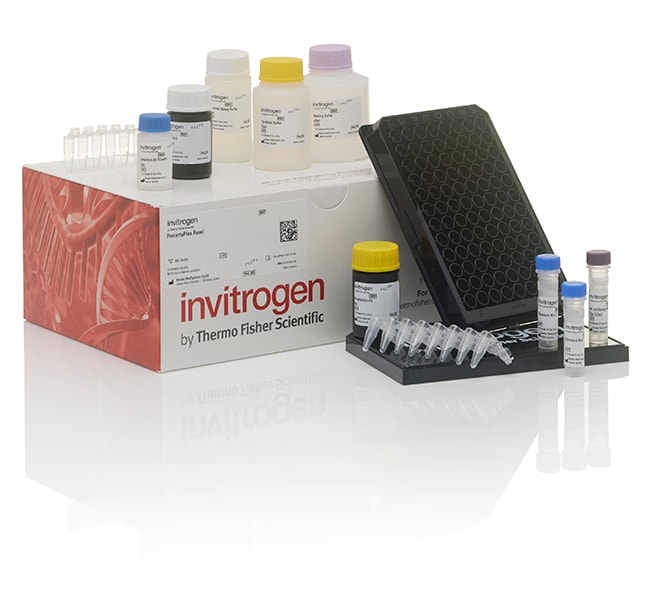
• 2 vials Human Standard Mix A (lyophilized)
• 2 vials Human Standard Mix B (lyophilized)
• 1 vial Capture Bead Mix B (1X)
• 1 vial Capture Bead Mix C (1X)
• 1 vial Capture Bead Mix D (1X)
• 1 vial Capture Bead Mix F (1X)
• 1 vial Biotinylated Detection Antibody Mix B (50X)
• 1 vial Biotinylated Detection Antibody Mix C (50X)
• 1 vial Biotinylated Detection Antibody Mix D (50X)
• 1 vial Biotinylated Detection Antibody Mix E (50X)
• 1 bottle Reading Buffer (1X)
• 1 bottle Wash Buffer (10X)
• 1 bottle Streptavidin-PE (1X)
• 1 bottle Universal Assay Buffer (1X)
• 1 bottle Detection Antibody Diluent (1X)
• 8-tube strip
Frequently asked questions (FAQs)
What is the size of the Luminex beads you currently use?
I am interested in performing Luminex assays using BioSource kits, and I have a Luminex xMAP system. Besides the kits and system, what other reagents and equipment will I need?
Do the Luminex beads require special care in handling?
Why would the Luminex acquisition software display "Sample Empty" messages during analysis?
What are the Luminex beads made of?
Citations & References (21)
Citations & References
Abstract
Decreased erythrocyte CD44 and CD58 expression link e-waste Pb toxicity to changes in erythrocyte immunity in preschool children.
Journal:Sci Total Environ
PubMed ID:30763849
'Lead (Pb) toxicity damages blood cells and disturbs the immune micro-environment. When Pb enters the circulatory system, >95% of Pb accumulates in erythrocytes. We therefore conducted this study to explore the long-term effect of Pb exposure on expression of erythrocyte adhesion molecules (CD44 and CD58) and related downstream cytokine concentrations.
Cardiovascular endothelial inflammation by chronic coexposure to lead (Pb) and polycyclic aromatic hydrocarbons from preschool children in an e-waste recycling area.
Journal:Environ Pollut
PubMed ID:30597391
'Lead (Pb) and polycyclic aromatic hydrocarbon (PAH) exposure is positively associated with cardiovascular disease (CVD), and the possible potential mechanism may be caused by damage to the endothelium by modulation of inflammatory processes. No comprehensive research shows co-exposure of Pb and PAH on cardiovascular endothelial inflammation in electronic waste (e-waste)
HIV-associated disruption of lung cytokine networks is incompletely restored in asymptomatic HIV-infected Malawian adults on antiretroviral therapy.
Journal:ERJ Open Res
PubMed ID:29255717
'Disruption of lung cytokine networks during chronic HIV infection is incompletely restored in individuals on antiretroviral therapy.'
Adaptation of influenza A (H7N9) virus in primary human airway epithelial cells.
Journal:Sci Rep
PubMed ID:28900138
'Influenza A (H7N9) is an emerging zoonotic pathogen with pandemic potential. To understand its adaptation capability, we examined the genetic changes and cellular responses following serial infections of A (H7N9) in primary human airway epithelial cells (hAECs). After 35 serial passages, six amino acid mutations were found, i.e. HA (R54G,
Niche matters: The comparison between bone marrow stem cells and endometrial stem cells and stromal fibroblasts reveal distinct migration and cytokine profiles in response to inflammatory stimulus.
Journal:PLoS One
PubMed ID:28419140
'Intrinsic inflammatory characteristics play a pivotal role in stem cell recruitment and homing through migration where the subsequent change in niche has been shown to alter these characteristics. The bone marrow mesenchymal stem cells (bmMSCs) have been demonstrated to migrate to the endometrium contributing to the stem cell reservoir and