Search


Citations & References (61)
Invitrogen™
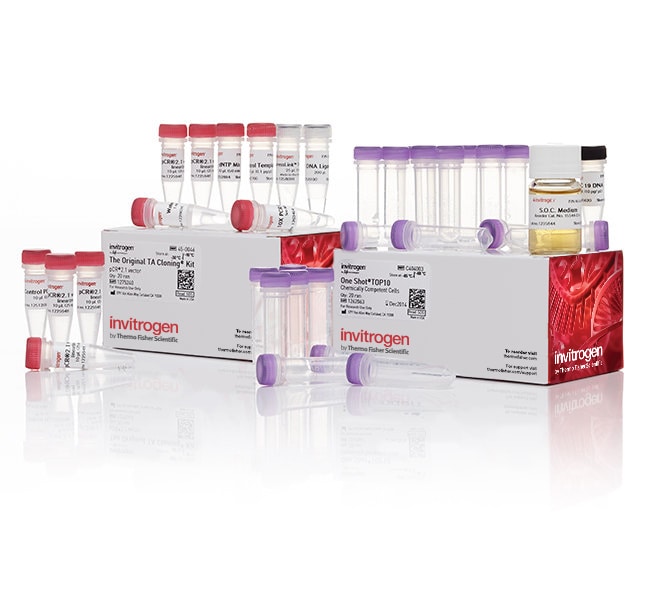
TA Cloning™ Kit, with pCR™2.1 Vector and One Shot™ TOP10 Chemically Competent E. coli
The TA Cloning™ Kit with pCR™2.1 vector provides a quick, one-step cloning strategy for directly inserting a Taq-amplified PCR productRead more
Have Questions?
Change view

| Catalog Number | No. of Reactions | Vector |
|---|---|---|
| K204001 | 20 Reactions | pCRII |
| K204040 | 40 Reactions | pCR2.1 |
Catalog number K204001
Price (USD)
740.65
Online exclusive
788.00Save 47.35
Each
No. of Reactions:
20 Reactions
Vector:
pCRII
Price (USD)
740.65
Online exclusive
788.00Save 47.35
Each
The TA Cloning™ Kit with pCR™2.1 vector provides a quick, one-step cloning strategy for directly inserting a Taq-amplified PCR product into a plasmid vector. The TA Cloning™ Kit uses the pCR™2.1 cloning vector and ExpressLink™ T4 DNA Ligase to generate a ligation product in a fifteen-minute, room-temperature ligation step. Reactions typically yield >80% recombinants containing inserts.
Features of the TA Cloning™ Kit with pCR™2.1 vector:
• Fast & convenient—15-minute, room-temperature ligation
• Efficient—blue/white screening and >80% clones with correct insert
• Flexible—choice of kanamycin or ampicillin resistance for flexible antibiotic selection
• Hassle-free—eliminates any enzymatic modifications of the PCR product
• Streamlined—does not require the use of PCR primers that contain restriction sites
The pCR™2.1 vector provides:
• 3'-T overhangs for direct ligation of Taq-amplified PCR products
• T7 promoter for in vitro RNA transcription and sequencing
• A versatile polylinker with flanking EcoR I sites for easy excision of inserts
• M13 forward and reverse primer sites for sequencing
How TA Cloning™ Works
Taq polymerase has a non-template-dependent activity that adds a single deoxyadenosine (A) to the 3' ends of PCR products. The linearized vector supplied in this kit has single 3' deoxythymidine (T) residues. This allows PCR inserts to ligate efficiently with the vector.
Kit Configurations
The TA Cloning™ Kit is offered in a variety of configurations: without competent cells (K2020-20 and K2020-40), with One Shot™ INVF' Chemically Competent E. coli (K2000-01 and K2000-40), with One Shot™ TOP10F' Chemically Competent E. coli (K2030-01 and K2030-40), and with One Shot™ TOP10 Chemically Competent E. coli (K2040-01 and K2040-40) in 20- and 40-reaction kit sizes.
Features of the TA Cloning™ Kit with pCR™2.1 vector:
• Fast & convenient—15-minute, room-temperature ligation
• Efficient—blue/white screening and >80% clones with correct insert
• Flexible—choice of kanamycin or ampicillin resistance for flexible antibiotic selection
• Hassle-free—eliminates any enzymatic modifications of the PCR product
• Streamlined—does not require the use of PCR primers that contain restriction sites
The pCR™2.1 vector provides:
• 3'-T overhangs for direct ligation of Taq-amplified PCR products
• T7 promoter for in vitro RNA transcription and sequencing
• A versatile polylinker with flanking EcoR I sites for easy excision of inserts
• M13 forward and reverse primer sites for sequencing
How TA Cloning™ Works
Taq polymerase has a non-template-dependent activity that adds a single deoxyadenosine (A) to the 3' ends of PCR products. The linearized vector supplied in this kit has single 3' deoxythymidine (T) residues. This allows PCR inserts to ligate efficiently with the vector.
Kit Configurations
The TA Cloning™ Kit is offered in a variety of configurations: without competent cells (K2020-20 and K2020-40), with One Shot™ INVF' Chemically Competent E. coli (K2000-01 and K2000-40), with One Shot™ TOP10F' Chemically Competent E. coli (K2030-01 and K2030-40), and with One Shot™ TOP10 Chemically Competent E. coli (K2040-01 and K2040-40) in 20- and 40-reaction kit sizes.
For Research Use Only. Not for use in diagnostic procedures.
Specifications
Bacterial or Yeast StrainTOP10
Cell TypeChemically Competent E. coli
Cloning MethodTA Cloning
For Use With (Application)PCR Cloning
No. of Reactions20 Reactions
Product LineOne Shot
Product TypeCloning Kit
PromoterT7
Quantity20 reactions
VectorpCRII
FormatKit
Unit SizeEach
Contents & Storage
TA Cloning™ kits contain linearized pCR™2.1 vector, ExpressLink™ T4 DNA ligase, 5X ExpressLink™ T4 DNA ligation buffer, dNTPs, 10X PCR buffer, sterile water, and controls. The competent cell kits contain One Shot™ chemically competent E. coli, S.O.C. medium, and a supercoiled control plasmid.
Store One Shot™ E. coli at -80°C. Store all other components at -20°C. All reagents are guaranteed stable for 6 months when properly stored.
Store One Shot™ E. coli at -80°C. Store all other components at -20°C. All reagents are guaranteed stable for 6 months when properly stored.
Citations & References (61)
Citations & References
Abstract
Molecular cloning of translocation t(1;14)(q21;q32) defines a novel gene (BCL9) at chromosome 1q21.
Journal:Blood
PubMed ID:9490669
Abnormalities of chromosome 1q21 are common in B-cell malignancies and have been associated with a poor response to therapy. The nature of the involved gene(s) on chromosome 1q21 remains unknown. A cell line (CEMO- 1) has recently been established from a patient with precursor-B-cell acute lymphoblastic leukemia (ALL), which exhibited
Molecular cloning and biological activity of a novel lysyl oxidase-related gene expressed in cartilage.
Journal:J Biol Chem
PubMed ID:11292829
We cloned a cDNA encoding a novel lysyl oxidase-related protein, named LOXC, by suppression subtractive hybridization between differentiated and calcified ATDC5 cells, a clonal mouse chondrogenic EC cell line. The deduced amino acid sequence of mouse LOXC consists of 757 amino acids and shows 50% identity with that of mouse
Differential gene expression between developing queens and workers in the honey bee, Apis mellifera [see comments]
Journal:Proc Natl Acad Sci U S A
PubMed ID:10318926
'Many insects show polyphenisms, or alternative morphologies, which are based on differential gene expression rather than genetic polymorphism. Queens and workers are alternative forms of the adult female honey bee and represent one of the best known examples of insect polyphenism. Hormonal regulation of caste determination in honey bees has
The mouse pale ear (ep) mutation is the homologue of human Hermansky- Pudlak syndrome.
Journal:Proc Natl Acad Sci U S A
PubMed ID:9256466
'The recessive mutation at the pale ear (ep) locus on mouse chromosome 19 was found to be the homologue of human Hermansky-Pudlak syndrome (HPS). A positional cloning strategy using yeast artificial chromosomes spanning the HPS locus was used to identify the HPS gene and its murine counterpart. These genes and
A novel N-terminal splice variant of the rat H+-K+-ATPase alpha2 subunit. Cloning, functional expression, and renal adaptive response to chronic hypokalemia.
Journal:J Biol Chem
PubMed ID:9446555
'The H+-K+-ATPase of renal collecting duct mediates K+ conservation during chronic hypokalemia. K+ deprivation promotes H+-K+-ATPase alpha2 (HKalpha2) gene expression in the medullary collecting duct, the principal site of active K+ reabsorption, suggesting that this isozyme contributes to renal K+ reclamation. We report here that alternative transcriptional initiation and mRNA