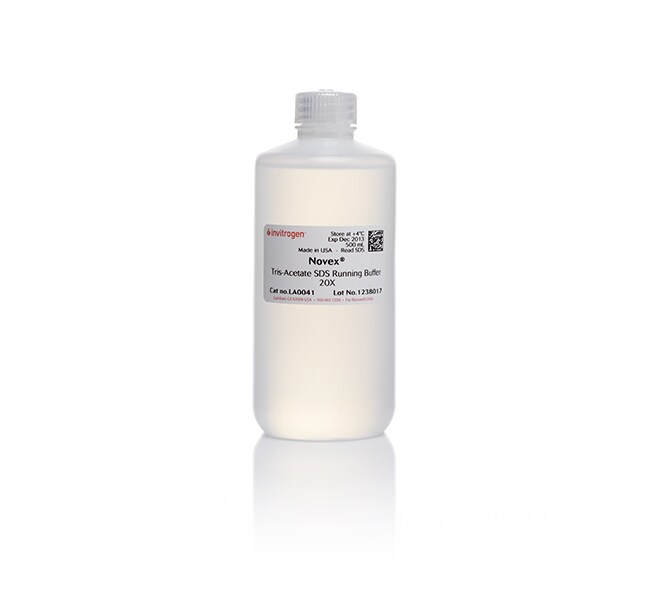
NuPAGE™ Tris-Acetat SDS Laufpuffer (20x)
Invitrogen™

NuPAGE™ Tris-Acetat SDS Laufpuffer (20x)

NuPAGE Tris-Acetat-SDS-Laufpuffer (20X) dient zum Trennen von Proteinen in ihrem denaturierten Zustand auf Tris-Acetat-Gelen. NuPAGE TRIS-Acetat-Gele bieten eine ausgezeichnete TrennungWeitere Informationen
Have Questions?
KatalognummerMenge
LA0041500 ml
Katalognummer LA0041
Preis (EUR)
116,65
Exklusiv online
125,00
Ersparnis 8,35 (7%)
Each
Menge:
500 ml
Preis (EUR)
116,65
Exklusiv online
125,00
Ersparnis 8,35 (7%)
Each
NuPAGE Tris-Acetat-SDS-Laufpuffer (20X) dient zum Trennen von Proteinen in ihrem denaturierten Zustand auf Tris-Acetat-Gelen. NuPAGE TRIS-Acetat-Gele bieten eine ausgezeichnete Trennung von Proteinen mit hoher Molekülmasse, wenn sie mit dem NuPAGE TRIS-Acetat-SD-Laufpuffer angewendet werden. NuPAGE TRIS-Acetat-Gele können auch mit Novex nativem TRIS-Glycin-Laufpuffer genutzt werden, um native Proteine effektiver als mit dem TRIS-Glycin-Gelsystem zu lösen.

Empfohlene Puffer
Verwenden Sie NuPAGE TRIS-Acetat-Gele mit NuPAGE TRIS-Acetat-SDS-Laufpuffern. Verwenden Sie NuPAGE LDS-Probenpuffer, um eine gute Probenreduktion und Bandauflösung zu gewährleisten. Für native Laufbedingungen sollten die nativen TRIS-Glycin-Lauf- und Probenpuffer verwendet werden.

Alle verfügbaren Puffer und Reagenzien für SDS-PAGE anzeigen

Nur für Forschungszwecke. Nicht zur Verwendung bei diagnostischen Verfahren.
Specifications
PufferLaufpuffer
Konzentration20 X
GelkompatibilitätNuPAGE™ TRIS-Acetat-Gele, NuPAGE™ TRIS-Acetat-Gele
Menge500 ml
Haltbarkeit1 Jahr
VersandbedingungZugelassen für den Versand bei Raumtemperatur oder auf nassem Eis
GeltypSDS-PAGE
ProduktlinieNuPAGE
ProdukttypSDS-Laufpuffer
Unit SizeEach
Inhalt und Lagerung
Bei +4 °C bis 25 °C lagern. Garantiert 6 Monate stabil, sofern in der Produktdokumentation nicht anders angegeben.

Häufig gestellte Fragen (FAQ)

Can I prepare my protein sample with the reducing agent and store it for future use?

DTT is not stable, so it must be added and the reduction performed just prior to loading your samples.

Find additional tips, troubleshooting help, and resources within our Protein Gel 1D Electrophoresis Support Center.

My LDS or SDS sample buffer precipitates when stored at 4 degrees C. Can I warm it up? Can I store it at room temperature?

Precipitation of the LDS or SDS at 4 degrees C is normal. Bring the buffer to room temperature and mix until the LDS/SDS goes into solution. If you do not want to wait for it to dissolve, you can store the sample buffer at room temperature.

Find additional tips, troubleshooting help, and resources within our Protein Gel 1D Electrophoresis Support Center.

How are Bolt gels different than NuPAGE gels?

While they are both Bis-Tris based gels, the chemistries are very different since Bolt gels are optimized for western blotting. Another key difference is the wedge well design of the Bolt gels, which allows larger sample volumes to be loaded.

Find additional tips, troubleshooting help, and resources within our Protein Gel 1D Electrophoresis Support Center.

What are the recommended sample loading volumes and protein loading amounts for your precast protein gels?

*Tris-Glycine and Invitrogen Tricine Mini gels: see here (http://tools.thermofisher.com/content/sfs/manuals/electrophoresisguide_man.pdf), Page 8

*NuPAGE Tris-Acetate and NuPAGE Bis-Tris Mini gels: see here (http://tools.thermofisher.com/content/sfs/manuals/nupage_tech_man.pdf), Page 10

*Bolt Bis-Tris Plus Mini gels: see here (http://www.thermofisher.com/us/en/home/life-science/protein-biology/protein-gel-electrophoresis/protein-gels/bolt-bis-tris-gels.html)

*Thermo Scientific Precise Tris-HEPES gels: see here (https://tools.thermofisher.com/content/sfs/manuals/MAN0011499_Precise_Protein_Gels_UG.pdf), Page 1

*Midi gels (Invitrogen Tris-Glycine, NuPAGE Bis-Tris and NuPAGE Tris-Acetate): see here (https://assets.thermofisher.com/TFS-Assets/LSG/manuals/novex_midigel_man.pdf), Page 4

*Thermo Scientific Precise Tris-Glycine gels: see here (https://tools.thermofisher.com/content/sfs/manuals/D25MAN0011814_Precise_TrisGlycine_Gels_UG.pdf), Page 1

Find additional tips, troubleshooting help, and resources within our Protein Electrophoresis and Western Blotting Support Center.

Do your precast protein gels contain SDS?

Our precast protein gels do not contain SDS but they can be run under denaturing conditions when used with the appropriate denaturing running buffer.
Note: NuPAGE Bis-Tris gels, Bolt Bis-Tris Plus gels, and Thermo Scientific Precise Tris-HEPES gels cannot be run under native conditions; they can only be run under denaturing conditions.

*Invitrogen Tris-Glycine gels: For Native electrophoresis, use Invitrogen Tris-Glycine Native Running Buffer. For Denaturing electrophoresis, use Invitrogen Tris-Glycine SDS Running Buffer

*NuPAGE Tris-Acetate gels: For Native electrophoresis, use Invitrogen Tris-Glycine Native Running Buffer. For Denaturing electrophoresis, use NuPAGE Tris-Acetate SDS Running Buffer

*NuPAGE Bis-Tris gels: For Denaturing electrophoresis, use NuPAGE MOPS-SDS Running Buffer or NuPAGE MES-SDS Running Buffer

*Bolt Bis-Tris Plus gels: For Denaturing electrophoresis, use Bolt MOPS SDS Running Buffer or Bolt MES SDS Running Buffer

*Thermo Scientific Precise Tris-Glycine gels: For Native electrophoresis, use Tris-Glycine SDS Running Buffer without SDS added. For Denaturing electrophoresis, use Tris-Glycine SDS Running Buffer.

*Thermo Scientific Precise Tris-HEPES gels: For Denaturing electrophoresis, use Tris-HEPES SDS Running Buffer.

Find additional tips, troubleshooting help, and resources within our Protein Electrophoresis and Western Blotting Support Center.

Zitierungen und Referenzen (1)

Zitierungen und Referenzen
Abstract
Biophysical and mutational analysis of the putative bZIP domain of Epstein-Barr virus EBNA 3C.
Authors:West MJ, Webb HM, Sinclair AJ, Woolfson DN,
Journal:J Virol
PubMed ID:15308737
Epstein-Barr virus nuclear antigen 3C (EBNA 3C) is essential for B-cell immortalization and functions as a regulator of viral and cellular transcription. EBNA 3C contains glutamine-rich and proline-rich domains and a region in the N terminus consisting of a stretch of basic residues followed by a run of leucine residues ... More