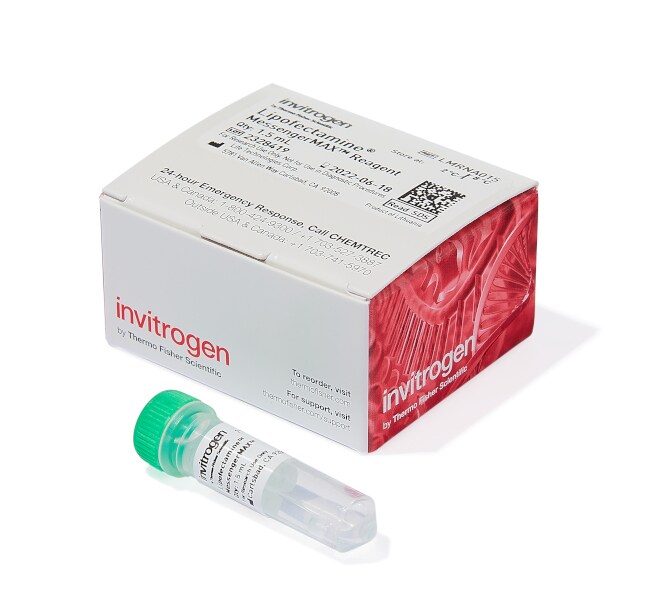
Réactif de transfection Lipofectamine™ MessengerMAX™
Invitrogen™

Réactif de transfection Lipofectamine™ MessengerMAX™

Le réactif de transfection d’ARNm MessengerMAX Lipofectamine™ offre une efficacité de transfection exceptionnelle dans les neurones et un large spectreAfficher plus
Have Questions?
Modifier l'affichagebuttonViewtableView
RéférenceQuantité
LMRNA0151,5 ml
LMRNA0010,1 ml
LMRNA0030,3 mL
LMRNA0080,75 ml
LMRNA15015 ml
Référence LMRNA015
Prix (EUR)
1 224,65
Offre exceptionnelle en ligne
1 458,00
Économisez 233,35 (16%)
Each
Quantité:
1,5 ml
Prix (EUR)
1 224,65
Offre exceptionnelle en ligne
1 458,00
Économisez 233,35 (16%)
Each
Le réactif de transfection d’ARNm MessengerMAX Lipofectamine™ offre une efficacité de transfection exceptionnelle dans les neurones et un large spectre de cellules primaires, permettant ainsi d’améliorer les résultats d’application et des recherches plus pertinentes sur le plan biologique. C’est parce que notre nouvelle technologie de nanoparticules lipidiques est optimisée pour délivrer un volume donné de la plus grande quantité d’ARNm possible sans l’étape d’entrée nucléaire requise avec l’ADN.

Transfectez avec succès plus de modèles cellulaires prédictifs avec un réactif qui fournit :
• Une efficacité de transfection exceptionnelle dans les neurones et les types de cellules primaires
• Expression protéique plus rapide sans risque d’intégration génomique
• Clivage jusqu’à 10 fois plus élevé grâce aux CRISPR d’ARNm

Une efficacité de transfection élevée dans les nouvelles applications de modification du génome
Le réactif Lipofectamine™ MessengerMAX™ permet d’augmenter la probabilité de clivage et de recombinaison avec succès grâce à l’ARNm de nucléase GeneArt™ CRISPR au travers d’une transfection hautement efficace, maximisant ainsi l’efficacité des modifications génétiques et simplifiant les processus en aval.

Transfectez efficacement les cellules difficiles à transfecter
Le réactif Lipofectamine™ MessengerMAX™ est conçu pour transfecter une quantité plus élevée d’ARNm dans les neurones et un large spectre de cellules primaires difficiles à transfecter. Cela élimine le besoin d’électroporation ou de virus et permet une amélioration > 2 fois de l’efficacité de la transfection par rapport aux autres réactifs à base de lipides.

Tirer parti des avantages de la transfection de l’ARNm
La transfection de l’ARNm ne nécessite pas d’absorption nucléaire, ce qui entraîne une expression plus rapide des protéines que la transfection de l’ADN puisque la translation de l’ARNm se produit dans le cytoplasme. De plus, l’ARNm ne présente aucun risque d’intégration génomique et l’efficacité de la transfection est indépendante du cycle cellulaire.
Usage exclusivement réservé à la recherche. Ne pas utiliser pour des procédures de diagnostic.
Spécifications
À utiliser avec (application)Transfection
Gamme de produitsLipofectamine
Type de produitRéactif de transfection
Quantité1,5 ml
Compatible avec le sérumOui
Conditions d’expéditionTempérature ambiante
Type de celluleLignées cellulaires établies, cellules neuronales, cellules souches, cellules primaires, cellules difficiles à transfecter
FormatPlaque à 6 puits, plaque à 12 puits, plaque à 24 puits, plaque à 48 puits, plaque à 96 puits, flacons
Type d’échantillonARNm
Transfection TechniqueTransfection basée sur les lipides
Unit SizeEach
Contenu et stockage
Conserver au réfrigérateur (entre 2 et 8°C).

Foire aux questions (FAQ)

I am trying to troubleshoot our mRNA transfection process using Lipofectamine MessengerMAX Transfection Reagent. Could you tell me some reasons why we may not be seeing expression after transfection? We are using primary cells, so I am not sure if it is due to the difficulty in transfecting these cells or another cause.

There are reasons that can influence expression after transfection, but before troubleshooting all the possibilities, a transfection experiment with a positive GFP mRNA control (Tri-Link CleanCap EGFP mRNA, Cat. No. L-7201) and the Lipofectamine MessengerMAX mRNA Transfection Reagent could be the solution. If this does not yield good results, it might be best to try an alternative delivery solution or different cells. However, if this gives acceptable results, the next step would be to try the mRNA of interest with the MessengerMAX reagent. If there are expression level concerns at this point, it might be the mRNA that is being used, and troubleshooting from this perspective might be needed. For example, some questions to ask would be: Is there a 5' cap? Is there a poly(A) tail? Is the mRNA pure? Do I get a single band on a gel? Was the DNA template clean?

Find additional tips, troubleshooting help, and resources within our Transfection Support Center.

We have seen quite a bit of variation in our mRNA transfection efficiency with Lipofectamine MessengerMAX Transfection Reagent, based on the number of passages prior to transfection. Do you have advice on the best passage number?

It is normal to observe some transfection efficiency differences between cell passages.To minimized this variability, we recommend using cells between 5-20 passages. Including a positive GFP mRNA control (Tri-Link CleanCap EGFP mRNA, Cat. No. L-7201) with every transfection experiment is helpful to quantitatively determine and follow any changes in transfection efficiencies from week to week.

Find additional tips, troubleshooting help, and resources within our Transfection Support Center.

I have been getting some toxicity in my mRNA transfections using Lipofectamine MessengerMAX Transfection Reagent. What would you recommend for minimizing toxicity?

Consider including appropriate 5' UTR and 3' UTR sequences into the template design to promote mRNA stability and acceptance by the cell. Use high purity in vitro transcribed mRNA purified with the MegaClear Transcription Cleanup Kit. Ensure A260/280 ratios are between 1.8 and 2.1. Check for mRNA quality and size by agarose gel electrophoresis. In some cases, consider incorporating chemically modified nucleotides in the transcription reaction. Cell number, mRNA, and lipid quantities may need to be adjusted. Ideal viable cell density on the day of transfection is between 70 and 90% confluence. For transfection optimization tips, please visit: thermofisher.com/transfectionsupport.

Find additional tips, troubleshooting help, and resources within our Transfection Support Center.

I accidentally left my lipid reagent at room temperature. Can I still use it?

Yes, all of our lipid transfection reagents are stable at room temperature for months.

Find additional tips, troubleshooting help, and resources within our Lipid-Based Transfection Support Center.

When transfecting mRNA, does the packaging of the foreign RNA into vesicles reduce the accessibility of the mRNA for protein translation or is the mRNA all released in the cytoplasm? If packaged away, what percent is packaged vs. what percent is left to be available for translation? Is this observed with DNA plasmids?

We have not observed differences between how a cell packages an mRNA payload versus a DNA payload for the purpose of delivery. Transfection involves complex formation between a liposome and mRNA, which create lipoplexes that are taken up by the cell via endocytosis. The liposome protects the mRNA during this process and also assists in endosomal escape, which releases the mRNA into the cytoplasm of the cell. The mRNA is immediately available for translation with the ribosome. In vitro transcribed mRNA may be prepared using the mMESSAGE mMACHINE T7 Ultra Transcription Kit, which incorporates a 5' ARCA cap and a 3' poly(A) tail to mimic endogenously transcribed mRNA.

Find additional tips, troubleshooting help, and resources within our Transfection Support Center.