Search
Invitrogen
XBP1 Monoclonal Antibody (9B7E5)
{{$productOrderCtrl.translations['antibody.pdp.commerceCard.promotion.promotions']}}
{{$productOrderCtrl.translations['antibody.pdp.commerceCard.promotion.viewpromo']}}
{{$productOrderCtrl.translations['antibody.pdp.commerceCard.promotion.promocode']}}: {{promo.promoCode}} {{promo.promoTitle}} {{promo.promoDescription}}. {{$productOrderCtrl.translations['antibody.pdp.commerceCard.promotion.learnmore']}}
Additional Information:
{{banner.description}}

FIGURE: 1 / 6
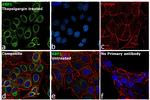
XBP1 Antibody (MA5-15768) in ICC/IF
Immunofluorescence analysis of XBP1 was performed using 70% confluent log phase MCF7 thapsigargin treated cells (2uM for 6hrs). The cells were fixed with 4% paraformaldehyde for 10 minutes, permeabilized with 0.1% Triton™ X-100 for 15 minutes, and blocked with 2% BSA for 45 minutes at room temperature. The cells were labeled with XBP1 Monoclonal Antibody (9B7E5)(Product # MA5-15768) at 5µg/mL in 0.1% BSA, incubated at 4 degree celsius overnight and then labeled with Donkey anti-Mouse IgG (H+L) Highly Cross-Adsorbed Secondary Antibody, Alex... View More


Product Details
MA5-15768
Applications
Tested Dilution
Publications
Product Specifications
Species Reactivity
Human,
Mouse,
Rat
Published species
Human
Host/Isotype
Mouse
/ IgG1, kappa
Class
Monoclonal
Type
Antibody
Clone
9B7E5
Immunogen
Recombinant protein corresponding to amino acids 2 to 160 of human XBP-1.
Conjugate
Form
Liquid
Concentration
1 mg/mL
Amount
100 µg
Purification
Antigen affinity chromatography
Storage buffer
PBS
Contains
0.02% sodium azide
Storage conditions
-20°C
Shipping conditions
Ambient (domestic); Wet ice (international)
RRID
Product Specific Information
A suggested positive control is XBP-1 recombinant protein.
Target Information
XBP1 encodes a transcription factor that regulates MHC class II genes by binding to a promoter element referred to as an X box. This gene product is a bZIP protein, which was also identified as a cellular transcription factor that binds to an enhancer in the promoter of the T cell leukemia virus type 1 promoter. It may increase expression of viral proteins by acting as the DNA binding partner of a viral transactivator. It has been found that upon accumulation of unfolded proteins in the endoplasmic reticulum (ER), the mRNA of this gene is processed to an active form by an unconventional splicing mechanism that is mediated by the endonuclease inositol-requiring enzyme 1 (IRE1). The resulting loss of 26 nt from the spliced mRNA causes a frame-shift and an isoform XBP1(S), which is the functionally active transcription factor. The isoform encoded by the unspliced mRNA, XBP1(U), is constitutively expressed, and thought to function as a negative feedback regulator of XBP1(S), which shuts off transcription of target genes during the recovery phase of ER stress. A pseudogene of XBP1 has been identified and localized to chromosome 5.
For Research Use Only. Not for use in diagnostic procedures. Not for resale without express authorization.
Bioinformatics
Protein Aliases: Hepatocarcinogenesis-related transcription factor; HTF; OTTHUMP00000028682; Tax-responsive element-binding protein 5; tax-responsive element-binding protein 5 homolog; TREB-5; unnamed protein product; X box binding protein-1; X-box-binding protein 1; XBP-1; XBP1
Gene Aliases: D11Ertd39e; HTF; TREB-5; TREB5; XBP-1; XBP1; XBP2
UniProt ID: (Human) P17861, (Rat) Q9R1S4, (Mouse) O35426
Entrez Gene ID: (Human) 7494, (Rat) 289754, (Mouse) 22433
transcription regulatory region sequence-specific DNA binding
RNA polymerase II regulatory region sequence-specific DNA binding
RNA polymerase II core promoter proximal region sequence-specific DNA binding
RNA polymerase II transcription factor activity, sequence-specific DNA binding
core promoter proximal region sequence-specific DNA binding
protease binding
DNA binding
transcription factor activity, sequence-specific DNA binding
protein binding
protein kinase binding
estrogen receptor binding
chromatin DNA binding
ubiquitin protein ligase binding
identical protein binding
histone deacetylase binding
sequence-specific DNA binding
ubiquitin-like protein ligase binding
protein heterodimerization activity
sequence-specific double-stranded DNA binding
core promoter binding
RNA polymerase II transcription factor binding
enhancer sequence-specific DNA binding
phosphatidylinositol 3-kinase regulatory subunit binding
transcription regulatory region DNA binding
negative regulation of transcription from RNA polymerase II promoter
angiogenesis
liver development
positive regulation of protein phosphorylation
endothelial cell proliferation
epithelial cell maturation
positive regulation of immunoglobulin production
regulation of transcription, DNA-templated
regulation of transcription from RNA polymerase II promoter
transcription from RNA polymerase II promoter
ubiquitin-dependent protein catabolic process
positive regulation of transcription from RNA polymerase II promoter involved in unfolded protein response
regulation of autophagy
positive regulation of autophagy
negative regulation of myotube differentiation
phosphatidylinositol 3-kinase signaling
cell growth
endoplasmic reticulum unfolded protein response
exocrine pancreas development
positive regulation of histone methylation
regulation of protein stability
protein destabilization
cellular response to nutrient
positive regulation of TOR signaling
cellular response to insulin stimulus
cellular response to oxidative stress
response to endoplasmic reticulum stress
cellular triglyceride homeostasis
cellular response to vascular endothelial growth factor stimulus
cellular response to glucose starvation
response to drug
glucose homeostasis
cholesterol homeostasis
positive regulation of transcription factor import into nucleus
negative regulation of apoptotic process
positive regulation of MHC class II biosynthetic process
positive regulation of B cell differentiation
positive regulation of T cell differentiation
positive regulation of fat cell differentiation
positive regulation of transcription from RNA polymerase II promoter
vascular endothelial growth factor receptor signaling pathway
neuron development
positive regulation of immunoglobulin secretion
response to electrical stimulus
fatty acid homeostasis
sterol homeostasis
serotonin secretion, neurotransmission
adipose tissue development
epithelial cell maturation involved in salivary gland development
cellular response to lipopolysaccharide
cellular response to amino acid stimulus
cellular response to antibiotic
cellular response to fructose stimulus
cellular response to glucose stimulus
cellular response to interleukin-4
cellular response to peptide hormone stimulus
cellular response to fluid shear stress
cellular response to laminar fluid shear stress
positive regulation of plasma cell differentiation
negative regulation of endoplasmic reticulum unfolded protein response
positive regulation of endoplasmic reticulum unfolded protein response
positive regulation of proteasomal protein catabolic process
positive regulation of protein acetylation
negative regulation of endoplasmic reticulum stress-induced intrinsic apoptotic signaling pathway
positive regulation of lactation
response to insulin-like growth factor stimulus
positive regulation of hepatocyte proliferation
positive regulation of endothelial cell apoptotic process
positive regulation of interleukin-6 secretion
regulation of cell growth
glandular epithelial cell maturation
lipid metabolic process
fatty acid biosynthetic process
autophagy
apoptotic process
immune response
response to unfolded protein
muscle organ development
positive regulation of cell proliferation
protein transport
cell differentiation
positive regulation of cell migration
negative regulation of transforming growth factor beta receptor signaling pathway
positive regulation of interleukin-6 production
positive regulation of vascular wound healing
IRE1-mediated unfolded protein response
ATF6-mediated unfolded protein response
ERAD pathway
positive regulation of protein import into nucleus
proteasome-mediated ubiquitin-dependent protein catabolic process
protein kinase B signaling
positive regulation of angiogenesis
positive regulation of protein kinase B signaling
negative regulation of SMAD protein import into nucleus
intrinsic apoptotic signaling pathway in response to endoplasmic reticulum stress
negative regulation of ERK1 and ERK2 cascade
positive regulation of phospholipid biosynthetic process
positive regulation of ERAD pathway
positive regulation of vascular smooth muscle cell proliferation
positive regulation of vascular associated smooth muscle cell migration
cellular response to leukemia inhibitory factor
transcription, DNA-templated
transport
multicellular organism development
Disclaimer

Clicking the images or links will redirect you to a website hosted by BenchSci that provides third-party scientific content. Neither the content nor the BenchSci technology and processes for selection have been evaluated by us; we are providing them as-is and without warranty of any kind, including for use or application of the Thermo Fisher Scientific products presented.

Performance Guarantee
If an Invitrogen™ antibody doesn't perform as described on our website or datasheet,we'll replace the product at no cost to you, or provide you with a credit for a future purchase.*
Learn more
We're here to help
Get expert recommendations for common problems or connect directly with an on staff expert for technical assistance related to applications, equipment and general product use.
Contact tech support