Search
Invitrogen
Phospho-EGFR (Tyr1068) Polyclonal Antibody
{{$productOrderCtrl.translations['antibody.pdp.commerceCard.promotion.promotions']}}
{{$productOrderCtrl.translations['antibody.pdp.commerceCard.promotion.viewpromo']}}
{{$productOrderCtrl.translations['antibody.pdp.commerceCard.promotion.promocode']}}: {{promo.promoCode}} {{promo.promoTitle}} {{promo.promoDescription}}. {{$productOrderCtrl.translations['antibody.pdp.commerceCard.promotion.learnmore']}}
Additional Information:
{{banner.description}}

FIGURE: 1 / 4
Phospho-EGFR (Tyr1068) Antibody (PA5-17848) in ICC/IF
Immunofluorescence analysis of Phospho-EGFR (Tyr1068) was performed using 70% confluent log phase A-431 cells treated with 200 ng/mL of EGF for 10 minutes. The cells were fixed with 4% paraformaldehyde for 10 minutes, permeabilized with 0.1% Triton™ X-100 for 10 minutes, and blocked with 1% BSA for 1 hour at room temperature. The cells were labeled with Phospho-EGFR (Tyr1068) Rabbit Polyclonal Antibody (Pro... View More


Product Details
PA5-17848
Applications
Tested Dilution
Publications
Product Specifications
Species Reactivity
Human,
Mouse,
Rat
Published species
Pig
Host/Isotype
Rabbit
/ IgG
Class
Polyclonal
Type
Antibody
Immunogen
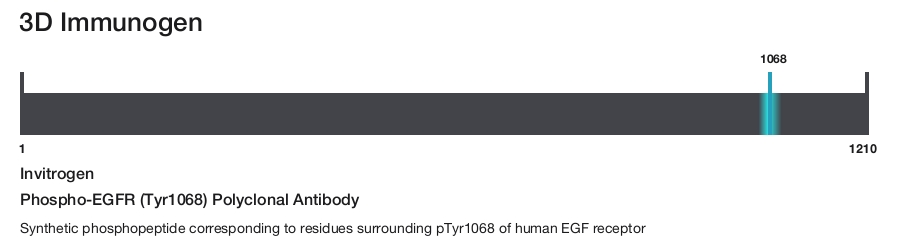
Synthetic phosphopeptide corresponding to residues surrounding pTyr1068 of human EGF receptor
Conjugate
Form
Liquid
Concentration
5 µg/mL
Amount
0.5 µg
Purification
Antigen affinity chromatography
Storage buffer
0.01M HEPES, pH 7.5, with 0.15M NaCl, 100µg/mL BSA, 50% glycerol
Contains
no preservative
Storage conditions
-20°C
Shipping conditions
Ambient (domestic); Wet ice (international)
RRID
Product Specific Information
It is not recommended to aliquot this antibody.
Target Information
EGFR, epidermal growth factor receptor, is a receptor tyrosine kinases that signals in response to various growth factors. Overexpression has been linked to numerous types of cancer and EGFR is the target of both biological and small molecular therapeutics. EGFR is encoded by the EGFR gene located on chromosome 7 in humans. EGFR belongs to the HER/ERbB family of proteins that includes three other receptor tyrosine kinases, ERbB2, ERbB3, ERbB4. EGFR is a transmembrane receptor and binding of its cognate ligands such as EGF (Epidermal Growth Factor) and TGF alpha (Transforming Growth Factor alpha) to the extracellular domain leads to EGFR dimerization followed by autophosphorylation of the tyrosine residues in the cytoplasmic domain. Overexpression is observed in tumors of the head and neck, brain, bladder, stomach, breast, lung, endometrium, cervix, vulva, ovary, esophagus, stomach and in squamous cell carcinoma.
For Research Use Only. Not for use in diagnostic procedures. Not for resale without express authorization.
Bioinformatics
Protein Aliases: 2.7.10.1; avian erythroblastic leukemia viral (v-erb-b) oncogene homolog; avian erythroblastic leukemia viral (v-erbB) oncogene homolog; cell growth inhibiting protein 40; cell proliferation-inducing protein 61; contains extracellular domain; EC 2.7.10.1; EGFR vIII; EGFR-related peptide; Epidermal growth factor receptor; Epidermal growth factor receptor formerly avian erythroblastic leukemia viral (v-erbB) oncogene homolog (Erbb1); epidermal growth factor receptor tyrosine kinase domain; epidermal growth factor receptor, formerly avian erythroblastic leukemia viral (v-erbB) oncogene homolog (Erbb1); erb-b2 receptor tyrosine kinase 1; GIG40; kinase EGFR; membrane protein; Oncogene ERBB; PIG61; Proto-oncogene c-ErbB-1; Receptor tyrosine-protein kinase erbB-1; unnamed protein product; Urogastrone; waved 2
Gene Aliases: 9030024J15Rik; AI552599; EGFR; ERBB; ErbB-1; ERBB1; Errb1; ERRP; HER1; mENA; NISBD2; NNCIS; PIG61; wa-2; wa2; Wa5
UniProt ID: (Human) P00533, (Mouse) Q01279
Entrez Gene ID: (Human) 1956, (Mouse) 13649, (Rat) 24329
nucleotide binding
virus receptor activity
chromatin binding
double-stranded DNA binding
protein kinase activity
MAP kinase kinase kinase activity
protein tyrosine kinase activity
transmembrane receptor protein tyrosine kinase activity
transmembrane signaling receptor activity
epidermal growth factor-activated receptor activity
protein binding
ATP binding
kinase activity
transferase activity
enzyme binding
kinase binding
protein phosphatase binding
protein tyrosine kinase activator activity
ubiquitin protein ligase binding
identical protein binding
cadherin binding
epidermal growth factor binding
actin filament binding
ATPase binding
glycoprotein binding
receptor signaling protein tyrosine kinase activity
signal transducer activity
receptor binding
integrin binding
transferase activity, transferring phosphorus-containing groups
protein kinase binding
nitric-oxide synthase regulator activity
protein heterodimerization activity
transmembrane signal receptor
MAPK cascade
cell morphogenesis
ossification
embryonic placenta development
positive regulation of protein phosphorylation
hair follicle development
signal transduction
cell surface receptor signaling pathway
transmembrane receptor protein tyrosine kinase signaling pathway
epidermal growth factor receptor signaling pathway
salivary gland morphogenesis
learning or memory
cell proliferation
positive regulation of cell proliferation
epidermis development
cerebral cortex cell migration
neuron differentiation
positive regulation of cell growth
positive regulation of cell migration
positive regulation of peptidyl-serine phosphorylation
ERBB2-EGFR signaling pathway
negative regulation of epidermal growth factor receptor signaling pathway
regulation of cell proliferation
negative regulation of protein catabolic process
positive regulation of phosphorylation
negative regulation of apoptotic process
positive regulation of MAPK cascade
protein kinase B signaling
positive regulation of DNA repair
positive regulation of DNA replication
positive regulation of transcription from RNA polymerase II promoter
viral entry into host cell
positive regulation of fibroblast proliferation
digestive tract morphogenesis
epithelial cell proliferation
positive regulation of epithelial cell proliferation
regulation of peptidyl-tyrosine phosphorylation
protein insertion into membrane
positive regulation of protein kinase B signaling
morphogenesis of an epithelial fold
eyelid development in camera-type eye
response to UV-A
positive regulation of ERK1 and ERK2 cascade
cellular response to amino acid stimulus
cellular response to growth factor stimulus
cellular response to epidermal growth factor stimulus
cellular response to estradiol stimulus
positive regulation of protein kinase C signaling
positive regulation of canonical Wnt signaling pathway
cell-cell adhesion
positive regulation of G1/S transition of mitotic cell cycle
positive regulation of pri-miRNA transcription from RNA polymerase II promoter
positive regulation of protein localization to plasma membrane
negative regulation of cardiocyte differentiation
activation of MAPKK activity
translation
protein phosphorylation
multicellular organism development
magnesium ion homeostasis
phosphorylation
single organismal cell-cell adhesion
peptidyl-tyrosine phosphorylation
positive regulation of cyclin-dependent protein serine/threonine kinase activity involved in G1/S transition of mitotic cell cycle
positive regulation of superoxide anion generation
positive regulation of catenin import into nucleus
intracellular signal transduction
ovulation cycle
positive regulation of MAP kinase activity
positive regulation of nitric oxide biosynthetic process
positive regulation of vasoconstriction
positive regulation of vasodilation
negative regulation of mitotic cell cycle
protein autophosphorylation
astrocyte activation
positive regulation of smooth muscle cell proliferation
neuron projection morphogenesis
positive regulation of inflammatory response
regulation of nitric-oxide synthase activity
response to calcium ion
positive regulation of synaptic transmission, glutamatergic
liver development
response to osmotic stress
response to oxidative stress
circadian rhythm
response to organic cyclic compound
diterpenoid metabolic process
signal transduction by protein phosphorylation
lung development
response to estradiol
response to cobalamin
response to hydroxyisoflavone
response to lipid
cellular response to drug
hydrogen peroxide metabolic process
tongue development
cellular response to mechanical stimulus
cellular response to dexamethasone stimulus
Disclaimer

Clicking the images or links will redirect you to a website hosted by BenchSci that provides third-party scientific content. Neither the content nor the BenchSci technology and processes for selection have been evaluated by us; we are providing them as-is and without warranty of any kind, including for use or application of the Thermo Fisher Scientific products presented.

Performance Guarantee
If an Invitrogen™ antibody doesn't perform as described on our website or datasheet,we'll replace the product at no cost to you, or provide you with a credit for a future purchase.*
Learn more
We're here to help
Get expert recommendations for common problems or connect directly with an on staff expert for technical assistance related to applications, equipment and general product use.
Contact tech support