Search


Citas y referencias (7)
Invitrogen™
Reactivo CellEvent™ Caspase 3/7 Green Ready Flow™
El reactivo de caspasa 3/7 CellEvent™ Green Ready Flow™ permite la detección de citometría de flujo de la caspasa 3Más información
| Número de catálogo | Cantidad |
|---|---|
| R37167 | 120 ensayos |
Número de catálogo R37167
Precio (MXN)
-
Cantidad:
120 ensayos
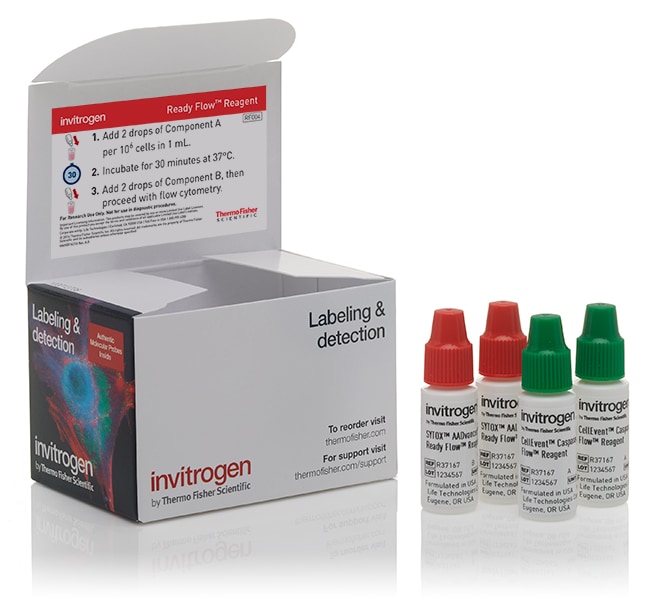
El reactivo de caspasa 3/7 CellEvent™ Green Ready Flow™ permite la detección de citometría de flujo de la caspasa 3 y la caspasa 7 en células apoptóticas. El producto incluye dos reactivos: el nuevo reactivo de detección verde CellEvent™ Caspase-3/7 de sustratos fluorogénicos, además de la tinción de células muertas SYTOX™ AADvanced™.
• Estable a temperatura ambiente.
• Formato cómodo y listo para su uso sin necesidad de diluir, pesar o pipetear.
• Fluorescencia verde excepcionalmente brillante al unirse a ácidos nucleicos.
• Tinción rápida de células apoptóticas sin pasos de lavado.
El reactivo de caspasa 3/7 CellEvent Green Ready Flow es un reactivo que penetra en las células y detecta la actividad de la caspasa 3/7 mediante citometría de flujo. Añada 2 gotas del cuentagotas directamente a 1 x 10⁶ células, incube y analice.
El reactivo de caspasa 3/7 CellEvent Green Ready Flow es en un péptido de cuatro aminoácidos (DEVD) conjugado con un colorante de unión de ácidos nucleicos. Durante la apóptosis, las proteínas caspasa-3 y caspasa-7 están activadas y pueden disociar la secuencia de reconocimiento de caspasa 3/7 codificada en el péptido DEVD. La disociación de la secuencia de reconocimiento y el enlace de ADN por el reactivo marca las células apoptóticas con una señal brillante fluorescente que tiene una absorción/emisión máximas de ∼ 502/530 nm. Cuando se utilizan junto con el colorante de células muertas SYTOX AADvanced, las células apoptóticas pueden diferenciarse fácilmente de las vivas y las necróticas.
Debido a que ningún parámetro define la apoptosis en todos los sistemas, se sugiere el uso de una combinación de mediciones diferentes para la detección fiable de la apoptosis.
• Estable a temperatura ambiente.
• Formato cómodo y listo para su uso sin necesidad de diluir, pesar o pipetear.
• Fluorescencia verde excepcionalmente brillante al unirse a ácidos nucleicos.
• Tinción rápida de células apoptóticas sin pasos de lavado.
El reactivo de caspasa 3/7 CellEvent Green Ready Flow es un reactivo que penetra en las células y detecta la actividad de la caspasa 3/7 mediante citometría de flujo. Añada 2 gotas del cuentagotas directamente a 1 x 10⁶ células, incube y analice.
El reactivo de caspasa 3/7 CellEvent Green Ready Flow es en un péptido de cuatro aminoácidos (DEVD) conjugado con un colorante de unión de ácidos nucleicos. Durante la apóptosis, las proteínas caspasa-3 y caspasa-7 están activadas y pueden disociar la secuencia de reconocimiento de caspasa 3/7 codificada en el péptido DEVD. La disociación de la secuencia de reconocimiento y el enlace de ADN por el reactivo marca las células apoptóticas con una señal brillante fluorescente que tiene una absorción/emisión máximas de ∼ 502/530 nm. Cuando se utilizan junto con el colorante de células muertas SYTOX AADvanced, las células apoptóticas pueden diferenciarse fácilmente de las vivas y las necróticas.
Debido a que ningún parámetro define la apoptosis en todos los sistemas, se sugiere el uso de una combinación de mediciones diferentes para la detección fiable de la apoptosis.
Especificaciones
ColorVerde
Excitación/emisión504/523
Tipo de etiquetaOtras etiquetas o colorantes
Etiqueta o tinteCaspasa 3/7 CellEvent™ de color verde, colorante de células muertas SYTOX AADvanced
Línea de productosCellEvent™ Ready Flow
Tipo de productoReactivo de caspasa 3/7
Cantidad120 ensayos
Condiciones de envíoTemperatura ambiente
Localización subcelularNucleus
FormatoFrasco cuentagotas
Unit SizeEach
Contenido y almacenamiento
4 frascos cuentagotas, almacenar a temperatura ambiente
Preguntas frecuentes
I would like to label only 100 µL of sample of the same cell density using a Ready Flow product. The manual notes 2 drops per 1 mL (1 X 10E6 cells/mL). May I scale down for smaller volumes?
What is the concentration of dye/reagent in the Ready Flow products?
Can I use the ReadyProbes reagents for flow cytometry?
Can I use CellEvent Caspase-3/7 Green Detection Reagent with fixed samples?
With the CellEvent Caspase-3/7 Green Detection Reagent, may I stain cells with nucleic acid stains?
Citations & References (7)
Citations & References
Abstract
Alternatives to current flow cytometry data analysis for clinical and research studies.
Journal:Methods
PubMed ID:29305968
'Flow cytometry has well-established methods for data analysis based on traditional data collection techniques. These techniques typically involved manual insertion of tube samples into an instrument that, historically, could only measure 1-3 colors. The field has since evolved to incorporate new technologies for faster and highly automated sample preparation and
Measurement and Characterization of Apoptosis by Flow Cytometry.
Journal:Curr Protoc Cytom
PubMed ID:27367289
'Apoptosis is an important mechanism in cell biology, playing a critical regulatory role in virtually every organ system. It has been particularly well characterized in the immune system, with roles ranging from immature immune cell development and selection to down-regulation of the mature immune response. Apoptosis is also the primary
Computational flow cytometry reveals that cryopreservation induces spermptosis but subpopulations of spermatozoa may experience capacitation-like changes.
Journal:Reproduction
PubMed ID:27965398
'The reduced lifespan of cryopreserved spermatozoa in the mare reproductive tract has been attributed to both capacitative and apoptotic changes. However, there is a lack of studies investigating both phenomena simultaneously. In order to improve our knowledge in this particular point, we studied in raw and frozen-thawed samples apoptotic and
New flow cytometry approaches in equine andrology.
Journal:Theriogenology
PubMed ID:27160445
Flow cytometry is currently recognized as a robust tool for the evaluation of sperm quality and function. However, within equine reproduction, this technique has not reached the sophistication of other areas of biology and medicine. In recent years, more sophisticated flow cytometers have been introduced in andrology laboratories, and the
Effects of ghrelin on the apoptosis of human neutrophils in vitro.
Journal:Int J Mol Med
PubMed ID:27431014
Acute respiratory distress syndrome (ARDS) is characterized by lung inflammation and the diffuse infiltration of neutrophils into the alveolar space. Neutrophils are abundant, short-lived leukocytes that play a key role in immune defense against microbial infections. These cells die via apoptosis following the activation and uptake of microbes, and will also