Search


Citas y referencias (25)
Invitrogen™
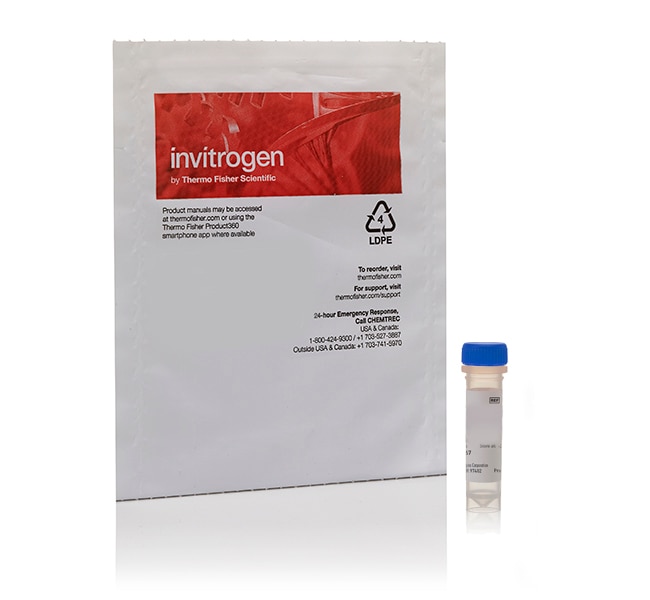
Ovalbumin, Texas Red™ Conjugate
The red fluorescent Texas Red ovalbumin conjugate is a protein with a relatively low molecular weight (∼45,000 daltons) labeled withMás información
| Número de catálogo | Cantidad |
|---|---|
| O23021 | 5 mg |
Número de catálogo O23021
Precio (USD)
-
Cantidad:
5 mg
The red fluorescent Texas Red ovalbumin conjugate is a protein with a relatively low molecular weight (∼45,000 daltons) labeled with the bright, photostable and pH-insensitive Texas Red dye.
For Research Use Only. Not for use in diagnostic procedures.
Especificaciones
Tipo de etiquetaClassic Dyes
Línea de productosTexas Red
Subtipo de proteínaAlbumin Proteins
Cantidad5 mg
Condiciones de envíoRoom Temperature
ConjugadoTexas Red
FormularioLyophilized
Unit SizeEach
Contenido y almacenamiento
Store in freezer (-5 to -30°C) and protect from light.
Citations & References (25)
Citations & References
Abstract
A prelysosomal compartment sequesters membrane-impermeant fluorescent dyes from the cytoplasmic matrix of J774 macrophages.
Journal:J Cell Biol
PubMed ID:3417786
'After the membrane impermeant dye Lucifer Yellow is introduced into the cytoplasmic matrix of J774 cells, the dye is sequestered within cytoplasmic vacuoles and secreted into the extracellular medium. In the present work we studied the intracellular transport of Lucifer Yellow in J774 macrophages and the nature of the cytoplasmic
Identification of Legionella pneumophila mutants that have aberrant intracellular fates.
Journal:Infect Immun
PubMed ID:8698483
'After uptake by macrophages, Legionella pneumiophila evades phagosome-lysosome fusion and replicates in a compartment associated with the endoplasmic reticulum. A collection of bacterial mutants defective for growth in macrophages were isolated, and the intracellular fate of each mutant strain was analyzed by fluorescence microscopy. To measure intracellular replication, bacteria inside
Involvement of early and late lysosomes in the degradation of mannosylated ligands by rat liver endothelial cells.
Journal:Exp Cell Res
PubMed ID:7843273
'The intracellular transport and degradation of endocytosed mannosylated albumin (Man-BSA) was studied in cell cultures of rat liver endothelial cells by subcellular fractionation, fluorescence microscopy, and electron microscopy. The ligand used for subcellular fractionation experiments was labeled with 125I-labeled tyramine cellobiose or 131I-labeled tyramine cellobiose. The labeled degradation products are
Analysis of the intracellular fate of Legionella pneumophila mutants.
Journal:Ann N Y Acad Sci
PubMed ID:8993346
'L. pneumophila is a model organism for investigating the mechanisms by which intracellular pathogens acquire the metabolites needed for replication while evading the microbicidal mechanisms of the macrophage. We determined that intracellular L. pneumophila replicate in close association with the endoplasmic reticulum and suggest that L. pneumophila exploits the macrophage
Fluorescent labeling of endocytic compartments.
Journal:Methods Cell Biol
PubMed ID:2464119