Search

Thermo Scientific™
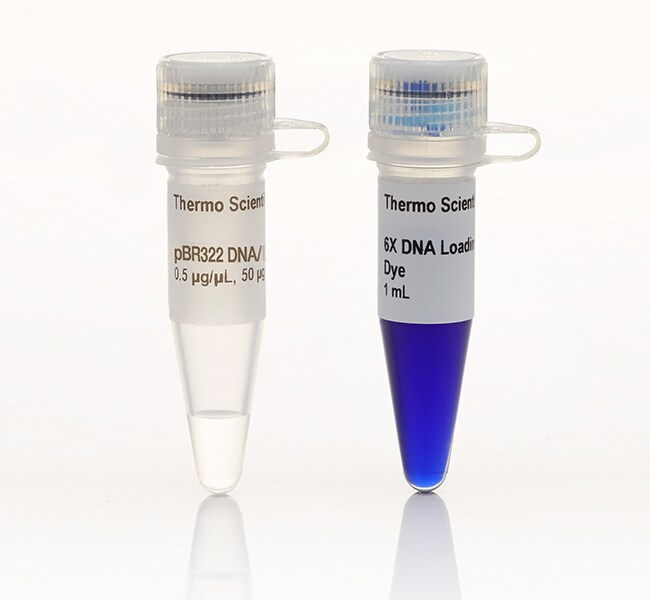
pBR322 DNA/BsuRI (HaeIII) Marker
Thermo Scientific pBR322 DNA/BsuRI (HaeIII) Marker is recommended for sizing and approximate quantification of small linear double-stranded DNA fragments inLeia mais
| Número do catálogo | Quantity |
|---|---|
| SM0271 | 50 μg |
Número do catálogo SM0271
Preço (BRL)
862,49
50 µg
Quantity:
50 μg
Preço (BRL)
862,49
50 µg
Thermo Scientific pBR322 DNA/BsuRI (HaeIII) Marker is recommended for sizing and approximate quantification of small linear double-stranded DNA fragments in agarose and non-denaturing polyacrylamide gels. pBR322 DNA is digested to completion with the appropriate Thermo Scientific restriction enzyme, then purified and dissolved in storage buffer. The DNA fragments contain blunt or sticky ends depending on the restriction enzyme used for the marker's preparation
The marker can be labeled radioactively with T4 Polynucleotide Kinase (see Resources for protocol).
Highlights
• Sizing and approximate quantification of small DNA fragments
• Sharp bands
• Supplied with loading dye for sample DNA
Note
• Bands at 587, 540, and 458 bp form an anomalous pattern on polyacrylamide gels.
• The shortest fragments (oblique) are not visible in standard electrophoresis.
• Fragment lengths are predicted by computer analysis of the respective DNA sequences.
The marker can be labeled radioactively with T4 Polynucleotide Kinase (see Resources for protocol).
Highlights
• Sizing and approximate quantification of small DNA fragments
• Sharp bands
• Supplied with loading dye for sample DNA
Note
• Bands at 587, 540, and 458 bp form an anomalous pattern on polyacrylamide gels.
• The shortest fragments (oblique) are not visible in standard electrophoresis.
• Fragment lengths are predicted by computer analysis of the respective DNA sequences.
For Research Use Only. Not for use in diagnostic procedures.
Especificações
Gel CompatibilityAgarose Gels
Quantity50 μg
Ready to LoadNo
Gel TypeAgarose
Product TypeDNA/BSURI (HAEIII) Marker
Unit Size50 µg