Search


Citations & References (5)
Invitrogen™
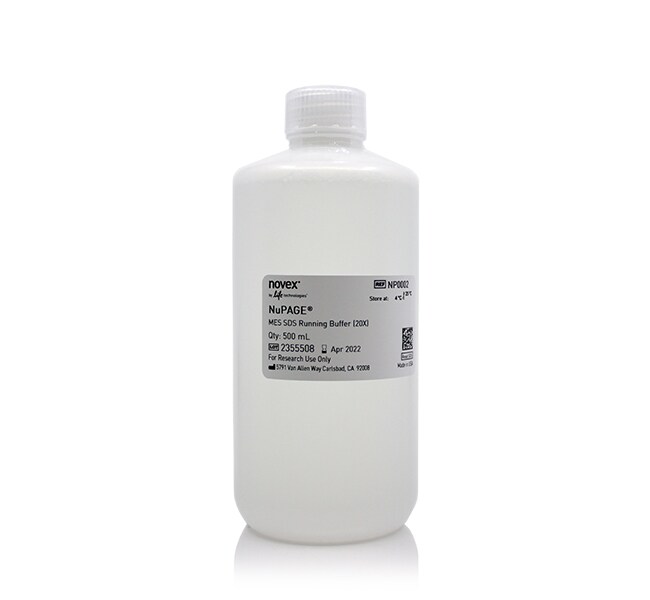
NuPAGE™ MES SDS Running Buffer (20X)
NuPAGE MES SDS Running Buffer (20X) is formulated for running proteins on NuPAGE Bis-Tris gels. It is recommended for separatingRead more
Have Questions?
Change view

| Catalog Number | Quantity |
|---|---|
| NP0002 | 500 mL |
| NP000202 | 5 L |
Catalog number NP0002
Price (EUR)
130,00
Each
Quantity:
500 mL
Price (EUR)
130,00
Each
NuPAGE MES SDS Running Buffer (20X) is formulated for running proteins on NuPAGE Bis-Tris gels. It is recommended for separating small- to medium-sized proteins.
Use the right buffer to optimize protein separations
NuPAGE MES SDS Running Buffer and NuPAGE MOPS SDS Running Buffer can both be used with NuPAGE Bis-Tris gels. MES has a lower pKa than MOPS, making the MES SDS Running Buffer faster than the MOPS SDS running buffers. The difference in ion migration affects stacking and results in a difference in protein separation range between these buffers. Use of MOPS buffer allows proteins to run slower than when using MES buffer.
Compare protein migration patterns using MES and MOPs on NuPAGE Bis-Tris gels
See all available buffers and reagents available for SDS-PAGE
Use the right buffer to optimize protein separations
NuPAGE MES SDS Running Buffer and NuPAGE MOPS SDS Running Buffer can both be used with NuPAGE Bis-Tris gels. MES has a lower pKa than MOPS, making the MES SDS Running Buffer faster than the MOPS SDS running buffers. The difference in ion migration affects stacking and results in a difference in protein separation range between these buffers. Use of MOPS buffer allows proteins to run slower than when using MES buffer.
Compare protein migration patterns using MES and MOPs on NuPAGE Bis-Tris gels
See all available buffers and reagents available for SDS-PAGE
For Research Use Only. Not for use in diagnostic procedures.
Specifications
Chemical Name or MaterialRunning Buffer
Formulation1X: 50 mM MES, 50 mM Tris Base, 0.1% SDS, 1 mM EDTA, pH 7.3
Recommended StorageContents: NuPAGE™ MES SDS Running Buffer (20X)
Storage: +4°C to 25°C
Storage: +4°C to 25°C
Solubility InformationWater
Concentration20X
Physical FormLiquid
Product LineNuPAGE
Quantity500 mL
pH7.3
Unit SizeEach
Frequently asked questions (FAQs)
Can I prepare my protein sample with the reducing agent and store it for future use?
My LDS or SDS sample buffer precipitates when stored at 4 degrees C. Can I warm it up? Can I store it at room temperature?
How are Bolt gels different than NuPAGE gels?
What is the advantage of NuPAGE Gels over regular Tris-Glycine gels?
Are the NuPAGE buffers/components (i.e., sample buffer, running buffer, and antioxidant) compatible with Bolt gels?
Citations & References (5)
Citations & References
Abstract
Matrix GLA protein, a regulatory protein for bone morphogenetic protein-2.
Journal:J Biol Chem
PubMed ID:11741887
'Matrix GLA protein (MGP) has been identified as a calcification inhibitor in cartilage and vasculature. Part of this effect may be attributed to its influence on osteoinductive activity of bone morphogenetic protein-2 (BMP-2). To detect binding between MGP and BMP-2, we performed immunoprecipitation using MGP and BMP-2 tagged with FLAG
Oligomerization of the integrin alphaIIbbeta3: roles of the transmembrane and cytoplasmic domains.
Journal:Proc Natl Acad Sci U S A
PubMed ID:11606749
'Integrins are a family of alpha/beta heterodimeric membrane proteins, which mediate cell-cell and cell-matrix interactions. The molecular mechanisms by which integrins are activated and cluster are currently poorly understood. One hypothesis posits that the cytoplasmic tails of the alpha and beta subunits interact strongly with one another in a 1:1
beta -Glucoside Kinase (BglK) from Klebsiella pneumoniae. PURIFICATION, PROPERTIES, AND PREPARATIVE SYNTHESIS OF 6-PHOSPHO-beta -D-GLUCOSIDES.
Journal:J Biol Chem
PubMed ID:12110692
ATP-dependent beta-glucoside kinase (BglK) has been purified from cellobiose-grown cells of Klebsiella pneumoniae. In solution, the enzyme (EC ) exists as a homotetramer composed of non-covalently linked subunits of M(r) approximately 33,000. Determination of the first 28 residues from the N terminus of the protein allowed the identification and cloning
An engineered Escherichia coli tyrosyl-tRNA synthetase for site-specific incorporation of an unnatural amino acid into proteins in eukaryotic translation and its application in a wheat germ cell-free system.
Journal:Proc Natl Acad Sci U S A
PubMed ID:12097643
Tyrosyl-tRNA synthetase (TyrRS) from Escherichia coli was engineered to preferentially recognize 3-iodo-L-tyrosine rather than L-tyrosine for the site-specific incorporation of 3-iodo-L-tyrosine into proteins in eukaryotic translation systems. The wild-type TyrRS does not recognize 3-iodo-L-tyrosine, because of the bulky iodine substitution. On the basis of the reported crystal structure of Bacillus
Adverse drug reactions.
Journal:Anaesthesia
PubMed ID:29313907