Search


Citations et références (4)
Invitrogen™
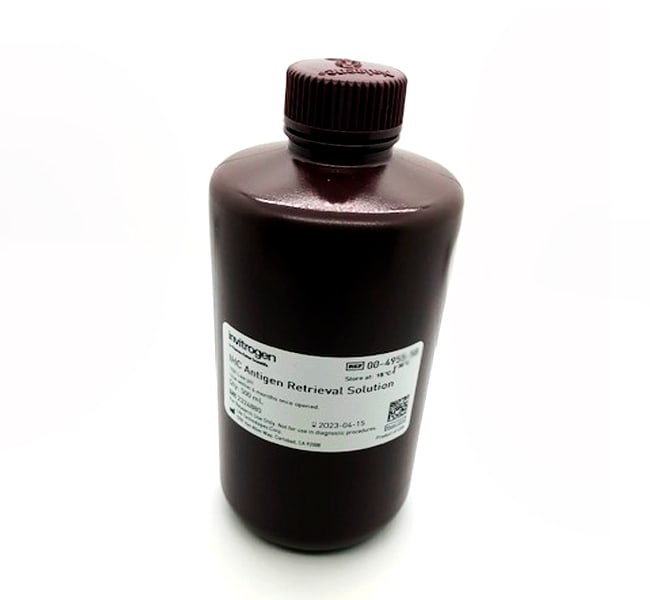
Solution de récupération d’antigène IHC, pH élevé (10X) eBioscience™
La solution de démasquage des antigènes IHC à pH élevé (10X) est conçue pour être utilisée lors de l’étape deAfficher plus
| Référence | Quantité |
|---|---|
| 00-4956-58 | 500 mL |
Référence 00-4956-58
Prix (EUR)
235,65
線上優惠
277,00Économisez 41,35 (15%)
Each
Quantité:
500 mL
Prix (EUR)
235,65
線上優惠
277,00Économisez 41,35 (15%)
Each
La solution de démasquage des antigènes IHC à pH élevé (10X) est conçue pour être utilisée lors de l’étape de démasquage des épitopes induit par la chaleur (HIER) avant l’immunohistochimie sur des coupes de tissus fixés à la formaline et enrobés de paraffine. Il a été démontré que l’utilisation de ce tampon en association avec de la chaleur (souvent par micro-ondes, bain-marie ou autocuiseur) permet de restaurer l’antigénicité des protéines modifiées lors de la fixation à la formaline des tissus. Ce tampon est fourni sous forme de solution mère 10X. La dilution de ce tampon à 1X avec de l’eau de qualité réactif produit une solution contenant 10 mM de Tris et 1 mM d’EDTA, pH 9,0
Application répandue
Coloration immunohistochimique de coupes de tissus fixés à la formaline et enrobés de paraffine
Application répandue
Coloration immunohistochimique de coupes de tissus fixés à la formaline et enrobés de paraffine
Usage exclusivement réservé à la recherche. Ne pas utiliser pour des procédures de diagnostic.
Spécifications
FormeLiquide
Type de produitSolution de récupération d’antigène IHC
À utiliser avec (application)Immunohistochimie (IHC)
Gamme de produitseBioscience
Quantité500 mL
Unit SizeEach
Citations et références (4)
Citations et références
Abstract
ROCK1 inhibitor stabilizes E-cadherin and improves barrier function in experimental necrotizing enterocolitis.
Journal:Am J Physiol Gastrointest Liver Physiol
PubMed ID:32090605
'Necrotizing enterocolitis (NEC) is a devastating gastrointestinal disease of newborns. Although incompletely understood, NEC is associated with intestinal barrier dysfunction. E-cadherin, an adherens junction, is a protein complex integral in maintaining normal barrier homeostasis. Rho-associated protein kinase-1 (ROCK1) is a kinase that regulates the E-cadherin complex, and p120-catenin is a
Targeting glioma-initiating cells via the tyrosine metabolic pathway.
Journal:J Neurosurg
PubMed ID:32059178
'Despite an aggressive multimodal therapeutic regimen, glioblastoma (GBM) continues to portend a grave prognosis, which is driven in part by tumor heterogeneity at both the molecular and cellular levels. Accordingly, herein the authors sought to identify metabolic differences between GBM tumor core cells and edge cells and, in so doing,
Grim-19 expressed by recombinant adenovirus for esophageal neoplasm target therapy.
Journal:Mol Med Rep
PubMed ID:29488605
Esophageal squamous cell carcinoma (ESCC) and esophageal adenocarcinoma (EA) are the two most common types of esophageal cancer, which is the sixth highest cause of cancer-associated mortality and the eighth most common cancer worldwide. Gene associated with retinoid-interferon (IFN)-induced mortality-19 (Grim-19) is reported to be a cell death activator that
Environmentally relevant exposure to dibutyl phthalate disrupts DNA damage repair gene expression in the mouse ovary†.
Journal:Biol Reprod
PubMed ID:31318015
Phthalates have a history of reproductive toxicity in animal models and associations with adverse reproductive outcomes in women. Human exposure to dibutyl phthalate (DBP) occurs via consumer products (7-10 µg/kg/day) and medications (1-233 µg/kg/day). Most DBP toxicity studies have focused on high supraphysiological exposure levels; thus, very little is known about exposures