Search


Citations et références (31)
Gibco™
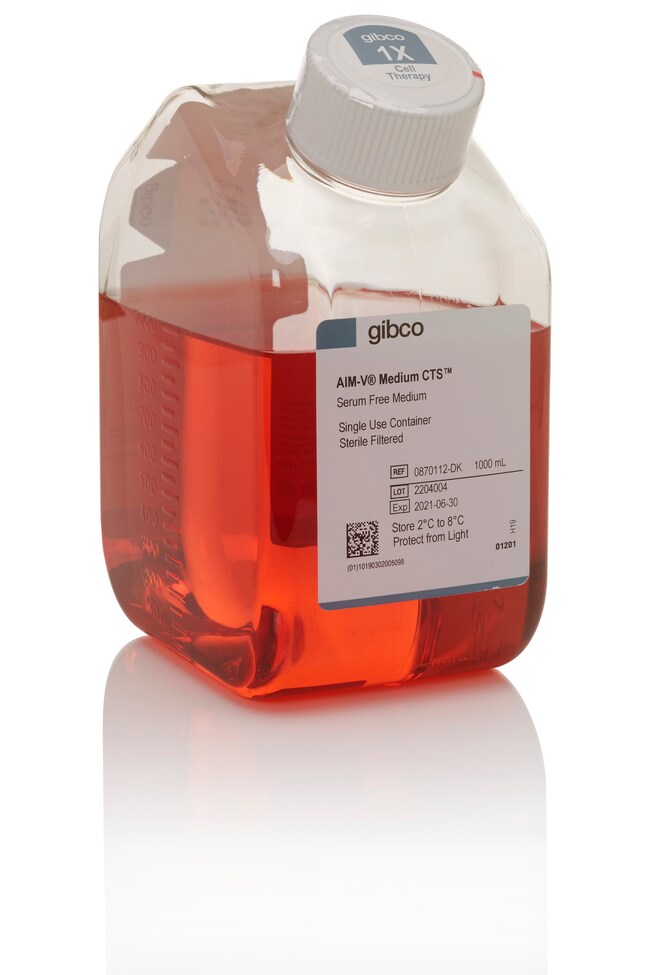
CTS™ AIM V™ SFM
Le milieu GIBCO CTS AIM V SFM (qualité thérapeutique) est le premier milieu disponible sur le marché sans sérum, définiAfficher plus
Have Questions?
Modifier l'affichage

| Référence | Quantité |
|---|---|
| 0870112DK | 1 000 mL |
| 0870112BK | 10 L |
Référence 0870112DK
Prix (EUR)
320,00
Each
Quantité:
1 000 mL
Prix (EUR)
320,00
Each
Le milieu GIBCO CTS AIM V SFM (qualité thérapeutique) est le premier milieu disponible sur le marché sans sérum, défini pour la prolifération et / ou la manipulation des cellules T et des cellules dendritiques et fabriqué conformément aux BPFa. Il contient de la L-glutamine, 50 µg / ml de sulfate de streptomycine et 10 µg / ml de sulfate de gentamicine.
À des fins de recherche ou de fabrication de produits à base de cellules, de gènes ou de tissus. MISE EN GARDE : Non destiné à être directement administré à des humains ou des animaux.
Spécifications
Type de celluleMonocytes, cellules dendritiques, cellules T, hybridomes, PBMC, fibroblastes, macrophages, cellules de myélome, lymphocytes
À utiliser avec (application)Recherche, développement et fabrication de thérapies cellulaires et géniques
FormatFlacon
Qualité de fabricationISO 13485, MDSAP, enregistré auprès de la FDA, 21 CFR 820
Type de produitMilieu pour culture cellulaire
Quantité1 000 mL
Durée de conservation14 mois à compter de la date de fabrication
Conditions d’expéditionTempérature ambiante
ClassificationOrigine animale
FormeLiquide
Serum LevelSans sérum
StérilitéStérilisation par filtration
Unit SizeEach
Contenu et stockage
Stocker le milieu entre 2 et 8°C. Conserver à l’abri de la lumière. AIM V™ a une durée de conservation de 14 mois.
Foire aux questions (FAQ)
What is CTS?
What is the difference between AIM V Medium (Cat. Nos. 12055083, 12055091) and CTS AIM V SFM (Cat. Nos. 0870112DK, 0870112BK)?
What is the difference between CTS AIM-V Medium and CTS AIM V SFM?
Citations et références (31)
Citations et références
Abstract
Live attenuated lentivirus infection elicits polyfunctional simian immunodeficiency virus Gag-specific CD8+ T cells with reduced apoptotic susceptibility in rhesus macaques that control virus replication after challenge with pathogenic SIVmac239.
Journal:J Immunol
PubMed ID:17878372
'HIV-specific CD8+ T cells that secrete multiple cytokines in response to Ag stimulation are associated with the control of virus replication during chronic HIV infection. To determine whether the presence of polyfunctional CD8+ T cell responses distinguishes protected and unprotected monkeys in a live attenuated lentivirus model, SIV Gag peptide-specific
Performance of serum-supplemented and serum-free media in IFNgamma Elispot Assays for human T cells.
Journal:Cancer Immunol Immunother
PubMed ID:19894047
'The choice of serum for supplementation of media for T cell assays and in particular, Elispot has been a major challenge for assay performance, standardization, optimization, and reproducibility. The Assay Working Group of the Cancer Vaccine Consortium (CVC-CRI) has recently identified the choice of serum to be the leading cause
[Study of adoptive immunotherapy for metastatic renal cell carcinoma with lymphokine-activated killer (LAK) cells and interleukin-2. II. Clinical evaluation]
Journal:Nippon Hinyokika Gakkai Zasshi
PubMed ID:8320888
'We evaluated adoptive immunotherapy using LAK cells combined with systemic administration of interleukin-2 (IL-2) in 11 patients with metastatic renal cell carcinoma. The LAK cells were generated by incubation in serum-free medium (AIM-V) supplemented with IL-2 (1,000 U/ml) for 4 days and were generally administered twice weekly (4 times/cycle). Daily
Serum-free culture medium and IL-7 costimulation increase the sensitivity of ELISpot detection.
Journal:J Immunol Methods
PubMed ID:18242633
'The identification of parameters maximizing detection sensitivity in ELISpot assays is important to transfer this technology into the clinical setting for identifying rare Ag-specific CD8(+) T cells. We have therefore considered human IFN-gamma CD8(+) T cell responses against viral epitopes to analyze different variables which could be critical during the
CD4 T cells guarantee optimal competitive fitness of CD8 memory T cells.
Journal:Eur J Immunol
PubMed ID:14971034
We studied the contribution of CD4 T cell help to survival and competitive fitness of CD8 memory T cells specific for influenza virus nucleoprotein. In agreement with recent studies, the optimal generation of functional memory CD8 T cells required CD4 help, although long-term maintenance of resting CD8 memory T cells