Search


Citations et références (66)
Gibco™
Bac-to-Bac™ Baculovirus Expression System
Le système d’expression baculovirus Bac-to-Bac permet la production efficace de baculovirus recombinant pour les tests d’expression dans les cellules d’insectes.Afficher plus
| Référence | Quantité |
|---|---|
| 10359016 | 1 kit |
Référence 10359016
Prix (EUR)
1 792,00
Each
Quantité:
1 kit
Prix (EUR)
1 792,00
Each
Le système d’expression baculovirus Bac-to-Bac permet la production efficace de baculovirus recombinant pour les tests d’expression dans les cellules d’insectes. Le système repose sur la génération de baculovirus recombinant par transposition spécifique au site dans E. coli plutôt que sur la recombinaison homologue dans les cellules d’insectes. Ce système comprend :
• Bacmide d’expression à gain de temps—Avec le système Bac-to-Bac, la cassette d’expression du vecteur pFastBac se recombine avec le bacmide parent dans les cellules compétentes E. coli DH10Bac pour former un bacmide d’expression. Le bacmide est ensuite transfecté dans des cellules d’insectes pour la production de particules de baculovirus recombinantes.
• Sélection facile des colonies—Le bacmide parent dans l’E. coli DH10Bac contient un segment du gène lacZa. Le gène lacZa est perturbé lors de la transposition de la cassette d’expression dans le bacmide, ce qui permet une sélection bleue / blanche de recombinants pour faciliter l’identification des colonies recombinantes.
• Efficacité de transfection élevée avec le réactif de transfection ExpiFectamine Sf—Les kits d’expression Bac-to-Bac TOPO sont désormais livrés avec le réactif de transfection ExpiFectamine Sf de nouvelle génération pour une transfection efficace de l’ADN dans les cellules d’insectes à l’aide de protocoles rapides et flexibles. En savoir plus sur ce réactif ›
• Flexibilité—Le système Bac-to-Bac est livré avec un vecteur pFastBac qui contient un grand site de clonage multiple (MCS) pour un clonage simplifié. Deux autres formats de vecteur sont proposés séparément : Vecteur HT pFastBac pour la production de protéines recombinantes marquées à l’histidine et vecteur double pFastBac pour l’expression simultanée de deux protéines à l’aide des promoteurs de p10 et de polyédrine.
• Expression protéique élevée—Le vecteur pFastBac utilise le promoteur de polyédrine puissant pour générer des niveaux d’expression élevés dans une variété de lignées cellulaires d’insectes, telles que les cellules Sf9, Sf21 et High Five.
• Bacmide d’expression à gain de temps—Avec le système Bac-to-Bac, la cassette d’expression du vecteur pFastBac se recombine avec le bacmide parent dans les cellules compétentes E. coli DH10Bac pour former un bacmide d’expression. Le bacmide est ensuite transfecté dans des cellules d’insectes pour la production de particules de baculovirus recombinantes.
• Sélection facile des colonies—Le bacmide parent dans l’E. coli DH10Bac contient un segment du gène lacZa. Le gène lacZa est perturbé lors de la transposition de la cassette d’expression dans le bacmide, ce qui permet une sélection bleue / blanche de recombinants pour faciliter l’identification des colonies recombinantes.
• Efficacité de transfection élevée avec le réactif de transfection ExpiFectamine Sf—Les kits d’expression Bac-to-Bac TOPO sont désormais livrés avec le réactif de transfection ExpiFectamine Sf de nouvelle génération pour une transfection efficace de l’ADN dans les cellules d’insectes à l’aide de protocoles rapides et flexibles. En savoir plus sur ce réactif ›
• Flexibilité—Le système Bac-to-Bac est livré avec un vecteur pFastBac qui contient un grand site de clonage multiple (MCS) pour un clonage simplifié. Deux autres formats de vecteur sont proposés séparément : Vecteur HT pFastBac pour la production de protéines recombinantes marquées à l’histidine et vecteur double pFastBac pour l’expression simultanée de deux protéines à l’aide des promoteurs de p10 et de polyédrine.
• Expression protéique élevée—Le vecteur pFastBac utilise le promoteur de polyédrine puissant pour générer des niveaux d’expression élevés dans une variété de lignées cellulaires d’insectes, telles que les cellules Sf9, Sf21 et High Five.
Usage exclusivement réservé à la recherche. Ne pas utiliser pour des procédures de diagnostic.
Spécifications
Type de produitSystème d’expression du baculovirus
Quantité1 kit
VecteurpFastBac
Méthode de clonageEnzyme de restriction / MCS
Gamme de produitsBac à Bac
AccélérateurPolyédrine
Marqueur de protéineNon étiqueté
Unit SizeEach
Contenu et stockage
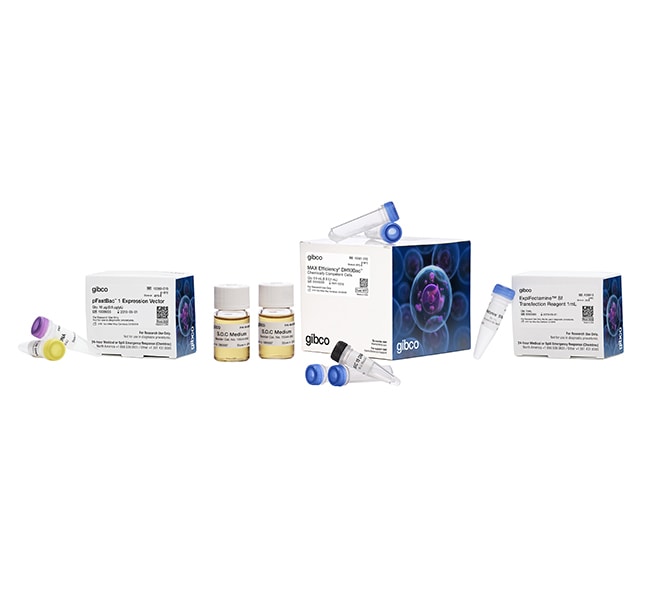
Chaque système d’expression baculovirus Bac-to-Bac comprend :
• Vecteur pFastBac1 (10 µg), stocker à -20°C
• Vecteur de contrôle pFastBac 1-GUS (4 ng), stocker à -20°C
• Efficacité MAX de DH10Bac chimiquement compétent E. coli (1 kit avec 5 x 0,1 ml), stocker à -80°C
• Réactif de transfection Expifectamine Sf (1 ml), stocker à 4°C, ne pas congeler
• Vecteur pFastBac1 (10 µg), stocker à -20°C
• Vecteur de contrôle pFastBac 1-GUS (4 ng), stocker à -20°C
• Efficacité MAX de DH10Bac chimiquement compétent E. coli (1 kit avec 5 x 0,1 ml), stocker à -80°C
• Réactif de transfection Expifectamine Sf (1 ml), stocker à 4°C, ne pas congeler
Foire aux questions (FAQ)
I cannot grow this white colony in liquid culture. What should I do?
What has happened when I see blue colonies? How about colonies which are blue in the center and white on the edges?
I'm getting mostly white/wild-type plaques instead of blue/recombinant plaques. What am I doing wrong?
I've infected my cells and see large polyhedra in one cell and smaller polyhedra (more numerous) in a neighboring cell. Is this normal?
I'm worried that I am not getting plaques. How many days does it take to see plaques and what size are they typically?
Citations et références (66)
Citations et références
Abstract
The vomeronasal receptor V2R2 does not require escort molecules for expression in heterologous systems.
Journal:Chem Senses
PubMed ID:15647459
'In rodents, many behavioural responses are triggered by pheromones. These molecules are believed to bind and activate two families of G-protein coupled receptors, namely V1Rs and V2Rs, which are specifically expressed in the chemosensory neurons of the vomeronasal organ. V2Rs are homologous with Group 3 of G-protein-coupled receptors, which includes
Identification of Novel SH3 Domain Ligands for the Src Family Kinase Hck. WISKOTT-ALDRICH SYNDROME PROTEIN (WASP), WASP-INTERACTING PROTEIN (WIP), AND ELMO1.
Journal:J Biol Chem
PubMed ID:12029088
'The importance of the SH3 domain of Hck in kinase regulation, substrate phosphorylation, and ligand binding has been established. However, few in vivo ligands are known for the SH3 domain of Hck. In this study, we used mass spectrometry to identify approximately 25 potential binding partners for the SH3 domain
Allocation of helper T-cell epitope immunodominance according to three-dimensional structure in the human immunodeficiency virus type I envelope glycoprotein gp120.
Journal:J Biol Chem
PubMed ID:11551929
'The specificity and intensity of CD4(+) helper T-cell responses determine the effectiveness of immune effector functions. Promiscuously immunodominant helper T-cell epitopes in the human immunodeficiency virus (HIV) envelope glycoprotein gp120 could be important in the development of broadly protective immunity, but the underlying mechanisms of immunodominance and promiscuity remain poorly
Expression, purification, and characterization of an activated cytokine-suppressive anti-inflammatory drug-binding protein 2 (CSBP2) kinase from baculovirus-infected insect cells.
Journal:Protein Expr Purif
PubMed ID:9226723
'An activated form of the human cytokine-suppressive anti-inflammatory drug-binding protein 2 (CSBP2) kinase was expressed in Spodoptera frugiperda (SF9) cells from a baculovirus vector. To maximize expression and to facilitate purification of the recombinant protein, CSBP2 kinase was expressed as a carboxy-terminal fusion protein to glutathione S-transferase (GST). Under optimal
Kinesin Superfamily Motor Protein KIF17 and mLin-10 in NMDA Receptor-Containing Vesicle Transport
Journal:Science
PubMed ID:10846156
'Experiments with vesicles containing N-methyl-D-aspartate (NMDA)receptor 2B (NR2B subunit) show that they are transported alongmicrotubules by KIF17, a neuron-specific molecular motor in neuronaldendrites. Selective transport is accomplished by direct interaction of theKIF17 tail with a PDZ domain of mLin-10 (Mint1/X11), which is aconstituent of a large protein complex including mLin-2