Search


Citations et références (10)
Gibco™
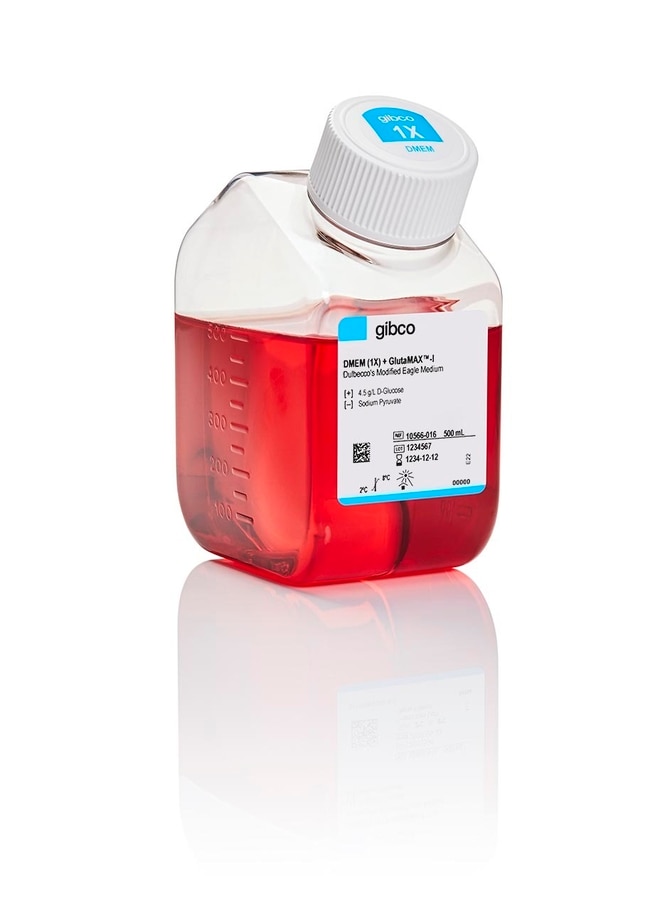
DMEM, haute teneur en glucose, supplément de GlutaMAX™
Le DMEM (Dulbecco’s Modified Eagle Medium) est un milieu de culture basal largement utilisé pour prendre en charge la croissanceAfficher plus
Have Questions?
Modifier l'affichage

| Référence | Quantité |
|---|---|
| 10566016 | 500 mL |
| 61965059 également connu sous le numéro 61965-059 | 10 x 500 ml |
| 61965240 également connu sous le numéro 61965-240 | 5 l |
| 61965026 également connu sous le numéro 61965-026 | 500 ml |
| 10566032 | 5 L |
Référence 10566016
Prix (EUR)
41,16
Each
Quantité:
500 mL
Prix (EUR)
41,16
Each
Le DMEM (Dulbecco’s Modified Eagle Medium) est un milieu de culture basal largement utilisé pour prendre en charge la croissance de nombreuses cellules de mammifères différentes. Les cellules cultivées avec succès dans du milieu DMEM comprennent les fibroblastes primaires, les neurones, les cellules gliales, les HUVEC et les cellules musculaires lisses, ainsi que les lignées cellulaires telles que HeLa, 293, Cos-7, et PC-12. Nous proposons une variété de modifications de DMEM pour une gamme d’applications de culture cellulaire. Trouvez la formulation la mieux adaptée à l’aide de l’outil de sélection de milieux de culture.
Ce milieu DMEM est modifié comme suit :
La formulation complète est disponible.
Utilisation du DMEM
Le DMEM est unique par rapport aux autres milieux de culture, car il contient une concentration d’acides aminés et de vitamines 4 fois supérieure à celle trouvée dans le milieu minimum essentiel de Eagle original À l’origine, le DMEM était formulé avec peu de glucose (1 g / l) et de pyruvate de sodium, mais il est souvent utilisé avec des niveaux supérieurs de glucose, avec ou sans pyruvate de sodium. Associé à un supplément GlutaMAX™, le milieu DMEM limite l’accumulation d’ammoniac toxique et améliore la croissance et la viabilité cellulaires dans un format facile à utiliser. Le DMEM ne contient ni protéines, ni lipides, ni facteurs de croissance. C’est pourquoi le milieu DMEM nécessite une supplémentation, en général avec 10 % de sérum de veau fœtal (SVF). Le milieu DMEM utilise un système de tampon au bicarbonate de sodium (3,7 g / l) et, par conséquent, nécessite un environnement contenant 5 à 10 % de CO2 pour préserver le pH physiologique.
Système de qualité et fabrication conforme aux BPFa
Le milieu DMEM est fabriqué sur un site conforme aux BPFa situé à Grand Island, dans l’État de New York. Ce site est homologué par la FDA comme fabricant de dispositifs médicaux et il est certifié ISO 13485. Pour assurer la continuité de la chaîne d’approvisionnement, nous proposons un produit identique au DMEM fabriqué sur notre site situé en Écosse (61965-059). Cette installation est également homologuée par la FDA comme fabricant de dispositifs médicaux et elle est certifiée ISO 13485.
Ce milieu DMEM est modifié comme suit :
| Avec | Sans |
| • Haute teneur en glucose | • Pyruvate de sodium |
| • GlutaMAX™ | |
| • Rouge de phénol |
La formulation complète est disponible.
Utilisation du DMEM
Le DMEM est unique par rapport aux autres milieux de culture, car il contient une concentration d’acides aminés et de vitamines 4 fois supérieure à celle trouvée dans le milieu minimum essentiel de Eagle original À l’origine, le DMEM était formulé avec peu de glucose (1 g / l) et de pyruvate de sodium, mais il est souvent utilisé avec des niveaux supérieurs de glucose, avec ou sans pyruvate de sodium. Associé à un supplément GlutaMAX™, le milieu DMEM limite l’accumulation d’ammoniac toxique et améliore la croissance et la viabilité cellulaires dans un format facile à utiliser. Le DMEM ne contient ni protéines, ni lipides, ni facteurs de croissance. C’est pourquoi le milieu DMEM nécessite une supplémentation, en général avec 10 % de sérum de veau fœtal (SVF). Le milieu DMEM utilise un système de tampon au bicarbonate de sodium (3,7 g / l) et, par conséquent, nécessite un environnement contenant 5 à 10 % de CO2 pour préserver le pH physiologique.
Système de qualité et fabrication conforme aux BPFa
Le milieu DMEM est fabriqué sur un site conforme aux BPFa situé à Grand Island, dans l’État de New York. Ce site est homologué par la FDA comme fabricant de dispositifs médicaux et il est certifié ISO 13485. Pour assurer la continuité de la chaîne d’approvisionnement, nous proposons un produit identique au DMEM fabriqué sur notre site situé en Écosse (61965-059). Cette installation est également homologuée par la FDA comme fabricant de dispositifs médicaux et elle est certifiée ISO 13485.
À des fins de recherche ou de commercialisation avancée Non destiné aux diagnostics ou à l’administration directe à des humains ou des animaux.
Spécifications
Lignée cellulaireHeLa, 293, Cos-7 et PC-12
Type de celluleFibroblastes primaires, neurones, cellules gliales, HUVEC et cellules musculaires lisses
Concentration1 X
Qualité de fabricationConforme aux BPFa en vertu de la norme ISO 13485
Gamme de produitsGibco, GlutaMAX
Type de produitDMEM (milieu Eagle modifié de Dulbecco)
Quantité500 mL
Durée de conservation12 mois à compter de la date de fabrication
Conditions d’expéditionTempérature ambiante
ClassificationAucun composant d’origine animale
FormeLiquide
Serum LevelSupplémentation en sérum standard
StérilitéStérilisation par filtration
Sterilization MethodSterile-filtered
Avec additifsHaute teneur en glucose, GlutaMAX, Rouge de phénol
Sans additifSans HEPES, Sans pyruvate de sodium
Unit SizeEach
Contenu et stockage
Conditions de stockage : 2 à 8°C. Conserver à l’abri de la lumière
Conditions d’expédition : température ambiante
Durée de conservation : 12 mois à compter de la date de fabrication
Conditions d’expédition : température ambiante
Durée de conservation : 12 mois à compter de la date de fabrication
Foire aux questions (FAQ)
Do both the DMEM, high glucose, GlutaMAX Supplements, Cat. No. 61965026 and 10566016, have the same formulation?
What is the manganese concentration in DMEM? Do you offer manganese-free DMEM?
What is the shelf life of the DMEM, high glucose, pyruvate medium once the bottle is opened and the medium is supplemented?
Is it necessary to store DMEM, high glucose, pyruvate medium in the dark?
How long can I keep my media after supplementing with serum?
Citations et références (10)
Citations et références
Abstract
Ectodysplasin is released by proteolytic shedding and binds to the EDAR protein.
Journal:Hum Mol Genet
PubMed ID:11309369
'Anhidrotic ectodermal dysplasia (EDA) is an X-linked disorder characterized by abnormal development of ectoderm and its appendices. The EDA gene encodes different isoforms of ectodysplasin, a transmembrane protein. The two longest isoforms, ectodysplasin-A1 and -A2, which differ by an insertion of two amino acids, are trimeric type II membrane proteins
A novel site on the Galpha -protein that recognizes heptahelical receptors.
Journal:J Biol Chem
PubMed ID:11027680
'Specific domains of the G-protein alpha subunit have been shown to control coupling to heptahelical receptors. The extreme N and C termini and a region between alpha4 and alpha5 helices of the G-protein alpha subunit are known to determine selective interaction with the receptors. The metabotropic glutamate receptor 2 activated
Cell adhesion and migration properties of beta 2-integrin negative polymorphonuclear granulocytes on defined extracellular matrix molecules. Relevance for leukocyte extravasation.
Journal:J Biol Chem
PubMed ID:11278780
'Regulated adhesion of leukocytes to the extracellular matrix is essential for transmigration of blood vessels and subsequent migration into the stroma of inflamed tissues. Although beta(2)-integrins play an indisputable role in adhesion of polymorphonuclear granulocytes (PMN) to endothelium, we show here that beta(1)- and beta(3)-integrins but not beta(2)-integrin are essential
Delivery of proteins into living cells by reversible membrane permeabilization with streptolysin-O.
Journal:Proc Natl Acad Sci U S A
PubMed ID:11248053
'The pore-forming toxin streptolysin O (SLO) can be used to reversibly permeabilize adherent and nonadherent cells, allowing delivery of molecules with up to 100 kDa mass to the cytosol. Using FITC-labeled albumin, 10(5)-10(6) molecules were estimated to be entrapped per cell. Repair of toxin lesions depended on Ca(2+)-calmodulin and on
Phosphorylation regulates intracellular trafficking of beta-secretase.
Journal:J Biol Chem
PubMed ID:11278841
beta-Secretase (BACE) is a transmembrane aspartyl protease, which generates the N terminus of Alzheimer's disease amyloid beta-peptide. Here, we report that BACE can be phosphorylated within its cytoplasmic domain at serine residue 498 by casein kinase 1. Phosphorylation exclusively occurs after full maturation of BACE by propeptide cleavage and complex