Search

Invitrogen™
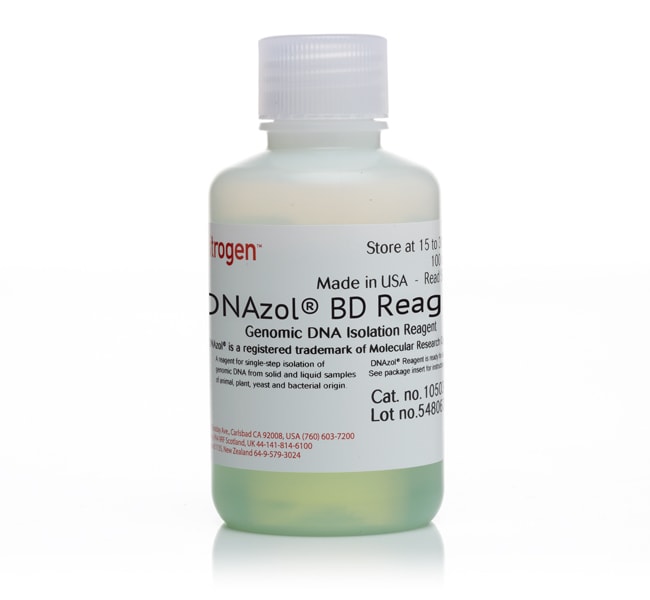
DNAzol™ BD Reagent, for isolation of genomic DNA from whole blood
Le réactif DNAzol™ BD est un réactif organique prêt à l’emploi spécifiquement formulé pour l’isolement de l’ADN génomique à partirAfficher plus
| Référence | Quantité |
|---|---|
| 10974020 | 100 mL |
Référence 10974020
Prix (EUR)
448,00
Each
Quantité:
100 mL
Prix (EUR)
448,00
Each
Le réactif DNAzol™ BD est un réactif organique prêt à l’emploi spécifiquement formulé pour l’isolement de l’ADN génomique à partir de sang total en 30 minutes environ.
• Formulé spécifiquement pour l’extraction de l’ADN génomique à partir de sang total
• Optimisé pour l’isolement rapide de l’ADN génomique
Isolement efficace de l’ADN génomique à partir de sang total
Le réactif DNAzol™ BD est spécifiquement formulé pour l’isolement de l’ADN génomique à partir de sang total. La procédure de réactif DNAzol™ BD est basée sur l’utilisation d’une nouvelle solution de lyse à base de détergent à la guanidine capable d’hydrolyser l’ARN et permettant la précipitation sélective de l’ADN à partir du lysat. 1 ml de réactif DNAzol™ peut être utilisé pour isoler l’ADN génomique de 0,5 ml de sang total afin de produire 10 à 20 µg d’ADN. Outre l’isolement de l’ADN génomique, le réactif DNAzol™ BD peut également être utilisé pour l’isolement de fragments apoptotiques extraits du sang total et d’ADN viral extrait du sérum.
Isolement rapide de l’ADN génomique
Le réactif DNAzol™ associe fiabilité, efficacité et simplicité dans son protocole d’isolement. Lors de la procédure, les échantillons sanguins sont mélangés au réactif DNAzol™ tandis que l’ADN est précipité à partir du lysat résultant avec de l’isopropanol. Le culot d’ADN est ensuite lavé successivement avec du réactif DNAzol™, puis de l’éthanol pour être ensuite solubilisé. L’ensemble de la procédure peut être réalisé en 30 minutes environ.
L’ADN isolé peut être utilisé pour un certain nombre d’applications en aval :
L’ADN génomique extrait à l’aide de la procédure DNAzol™ convient à d’innombrables applications, notamment le transfert Southern, le clonage, la PCR, la digestion par des enzymes de restriction et l’hybridation sur transfert en point.
Usage exclusivement réservé à la recherche. Non destiné à une utilisation thérapeutique ou diagnostique sur l’homme ou l’animal
• Formulé spécifiquement pour l’extraction de l’ADN génomique à partir de sang total
• Optimisé pour l’isolement rapide de l’ADN génomique
Isolement efficace de l’ADN génomique à partir de sang total
Le réactif DNAzol™ BD est spécifiquement formulé pour l’isolement de l’ADN génomique à partir de sang total. La procédure de réactif DNAzol™ BD est basée sur l’utilisation d’une nouvelle solution de lyse à base de détergent à la guanidine capable d’hydrolyser l’ARN et permettant la précipitation sélective de l’ADN à partir du lysat. 1 ml de réactif DNAzol™ peut être utilisé pour isoler l’ADN génomique de 0,5 ml de sang total afin de produire 10 à 20 µg d’ADN. Outre l’isolement de l’ADN génomique, le réactif DNAzol™ BD peut également être utilisé pour l’isolement de fragments apoptotiques extraits du sang total et d’ADN viral extrait du sérum.
Isolement rapide de l’ADN génomique
Le réactif DNAzol™ associe fiabilité, efficacité et simplicité dans son protocole d’isolement. Lors de la procédure, les échantillons sanguins sont mélangés au réactif DNAzol™ tandis que l’ADN est précipité à partir du lysat résultant avec de l’isopropanol. Le culot d’ADN est ensuite lavé successivement avec du réactif DNAzol™, puis de l’éthanol pour être ensuite solubilisé. L’ensemble de la procédure peut être réalisé en 30 minutes environ.
L’ADN isolé peut être utilisé pour un certain nombre d’applications en aval :
L’ADN génomique extrait à l’aide de la procédure DNAzol™ convient à d’innombrables applications, notamment le transfert Southern, le clonage, la PCR, la digestion par des enzymes de restriction et l’hybridation sur transfert en point.
Usage exclusivement réservé à la recherche. Non destiné à une utilisation thérapeutique ou diagnostique sur l’homme ou l’animal
Usage exclusivement réservé à la recherche. Ne pas utiliser pour des procédures de diagnostic.
Spécifications
Type de produit finalADN génomique
À utiliser avec (application)PCR, transfert Southern, séquençage, clonage
Compatibilité à haut débitNon compatible avec des cadences élevées (manuel)
Gamme de produitsDNAzol
Type de produitRéactif BD
Quantité100 mL
Type d’échantillonSang
Conditions d’expéditionTempérature ambiante
CibleADN génomique
Heure du test30 min
Isolation TechnologyExtraction organique
Unit SizeEach
Contenu et stockage
Conserver à température ambiante.