Search


Citations et références (9)
Gibco™
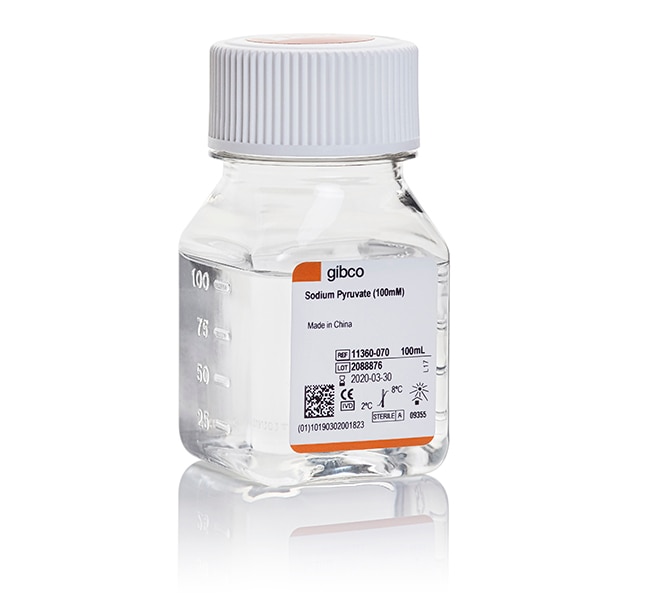
Pyruvate de sodium (100 mM)
Le pyruvate de sodium est couramment ajouté aux milieux de culture cellulaire comme source de carbone en plus du glucose.Afficher plus
| Référence | Quantité |
|---|---|
| 11360070 | 100 ml |
Référence 11360070
Prix (EUR)
18,72
Each
Quantité:
100 ml
Prix (EUR)
18,72
Each
Le pyruvate de sodium est couramment ajouté aux milieux de culture cellulaire comme source de carbone en plus du glucose. Puisque les cellules font du pyruvate de sodium un métabolite intermédiaire dans la voie de la glycolyse, ce n’est pas un supplément nécessaire pour toutes les cultures cellulaires. Toutefois, si les cellules se sont développées dans un milieu de culture supplémenté de pyruvate de sodium, nous vous recommandons de continuer à utiliser le supplément car il se peut que sans lui, la croissance des cellules soit ralentie. Le pyruvate de sodium Gibco™ (100 mM) est formulé à l’aide de 11 g par litre d’eau. La concentration finale de pyruvate de sodium utilisée dans la plupart des milieux de culture cellulaire est 1 mM.
Fabrication et système de qualité conformes aux BPFa sur deux sites
La solution de pyruvate de sodium Gibco™ est fabriquée sur un site conforme aux BPFa situé à Grand Island, New York, États-Unis. Ce site est homologué par la FDA comme fabricant de dispositifs médicaux et il est certifié ISO 13485. Pour assurer la continuité de la chaîne d’approvisionnement, nous proposons une solution de pyruvate de sodium Gibco™ identique fabriquée sur notre site situé en Écosse (11360-039). Ce site est homologué par la FDA comme fabricant de dispositifs médicaux et il est certifié ISO 13485.
Fabrication et système de qualité conformes aux BPFa sur deux sites
La solution de pyruvate de sodium Gibco™ est fabriquée sur un site conforme aux BPFa situé à Grand Island, New York, États-Unis. Ce site est homologué par la FDA comme fabricant de dispositifs médicaux et il est certifié ISO 13485. Pour assurer la continuité de la chaîne d’approvisionnement, nous proposons une solution de pyruvate de sodium Gibco™ identique fabriquée sur notre site situé en Écosse (11360-039). Ce site est homologué par la FDA comme fabricant de dispositifs médicaux et il est certifié ISO 13485.
Réservé à un usage diagnostique in vitro.
Spécifications
Type de celluleCellules de mammifères
Concentration100 mM
Quantité100 ml
Durée de conservation12 mois
Conditions d’expéditionTempérature ambiante
FormeLiquide
Type de produitPyruvate de sodium
StérilitéStérilisation par filtration
Unit SizeEach
Contenu et stockage
Conditions de stockage : 2°C à 8°C À l’abri de la lumière
Conditions d’expédition : température ambiante
Durée de conservation : 12 mois à compter de la date de fabrication
Conditions d’expédition : température ambiante
Durée de conservation : 12 mois à compter de la date de fabrication
Foire aux questions (FAQ)
For how long is Sodium Pyruvate (100 mM) stable at 2-8 degrees C after opening the bottle?
How is your sodium pyruvate supplied?
What is the purpose of sodium pyruvate in media?
Citations et références (9)
Citations et références
Abstract
A comparison between different human hepatocyte models reveals profound differences in net glucose production, lipid composition and metabolism in vitro.
Journal:Experimental cell research
PubMed ID:38499143
Effects of an indole derivative on cell proliferation, transfection, and alternative splicing in production of lentiviral vectors by transient co-transfection.
Journal:PloS one
PubMed ID:38833479
Lentiviral vectors derived from human immunodeficiency virus type I are widely used to deliver functional gene copies to mammalian cells for research and gene therapies. Post-transcriptional splicing of lentiviral vector transgene in transduced host and transfected producer cells presents barriers to widespread application of lentiviral vector-based therapies. The present study
Metabolism of 4 beta -hydroxycholesterol in humans.
Journal:J Biol Chem
PubMed ID:12077124
'One of the major oxysterols in the human circulation is 4 beta-hydroxycholesterol formed from cholesterol by the drug-metabolizing enzyme cytochrome P450 3A4. Deuterium-labeled 4 beta-hydroxycholesterol was injected into two healthy volunteers, and the apparent half-life was found to be 64 and 60 h, respectively. We have determined earlier the half-lives
Delivery of proteins into living cells by reversible membrane permeabilization with streptolysin-O.
Journal:Proc Natl Acad Sci U S A
PubMed ID:11248053
'The pore-forming toxin streptolysin O (SLO) can be used to reversibly permeabilize adherent and nonadherent cells, allowing delivery of molecules with up to 100 kDa mass to the cytosol. Using FITC-labeled albumin, 10(5)-10(6) molecules were estimated to be entrapped per cell. Repair of toxin lesions depended on Ca(2+)-calmodulin and on
Use of human tissue explants to study human infectious agents.
Journal:Nat Protoc
PubMed ID:19197269
The study of human cell-cell and cell-pathogen interactions that occur in the context of complex tissue cytoarchitecture is critical for deciphering the mechanisms of many normal and pathogenic processes. This protocol describes methods for culturing and infecting explants of human tissues to study the pathogenesis of human infectious agents and