Search


Citations et références (90)
Invitrogen™
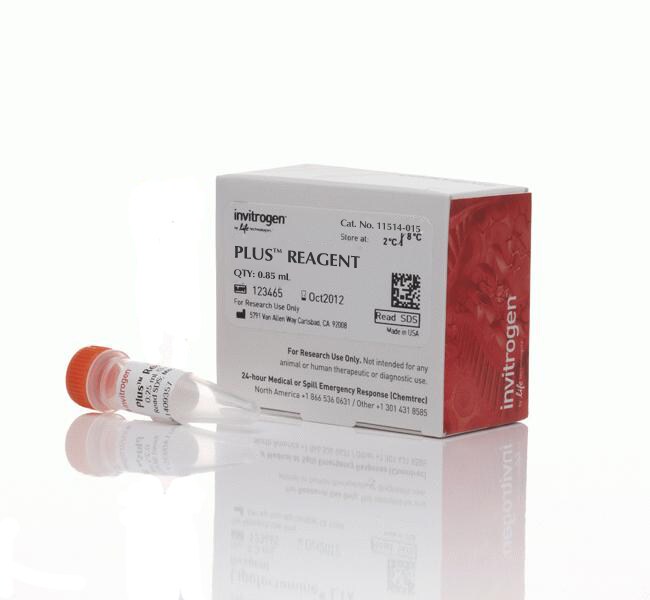
Réactif PLUS™
Le réactif PLUS™ est utilisé conjointement à divers réactifs de transfection tels que le réactif Lipofectamine™ dans le but d’améliorerAfficher plus
| Référence | Quantité |
|---|---|
| 11514015 | 0,85 mL |
Référence 11514015
Prix (EUR)
719,65
Online Exclusive
750,00Économisez 30,35 (4%)
0.85 mL
Quantité:
0,85 mL
Prix (EUR)
719,65
Online Exclusive
750,00Économisez 30,35 (4%)
0.85 mL
Le réactif PLUS™ est utilisé conjointement à divers réactifs de transfection tels que le réactif Lipofectamine™ dans le but d’améliorer l’efficacité de la transfection au sein des lignées de cellules adhérentes.
Utilisation du réactif PLUS™
Certains clients trouvent que l’utilisation du réactif PLUS™ permet de limiter l’optimisation de la concentration d’ADN nécessaire à l’obtention de bonnes performances en matière de transfection. L’ajout de réactif PLUS™ pourrait également réduire de moitié environ les quantités d’ADN et de lipides requises par rapport à l’utilisation de lipides seuls. Le réactif PLUS™ a été spécifiquement conçu pour élargir le nombre de types de cellules transfectables. Associé au réactif Lipofectamine™, le réactif PLUS™ a prouvé ses capacités d’amélioration de la transfection de BHK-21, NIH 3T3 et autres lignées cellulaires.
Utilisation du réactif PLUS™
Certains clients trouvent que l’utilisation du réactif PLUS™ permet de limiter l’optimisation de la concentration d’ADN nécessaire à l’obtention de bonnes performances en matière de transfection. L’ajout de réactif PLUS™ pourrait également réduire de moitié environ les quantités d’ADN et de lipides requises par rapport à l’utilisation de lipides seuls. Le réactif PLUS™ a été spécifiquement conçu pour élargir le nombre de types de cellules transfectables. Associé au réactif Lipofectamine™, le réactif PLUS™ a prouvé ses capacités d’amélioration de la transfection de BHK-21, NIH 3T3 et autres lignées cellulaires.
Usage exclusivement réservé à la recherche. Ne pas utiliser pour des procédures de diagnostic.
Spécifications
À utiliser avec (application)Transfection
Compatibilité à haut débitNon compatible avec des cadences élevées (manuel)
Gamme de produitsPLUS
Type de produitRéactif
Quantité0,85 mL
Compatible avec le sérumOui
Conditions d’expéditionGlace
Type de celluleLignées cellulaires établies, cellules souches, cellules primaires, cellules difficiles à transfecter
FormatPlaque à 6 puits, plaque à 12 puits, plaque à 24 puits, plaque à 48 puits, plaque à 96 puits, flacons
Type d’échantillonADN plasmide, plasmides d’ARNi (ARNsh, miR)
Transfection TechniqueTransfection basée sur les lipides
Unit Size0.85 mL
Contenu et stockage
Contient un flacon (0,85 ml) de réactif PLUS™. Conserver à 4°C. Ne pas congeler.
Foire aux questions (FAQ)
I accidentally left my lipid reagent at room temperature. Can I still use it?
Do you offer a reagent for the transfection of endothelial cells?
Can I use the PLUS Reagent with Lipofectamine RNAiMAX?
Why do I have to dilute my DNA in medium before adding the PLUS Reagent? Can I just add them together?
What is the PLUS Reagent?
Citations et références (90)
Citations et références
Abstract
c-Jun is a JNK-independent coactivator of the PU.1 transcription factor.
Journal:J Biol Chem
PubMed ID:9988737
The ETS domain transcription factor PU.1 is necessary for the development of monocytes and regulates, in particular, the expression of the monocyte-specific macrophage colony-stimulating factor (M-CSF) receptor, which is critical for monocytic cell survival, proliferation, and differentiation. The bZIP transcription factor c-Jun, which is part of the AP-1 transcription factor
Receptor-selective effects of endogenous RGS3 and RGS5 to regulate mitogen-activated protein kinase activation in rat vascular smooth muscle cells.
Journal:J Biol Chem
PubMed ID:12006602
Regulators of G protein signaling (RGS) proteins compose a highly diverse protein family best known for inhibition of G protein signaling by enhancing GTP hydrolysis by Galpha subunits. Little is known about the function of endogenous RGS proteins. In this study, we used synthetic ribozymes targeted to RGS2, RGS3, RGS5,
A
Journal:J Biol Chem
PubMed ID:11973330
The large size (six membrane-spanning repeats in each of four domains) and asymmetric architecture of the voltage-dependent Na+ channel has hindered determination of its structure. With the goal of determining the minimum structure of the Na+ channel permeation pathway, we created two stable cell lines expressing the voltage-dependent rat skeletal
Vesicle-associated membrane protein-2/synaptobrevin binding to synaptotagmin I promotes O-glycosylation of synaptotagmin I.
Journal:J Biol Chem
PubMed ID:12048209
Synaptotagmin I (Syt I), an evolutionarily conserved integral membrane protein of synaptic vesicles, is now known to regulate Ca2+-dependent neurotransmitter release. Syt I protein should undergo several post-translational modifications before maturation and subsequent functioning on synaptic vesicles (e.g. N-glycosylation and fatty acylation in vertebrate Syt I), because the apparent molecular
Extracellular Export of Sphingosine Kinase-1 Enzyme. SPHINGOSINE 1-PHOSPHATE GENERATION AND THE INDUCTION OF ANGIOGENIC VASCULAR MATURATION.
Journal:J Biol Chem
PubMed ID:11741921
The enzyme sphingosine kinase (SK) catalyzes the formation of sphingosine 1-phosphate (S1P), a bioactive lipid that acts extracellularly on G protein-coupled receptors of the S1P(1)/EDG-1 subfamily. Although S1P is formed in the cytosol of various cells, S1P release is not understood and is controversial because this lipid mediator is also