Search


Citations et références (185)
Invitrogen™
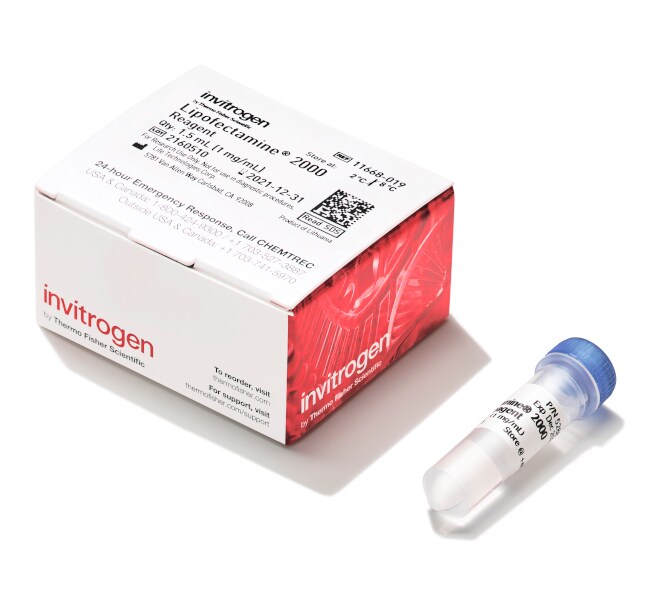
Réactif de transfection Lipofectamine™ 2000
Le réactif de transfection Lipofectamine™ 2000 est un agent de transfection polyvalent qui s’est avéré capable de transfecter la plusAfficher plus
Have Questions?
Modifier l'affichage

| Référence | Quantité |
|---|---|
| 11668019 | 1,5 ml |
| 11668500 | 15 mL |
| 11668027 | 0,75 mL |
| 11668030 | 0,3 mL |
Référence 11668019
Prix (EUR)
993,65
Offre exceptionnelle en ligne
1 212,00Économisez 218,35 (18%)
Each
Quantité:
1,5 ml
Prix (EUR)
993,65
Offre exceptionnelle en ligne
1 212,00Économisez 218,35 (18%)
Each
Le réactif de transfection Lipofectamine™ 2000 est un agent de transfection polyvalent qui s’est avéré capable de transfecter la plus vaste variété de lignées de cellules adhérentes et en suspension. Les chercheurs utilisent le réactif Lipofectamine™ 2000 pour les expériences d’extinction de gènes par ARNsi et ARNsh, ainsi que pour les études d’expression génétique.
Avantages du réactif de transfection Lipofectamine™ 2000 :
• Une efficacité de transfection exceptionnelle sur une très large gamme de lignées cellulaires et les plus hauts niveaux d’expression des protéines recombinantes
• Des performances supérieures pour la co-transfection de l’ARNsi et de l’ADN plasmidique
• Une efficacité prouvée dans la présence de sérum : élimine le besoin de changer de milieu de culture à la suite de la transfection
• Des performances fiables pour les applications à rendement élevé
• Le meilleur choix pour établir des lignées cellulaires stables
Un réactif de transfection à haute performance pour l’expression génétique et l’inhibition génétique
Le réactif de transfection Lipofectamine™ 2000 fonctionne efficacement avec toutes les lignées cellulaires courantes ainsi qu’avec de nombreux complexes et peut être utilisé dans des milieux avec ou sans sérum. Pour l’inhibition génétique, les transfections hautement efficaces du réactif Lipofectamine™ 2000 permettent des expériences de haut niveau d’extinction des gènes, ce qui est nécessaire à la production de résultats convaincants. Le réactif de transfection Lipofectamine™ 2000 est le premier choix pour la co-transfection, de par efficacité en matière de transfection aussi bien d’ARNsi que d’ADN plasmidique. Le réactif de transfection Lipofectamine™ 2000 est facile à utiliser : il se mélange avec de l’acide nucléique et s’ajoute à la culture cellulaire.
Idéal pour un travail à haut débit
La simplicité et la vitesse combinées à une efficacité de transfection élevée font du réactif de transfection Lipofectamine™ 2000 le réactif idéal pour l’expression de protéines transitoires ou les transfections ARNi à haut débit. Les conditions de transfection peuvent facilement être établies pour les systèmes robotiques ou automatisés utilisés dans de telles applications.
Avantages du réactif de transfection Lipofectamine™ 2000 :
• Une efficacité de transfection exceptionnelle sur une très large gamme de lignées cellulaires et les plus hauts niveaux d’expression des protéines recombinantes
• Des performances supérieures pour la co-transfection de l’ARNsi et de l’ADN plasmidique
• Une efficacité prouvée dans la présence de sérum : élimine le besoin de changer de milieu de culture à la suite de la transfection
• Des performances fiables pour les applications à rendement élevé
• Le meilleur choix pour établir des lignées cellulaires stables
Un réactif de transfection à haute performance pour l’expression génétique et l’inhibition génétique
Le réactif de transfection Lipofectamine™ 2000 fonctionne efficacement avec toutes les lignées cellulaires courantes ainsi qu’avec de nombreux complexes et peut être utilisé dans des milieux avec ou sans sérum. Pour l’inhibition génétique, les transfections hautement efficaces du réactif Lipofectamine™ 2000 permettent des expériences de haut niveau d’extinction des gènes, ce qui est nécessaire à la production de résultats convaincants. Le réactif de transfection Lipofectamine™ 2000 est le premier choix pour la co-transfection, de par efficacité en matière de transfection aussi bien d’ARNsi que d’ADN plasmidique. Le réactif de transfection Lipofectamine™ 2000 est facile à utiliser : il se mélange avec de l’acide nucléique et s’ajoute à la culture cellulaire.
Idéal pour un travail à haut débit
La simplicité et la vitesse combinées à une efficacité de transfection élevée font du réactif de transfection Lipofectamine™ 2000 le réactif idéal pour l’expression de protéines transitoires ou les transfections ARNi à haut débit. Les conditions de transfection peuvent facilement être établies pour les systèmes robotiques ou automatisés utilisés dans de telles applications.
Usage exclusivement réservé à la recherche. Ne pas utiliser pour des procédures de diagnostic.
Spécifications
À utiliser avec (application)Transfection
Compatibilité à haut débitCompatible avec le haut débit
Gamme de produitsLipofectamine
Type de produitRéactif de transfection
Quantité1,5 ml
Compatible avec le sérumOui
Conditions d’expéditionHomologué pour des expéditions à température ambiante ou sur glace
Type de celluleLignées cellulaires établies, cellules souches, cellules primaires, cellules difficiles à transfecter
FormatPlaque à 6 puits, plaque à 12 puits, plaque à 24 puits, plaque à 48 puits, plaque à 96 puits, flacons
Type d’échantillonADN plasmide, ARNic synthétique, plasmides d’ARNi (ARNsh, miR)
Transfection TechniqueTransfection basée sur les lipides
Unit SizeEach
Contenu et stockage
Contient un flacon (1,5 ml) de réactif Lipofectamine™ 2000. Conservez à 2–8°C. Ne pas congeler.
Foire aux questions (FAQ)
I transfected GFP into cells using Lipofectamine 2000 and saw a light granular orange background fluorescence. What could be causing this?
I accidentally left my lipid reagent at room temperature. Can I still use it?
Can I use Lipofectamine RNAiMAX to co-transfect siRNA with plasmid DNA?
Can I use Lipofectamine 2000 to co-transfect plasmids and siRNA?
For how long is the Lipofectamine 2000:DNA complex stable?
Citations et références (185)
Citations et références
Abstract
Role of tyrosine kinase Jak2 in prolactin-induced differentiation and growth of mammary epithelial cells.
Journal:J Biol Chem
PubMed ID:11821424
Genetic studies in mice have established a critical role for prolactin receptors and transcription factor Stat5 in mammary gland differentiation. However, the enzymatic coupling between prolactin receptors and Stat5 in this process has not been established. In addition to Jak2, several other tyrosine kinases reportedly also are associated with prolactin
Confirmation by FRET in individual living cells of the absence of significant amyloid beta -mediated caspase 8 activation.
Journal:Proc Natl Acad Sci U S A
PubMed ID:12409609
When cells are exposed to death-inducing molecules such as tumor necrosis factor-alpha or Fas, caspase 8 is activated and cleaves an apoptotic facilitator, Bid, that is a member of the Bcl-2 family. After additional modification, the C-terminal moiety of Bid is translocated to the mitochondria and induces the release of
AMP-activated Kinase Inhibits the Epithelial Na+ Channel through Functional Regulation of the Ubiquitin Ligase Nedd4-2.
Journal:J Biol Chem
PubMed ID:16844684
'We recently found that the metabolic sensor AMP-activated kinase (AMPK) inhibits the epithelial Na(+) channel (ENaC) through decreased plasma membrane ENaC expression, an effect requiring the presence of a binding motif in the cytoplasmic tail of the beta-ENaC subunit for the ubiquitin ligase Nedd4-2. To further examine the role of
Mammalian cell penetration, siRNA transfection, and DNA transfection by supercharged proteins.
Journal:Proc Natl Acad Sci U S A
PubMed ID:19307578
'Nucleic acid reagents, including small interfering RNA (siRNA) and plasmid DNA, are important tools for the study of mammalian cells and are promising starting points for the development of new therapeutic agents. Realizing their full potential, however, requires nucleic acid delivery reagents that are simple to prepare, effective across many
Dynamic fluorescent imaging of human immunodeficiency virus type 1 gag in live cells by biarsenical labeling.
Journal:J Virol
PubMed ID:15767407
'Human immunodeficiency virus type 1 (HIV-1) Gag is the primary structural protein of the virus and is sufficient for particle formation. We utilized the recently developed biarsenical-labeling method to dynamically observe HIV-1 Gag within live cells by adding a tetracysteine tag (C-C-P-G-C-C) to the C terminus of Gag in both