Search

Invitrogen™
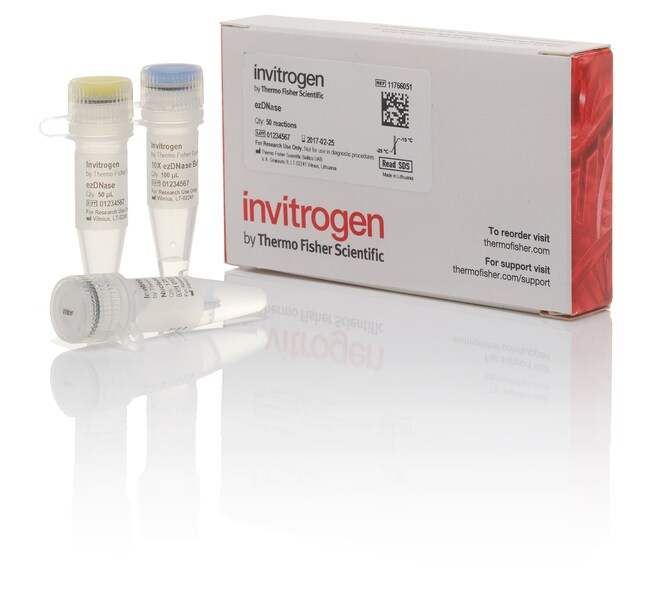
Enzyme ezDNase™
L’enzyme Invitrogen™ ezDNase™ est une DNase recombinante double brin spécifique pour l’élimination rapide de l’ADN génomique contaminant des préparations d’ARN.Afficher plus
| Référence | Quantité |
|---|---|
| 11766051 | 50 μl |
Référence 11766051
Prix (EUR)
246,65
線上優惠
268,00Économisez 21,35 (8%)
Each
Quantité:
50 μl
Prix (EUR)
246,65
線上優惠
268,00Économisez 21,35 (8%)
Each
L’enzyme Invitrogen™ ezDNase™ est une DNase recombinante double brin spécifique pour l’élimination rapide de l’ADN génomique contaminant des préparations d’ARN. Il clive les liaisons phosphodiester dans l’ADN double brin pour obtenir 2 à 8 bp d’oligonucléotides avec des extrémités 5’-phosphate et 3’-hydroxyle.
Les caractéristiques de l’enzyme ezDNase sont les suivantes :
• Élimination efficace et rapide de l’ADN génomique
•—Très spécifique : aucun impact sur l’ARN, l’ADNc ou les amorces dans les réactions RT
La haute spécificité de l’enzyme ezDNase pour l’ADN double brin permet l’élimination efficace et rapide de l’ADN génomique sans réduction de la qualité ou de la quantité d’ARN ou d’ADN simple brin présents dans la réaction telle que l’ADNc et les amorces. L’enzyme ezDNase est thermo-labile et peut donc être facilement désactivée par le traitement thermique à température modérée (55°C). Ces caractéristiques font de l’ezDNase un choix supérieur pour l’élimination de l’ADN génomique avant les réactions de transcription inverse.
Lorsqu’il est utilisé en association avec le mélange SuperScript™ IV VILO™ Master Mix ou d’autres réactifs de transcription inverse Invitrogen, l’enzyme ezDNase aide à réduire de façon significative la possibilité de compromettre la synthèse d’ADNc par l’ADN génomique et de réduire la variation dans la quantification RT-qPCR provoquée par la perte ou les dommages d’ARN pendant le traitement par DNase classique.
Les caractéristiques de l’enzyme ezDNase sont les suivantes :
• Élimination efficace et rapide de l’ADN génomique
•—Très spécifique : aucun impact sur l’ARN, l’ADNc ou les amorces dans les réactions RT
La haute spécificité de l’enzyme ezDNase pour l’ADN double brin permet l’élimination efficace et rapide de l’ADN génomique sans réduction de la qualité ou de la quantité d’ARN ou d’ADN simple brin présents dans la réaction telle que l’ADNc et les amorces. L’enzyme ezDNase est thermo-labile et peut donc être facilement désactivée par le traitement thermique à température modérée (55°C). Ces caractéristiques font de l’ezDNase un choix supérieur pour l’élimination de l’ADN génomique avant les réactions de transcription inverse.
Lorsqu’il est utilisé en association avec le mélange SuperScript™ IV VILO™ Master Mix ou d’autres réactifs de transcription inverse Invitrogen, l’enzyme ezDNase aide à réduire de façon significative la possibilité de compromettre la synthèse d’ADNc par l’ADN génomique et de réduire la variation dans la quantification RT-qPCR provoquée par la perte ou les dommages d’ARN pendant le traitement par DNase classique.
Usage exclusivement réservé à la recherche. Ne pas utiliser pour des procédures de diagnostic.
Spécifications
Tampon compatibleRéactifs de transcription inverse
À utiliser avec (application)RT-qPCR
Type de produitEnzymes
Quantité50 μl
Type d’échantillonARN
Conditions d’expéditionSous glace sèche
Concentration10X
EnzymesDNase
FormeLiquide
Gamme de produitsezDNase
Unit SizeEach
Contenu et stockage
• 50 μl d’enzyme ezDNase
• 100 μl de tampon ezDNase (10X)
• 1,25 ml d’eau exempte de nucléase
Conserver entre -5 et -30°C.
• 100 μl de tampon ezDNase (10X)
• 1,25 ml d’eau exempte de nucléase
Conserver entre -5 et -30°C.