Search


Citations et références (5)
Gibco™
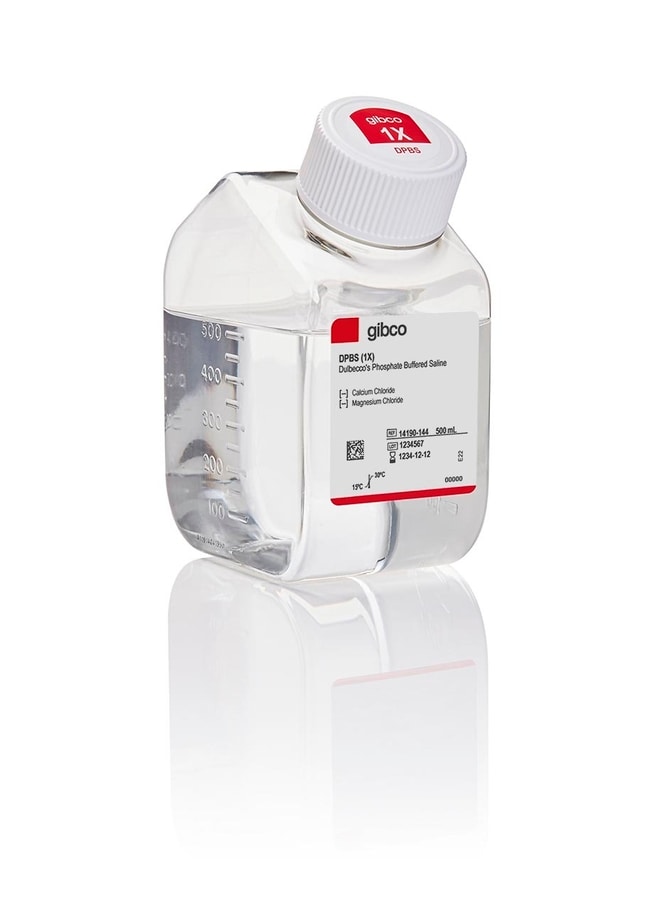
DPBS, sans calcium, sans magnésium
La solution saline dans un tampon phosphate de Dulbecco (DPBS) est une solution saline équilibrée utilisée pour une variété d’applicationsAfficher plus
Have Questions?
Modifier l'affichage

| Référence | Quantité | Conditionnement |
|---|---|---|
| 14190144 | 500 mL | Flacon |
| 14190086 également connu sous le numéro 14190-086 | 100 mL | Flacon |
| 14190185 également connu sous le numéro 14190-185 | 20 mL x 100 mL | Flacon |
| 14190094 également connu sous le numéro 14190-094 | 500 mL | Flacon |
| 14190250 | 10 x 500 mL | Flacon |
| 14190169 également connu sous le numéro 14190-169 | 10 x 500 mL | Flacon |
| 14190136 | 1 000 mL | Flacon |
| 14190342 | 5 L | Sachet |
| 14190359 | 10 L | Sachet |
| 14190240 également connu sous le numéro 14190-240 | 10 L | Sachet |
| 14190367 | 20 L | Sachet |
Référence 14190144
Prix (EUR)
29,65
線上優惠
35,83Économisez 6,18 (17%)
Each
Quantité:
500 mL
Conditionnement:
Flacon
Prix (EUR)
29,65
線上優惠
35,83Économisez 6,18 (17%)
Each
La solution saline dans un tampon phosphate de Dulbecco (DPBS) est une solution saline équilibrée utilisée pour une variété d’applications de culture cellulaire, telles que le lavage des cellules avant dissociation, le transport des cellules et des tissus, la dilution des cellules pour comptage et la préparation des réactifs. Des formulations sans calcium et magnésium sont nécessaires pour rincer les chélateurs de la culture avant la dissociation cellulaire.
Nous proposons une variété de formulations de DPBS Gibco™ pour une gamme d’applications de culture cellulaire.
La formulation complète est disponible.
Système de fabrication et de Qualité BPFa
Gibco™ DPBS est fabriqué dans un établissement conforme aux BPFa, situé à Grand Island, dans l’État de New York. Ce site est homologué par la FDA comme fabricant de dispositifs médicaux et il est certifié ISO 13485. Pour assurer la continuité de la chaîne d’approvisionnement, nous proposons un produit DPBS Gibco™ identique fabriqué sur notre site situé en Écosse (14190-240). Ce site est homologué par la FDA comme fabricant de dispositifs médicaux et il est certifié ISO 13485.
Nous proposons une variété de formulations de DPBS Gibco™ pour une gamme d’applications de culture cellulaire.
Cette DPBS est modifiée comme suit :
| Sans |
| • Calcium |
| • Magnésium |
| • Rouge de phénol |
La formulation complète est disponible.
Système de fabrication et de Qualité BPFa
Gibco™ DPBS est fabriqué dans un établissement conforme aux BPFa, situé à Grand Island, dans l’État de New York. Ce site est homologué par la FDA comme fabricant de dispositifs médicaux et il est certifié ISO 13485. Pour assurer la continuité de la chaîne d’approvisionnement, nous proposons un produit DPBS Gibco™ identique fabriqué sur notre site situé en Écosse (14190-240). Ce site est homologué par la FDA comme fabricant de dispositifs médicaux et il est certifié ISO 13485.
À des fins de recherche ou de commercialisation avancée Non destiné aux diagnostics ou à l’administration directe à des humains ou des animaux.
Spécifications
Nom chimique ou matériauSolution saline dans un tampon phosphate de Dulbecco (DPBS)
CouleurTransparents
ComprendSans pyruvate de sodium
Qualité de fabricationcGMP-compliant under the ISO 13485 standard
Osmolalité270 à 300 mOsm/kg
ConditionnementFlacon
Température de stockageConditions de stockage : 15°C à 30°C, Conditions d’expédition : température ambiante, Durée de conservation : 36 mois à compter de la date de fabrication
StérilitéStérilisation par filtration
Méthode de stérilisationSterile-filtered
Concentration1X
À utiliser avec (application)Culture de cellules de mammifères
QualitéCell Culture
Forme physiqueLiquide
Gamme de produitsGibco
Quantité500 mL
Type de solutionSolution saline dans un tampon phosphate de Dulbecco
pH7,0 à 7,3
Unit SizeEach
Foire aux questions (FAQ)
What procedures are recommended for the preparation of beta amyloid-containing samples?
What is the shelf life of DPBS after it has been opened?
What is the shelf life of DPBS (Cat. No. 14190136)?
Does Diploid Growth Serum-Reduced Medium (SRM) contain L-glutamine?
Do I have to adjust my infection parameters when using Diploid Production Serum-Free Medium (SFM)?
Citations et références (5)
Citations et références
Abstract
A comparison between different human hepatocyte models reveals profound differences in net glucose production, lipid composition and metabolism in vitro.
Journal:Experimental cell research
PubMed ID:38499143
Effects of an indole derivative on cell proliferation, transfection, and alternative splicing in production of lentiviral vectors by transient co-transfection.
Journal:PloS one
PubMed ID:38833479
Lentiviral vectors derived from human immunodeficiency virus type I are widely used to deliver functional gene copies to mammalian cells for research and gene therapies. Post-transcriptional splicing of lentiviral vector transgene in transduced host and transfected producer cells presents barriers to widespread application of lentiviral vector-based therapies. The present study
Macrophage foam cell formation with native low density lipoprotein.
Journal:J Biol Chem
PubMed ID:12118008
'This investigation has elucidated a mechanism for development of macrophage foam cells when macrophages are incubated with native low density lipoprotein (LDL). LDL is believed to be the main source of cholesterol that accumulates in monocyte-derived macrophages within atherosclerotic plaques, but native LDL has not previously been shown to cause
Microfluidic single-cell real-time PCR for comparative analysis of gene expression patterns.
Journal:Nat Protoc
PubMed ID:22481529
'Single-cell quantitative real-time PCR (qRT-PCR) combined with high-throughput arrays allows the analysis of gene expression profiles at a molecular level in approximately 11 h after cell sample collection. We present here a high-content microfluidic real-time platform as a powerful tool for comparatively investigating the regulation of developmental processes in single
Efficient intracellular assembly of papillomaviral vectors.
Journal:J Virol
PubMed ID:14694107
Although the papillomavirus structural proteins, L1 and L2, can spontaneously coassemble to form virus-like particles, currently available methods for production of L1/L2 particles capable of transducing reporter plasmids into mammalian cells are technically demanding and relatively low-yield. In this report, we describe a simple 293 cell transfection method for efficient