Search


Citations et références (10)
Gibco™
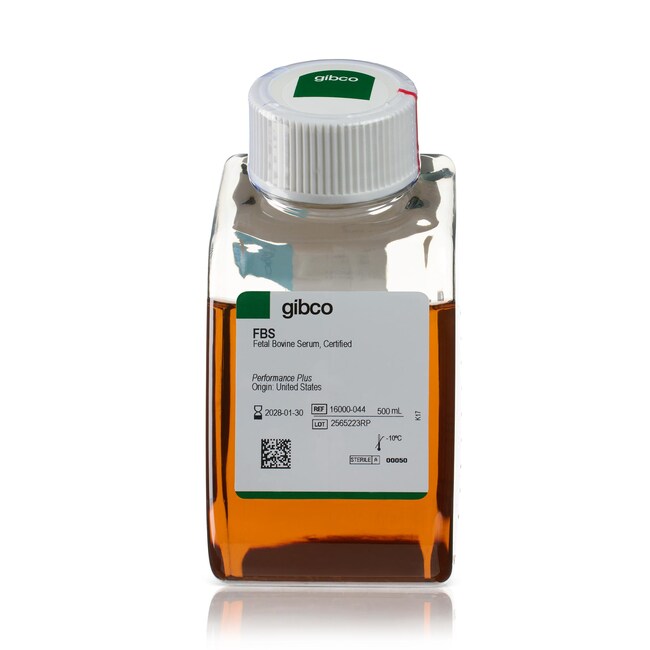
Sérum de veau fœtal, certifié, États-Unis
Les sérums de veau fœtal Gibco offrent une excellente valeur pour la culture cellulaire de base, la recherche spécialisée etAfficher plus
Have Questions?
Modifier l'affichage

| Référence | Quantité | Format |
|---|---|---|
| 16000044 | 500 mL | Flacon |
| A3160401 | 50 mL | One Shot |
| A3160402 | 10 x 50 mL | One Shot |
Our improved Premium Plus Fetal Bovine Serum (FBS) features enhanced specifications with unchanged stability, manufacturing, storage, and transport processes.
Référence 16000044
Les sérums de veau fœtal Gibco offrent une excellente valeur pour la culture cellulaire de base, la recherche spécialisée et les dosages spécifiques. Ils bénéficient de la confiance des chercheurs grâce à un soutien primé et d’une qualité constante, répondant à vos besoins en matière de recherche et de budget
Sérums Gibco : Qualité fiable pour une performance constante
Catégorie du sérum : Premium (Performance Plus)
• Utilisés dans une vaste gamme de types de cellules, particulièrement dans les lignées cellulaires sensibles
• Nos sérums les plus caractérisés offrent les plus bas niveaux d’endotoxine et d’hémoglobine
• Niveau d’endotoxine : ≤ 5 UE/ml
• Niveau d’hémoglobine : ≤ 15 mg/dl
• Origine : États-Unis
Les sérum Gibco sont
• Certifiés ISO 13485 et traités dans des installations homologuées par la FDA
• Marqués pour le diagnostic in vitro (conformes aux niveaux de contrôles de stérilité USP les plus élevés)
• Filtrés trois fois à 0,1 µm
• Le flacon Gibco est plus facile à utiliser dans la hotte, réduisant le risque de contamination et vous aidant à réaliser une culture cellulaire plus régulière
• L’autocollant détachable sur l’étiquette fournit une référence pratique permettant d’enregistrer le numéro de lot et la date de péremption dans le cahier de laboratoire
Sérums Gibco : Qualité fiable pour une performance constante
Catégorie du sérum : Premium (Performance Plus)
• Utilisés dans une vaste gamme de types de cellules, particulièrement dans les lignées cellulaires sensibles
• Nos sérums les plus caractérisés offrent les plus bas niveaux d’endotoxine et d’hémoglobine
• Niveau d’endotoxine : ≤ 5 UE/ml
• Niveau d’hémoglobine : ≤ 15 mg/dl
• Origine : États-Unis
Les sérum Gibco sont
• Certifiés ISO 13485 et traités dans des installations homologuées par la FDA
• Marqués pour le diagnostic in vitro (conformes aux niveaux de contrôles de stérilité USP les plus élevés)
• Filtrés trois fois à 0,1 µm
• Le flacon Gibco est plus facile à utiliser dans la hotte, réduisant le risque de contamination et vous aidant à réaliser une culture cellulaire plus régulière
• L’autocollant détachable sur l’étiquette fournit une référence pratique permettant d’enregistrer le numéro de lot et la date de péremption dans le cahier de laboratoire
À des fins de recherche ou de commercialisation avancée Non destiné aux diagnostics ou à l’administration directe à des humains ou des animaux.
Spécifications
Concentration en endotoxines≤5 UE/mL
Concentration d’hémoglobine≤ 15 mg/dl
Pureté ou qualitéCertifiés
Conditions d’expéditionCongelé
EspècesBovine
AgeFœtal
Pays d’origineÉtats-Unis
FormeLiquide
FormatFlacon
Type de produitSérum de veau fœtal
Quantité500 mL
Serum TreatmentStandard (filtration stérile)
StérilitéStérile
Sterilization MethodTriple filtration, 0,1 μm
Unit SizeEach
Contenu et stockage
Conditions de stockage : ≤-10°C
Conditions d’expédition : Congelé
Conditions d’expédition : Congelé
Foire aux questions (FAQ)
What are the benefits and disadvantages of using heat-inactivated FBS in cell culture?
How much of the total protein measured in Fetal Bovine Serum (heat inactivated or otherwise) is attributed to albumin?
How much Fetal Bovine Serum (FBS) do I need to add to my medium?
How long can I store Gibco Fetal Bovine Serum at 4 degrees C?
How should I thaw Gibco Fetal Bovine Serum?
Citations et références (10)
Citations et références
Abstract
Fibroblast growth factor receptor-1 signaling induces osteopontin expression and vascular smooth muscle cell-dependent adventitial fibroblast migration in vitro.
Journal:Circulation
PubMed ID:12176960
'BACKGROUND: Increased expression of osteopontin (OPN), fibroblast growth factors (FGFs), and their type-1 receptor (FGFR-1) is associated with neointima formation and atherosclerosis. This study tested the hypothesis that ligand activation of FGFR-1 stimulates OPN expression in rat aortic smooth muscle cells (RASMCs), explored the signaling pathway involved, and assessed the
Ultraviolet-induced junD activation and apoptosis in myeloblastic leukemia ML-1 cells.
Journal:J Biol Chem
PubMed ID:12082101
'The exposure of mammalian cells to UV irradiation induces the expression of immediate early genes such as c-jun and c-fos and activates the transcription factors AP-1 and NF-kappaB. JunD is one of the three members of the Jun family and shares some functional characteristics with c-Jun. In the present study,
Dystrophin deficiency markedly increases enterovirus-induced cardiomyopathy: a genetic predisposition to viral heart disease.
Journal:Nat Med
PubMed ID:12118246
Both enteroviral infection of the heart and mutations in the dystrophin gene can cause cardiomyopathy. Little is known, however, about the interaction between genetic and acquired forms of cardiomyopathy. We previously demonstrated that the enteroviral protease 2A cleaves dystrophin; therefore, we hypothesized that dystrophin deficiency would predispose to enterovirus-induced cardiomyopathy.
Ascorbic-acid transporter Slc23a1 is essential for vitamin C transport into the brain and for perinatal survival.
Journal:Nat Med
PubMed ID:11984580
The only proven requirement for ascorbic acid (vitamin C) is in preventing scurvy, presumably because it is a cofactor for hydroxylases required for post-translational modifications that stabilize collagen. We have created mice deficient in the mouse ortholog (solute carrier family 23 member 1 or Slc23a1) of a rat ascorbic-acid transporter,
Cell docking and on-chip monitoring of cellular reactions with a controlled concentration gradient on a microfluidic device.
Journal:Anal Chem
PubMed ID:12199565
We have developed a microfluidic device for on-chip monitoring of cellular reactions. The device consists of two primary analytical functions: control of cell transport and immobilization, and dilution of an analyte solution to generate a concentration gradient. In this device, a dam structure in parallel to the fluid flow was