Search



Citations et références (3)
Gibco™
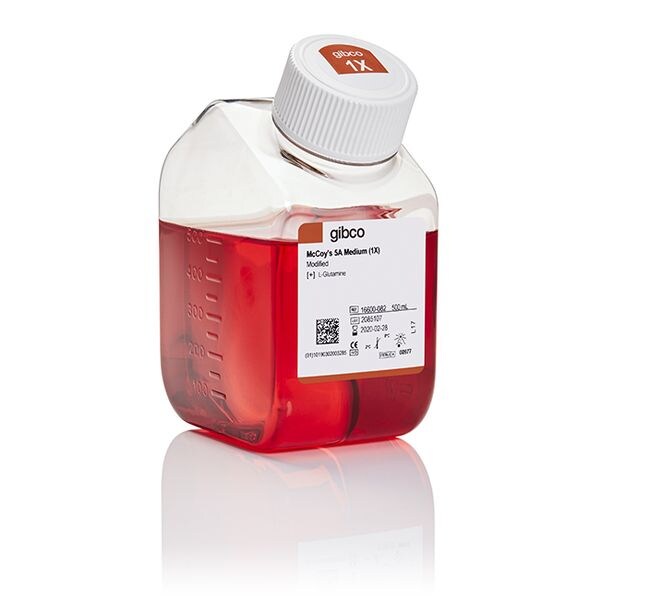
Milieu McCoy 5A (modifié)
Le milieu de culture McCoy’s 5A (modifié) est un milieu à usage universel, qui stimule la propagation de nombreux typesAfficher plus
| Référence | Quantité |
|---|---|
| 16600082 | 500 mL |
Référence 16600082
Prix (EUR)
39,65
Online exclusive
47,37Économisez 7,72 (16%)
Each
Quantité:
500 mL
Prix (EUR)
39,65
Online exclusive
47,37Économisez 7,72 (16%)
Each
Le milieu de culture McCoy’s 5A (modifié) est un milieu à usage universel, qui stimule la propagation de nombreux types de cellules primaires, de lignées cellulaires établies et d’explants issus des tissus de biopsie. Ce milieu de culture favorise la croissance des cellules primaires de mammifères dérivées d’une moelle osseuse normale, de la peau, de la rate, du rein, du poumon, des embryons de rats et autres tissus.
Ce milieu McCoy 5A est modifié comme suit :
La formulation complète est disponible.
Utilisation du milieu McCoy’s 5A (modifié)
Le Dr. Thomas McCoy a initialement formulé le milieu McCoy 5A comme une modification du milieu de base 5A. Contrairement à d’autres milieux, le McCoy 5A contient l’agent de réduction glutathion, bacto-peptone et un niveau élevé de glucose. Ce produit comprend également l’ajout, par le Dr. Hsu, de sels de Hanks pour une utilisation à l’extérieur d’un incubateur à CO2. Le milieu de culture McCoy 5A (modifié) nécessite une supplémentation en sérum, en général avec 10 % de sérum de veau fœtal (SVF). Le milieu de culture McCoy 5A (modifié) utilise un système de tampon au bicarbonate de sodium (2,2 g / l) et nécessite par conséquent un environnement contenant 5 à 10% de CO2 pour préserver le pH physiologique.
Fabrication et système de qualité conformes aux BPFa
le milieu MacCoy 5A (modifié) est fabriqué sur un site conforme aux BPFa situé à Grand Island, New York, États-Unis. Ce site est homologué par la FDA comme fabricant de dispositifs médicaux et il est certifié ISO 13485. Pour assurer la continuité de la chaîne d’approvisionnement, nous proposons un produit McCoy 5A (modifié) identique fabriqué sur notre site situé en Écosse (26600-080). Ce site est homologué par la FDA comme fabricant de dispositifs médicaux et il est certifié ISO 13485.
Ce milieu McCoy 5A est modifié comme suit :
| Avec | Sans |
| • Haute teneur en glucose | • Pyruvate de sodium |
| • L-glutamine | • HEPES |
| • Bacto-peptone | |
| • Rouge de phénol |
La formulation complète est disponible.
Utilisation du milieu McCoy’s 5A (modifié)
Le Dr. Thomas McCoy a initialement formulé le milieu McCoy 5A comme une modification du milieu de base 5A. Contrairement à d’autres milieux, le McCoy 5A contient l’agent de réduction glutathion, bacto-peptone et un niveau élevé de glucose. Ce produit comprend également l’ajout, par le Dr. Hsu, de sels de Hanks pour une utilisation à l’extérieur d’un incubateur à CO2. Le milieu de culture McCoy 5A (modifié) nécessite une supplémentation en sérum, en général avec 10 % de sérum de veau fœtal (SVF). Le milieu de culture McCoy 5A (modifié) utilise un système de tampon au bicarbonate de sodium (2,2 g / l) et nécessite par conséquent un environnement contenant 5 à 10% de CO2 pour préserver le pH physiologique.
Fabrication et système de qualité conformes aux BPFa
le milieu MacCoy 5A (modifié) est fabriqué sur un site conforme aux BPFa situé à Grand Island, New York, États-Unis. Ce site est homologué par la FDA comme fabricant de dispositifs médicaux et il est certifié ISO 13485. Pour assurer la continuité de la chaîne d’approvisionnement, nous proposons un produit McCoy 5A (modifié) identique fabriqué sur notre site situé en Écosse (26600-080). Ce site est homologué par la FDA comme fabricant de dispositifs médicaux et il est certifié ISO 13485.
Spécifications
Lignée cellulaireFibroblastes de rat
Type de celluleTissus de biopsie
Concentration1 X
Qualité de fabricationConforme aux BPFa en vertu de la norme ISO 13485
Gamme de produitsGibco
Type de produitMilieu modifié McCoy 5A
Quantité500 mL
Durée de conservation12 mois à compter de la date de fabrication
Conditions d’expéditionTempérature ambiante
ClassificationOrigine animale
FormeLiquide
StérilitéStérilisation par filtration
Sterilization MethodSterile-filtered
Avec additifsHaute teneur en glucose, Glutamine, Rouge de phénol, Bicarbonate de sodium
Sans additifSans HEPES, Sans pyruvate de sodium
Unit SizeEach
Contenu et stockage
Conditions de stockage : 2-8°C. Stocker à l’abri de la lumière
Conditions d’expédition : température ambiante
Durée de conservation : 12 mois à compter de la date de fabrication
Conditions d’expédition : température ambiante
Durée de conservation : 12 mois à compter de la date de fabrication
Foire aux questions (FAQ)
What is the shelf life of the DMEM, high glucose, pyruvate medium once the bottle is opened and the medium is supplemented?
Is it necessary to store DMEM, high glucose, pyruvate medium in the dark?
How long can I keep my media after supplementing with serum?
My medium was shipped at room temperature but it is supposed to be stored refrigerated. Is it okay?
How can I remove mycoplasma contamination from my cell culture medium?
Citations et références (3)
Citations et références
Abstract
Novel kelch-like protein, KLEIP, is involved in actin assembly at cell-cell contact sites of Madin-Darby canine kidney cells.
Journal:Mol Biol Cell
PubMed ID:14668487
Dynamic rearrangements of cell-cell adhesion underlie a diverse range of physiological processes, but their precise molecular mechanisms are still obscure. Thus, identification of novel players that are involved in cell-cell adhesion would be important. We isolated a human kelch-related protein, Kelch-like ECT2 interacting protein (KLEIP), which contains the broad-complex, tramtrack,
DMH1, a novel BMP small molecule inhibitor, increases cardiomyocyte progenitors and promotes cardiac differentiation in mouse embryonic stem cells.
Journal:PLoS One
PubMed ID:22848549
The possibility of using cell-based therapeutics to treat cardiac failure has generated significant interest since the initial introduction of stem cell-based technologies. However, the methods to quickly and robustly direct stem cell differentiation towards cardiac cell types have been limited by a reliance on recombinant growth factors to provide necessary
A 2-D liquid separations/mass mapping method for interlysate comparison of ovarian cancers.
Journal:Anal Chem
PubMed ID:11985308
A two-dimensional liquid phase separation of proteins from whole cell lysates coupled on-line to an electrospray-ionization time-of-flight (ESI-TOF) mass spectrometer (MS) is used to map the protein content of ovarian surface epithelial cells (OSE) and an ovarian carcinoma-derived cell line (ES2). The two dimensions involve the use of liquid isoelectric