Search

Invitrogen™
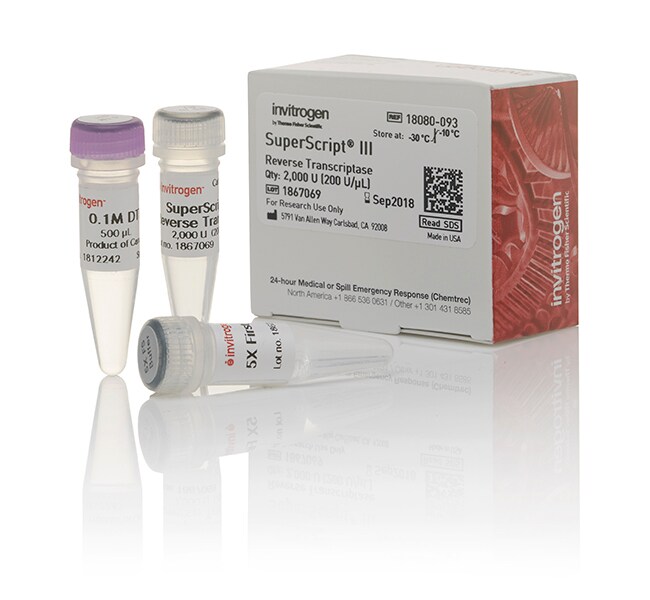
Transcriptase inverse SuperScript™ III
La transcriptase inverse Invitrogen SuperScript III est une transcriptase inverse (RT) M-MLV génétiquement modifiée, créée par l’introduction de plusieurs mutationsAfficher plus
Have Questions?
Modifier l'affichage

| Référence | Nbre de réactions |
|---|---|
| 18080093 | 10 réactions |
| 18080044 | 50 réactions |
| 18080085 | 200 réactions |
Référence 18080093
Prix (EUR)
123,65
Online Exclusive
156,00Économisez 32,35 (21%)
Each
Nbre de réactions:
10 réactions
Prix (EUR)
123,65
Online Exclusive
156,00Économisez 32,35 (21%)
Each
La transcriptase inverse Invitrogen SuperScript III est une transcriptase inverse (RT) M-MLV génétiquement modifiée, créée par l’introduction de plusieurs mutations pour une activité réduite de la RNase H, une demi-vie accrue et une meilleure stabilité thermique. La RT SuperScript III offre des rendements plus élevés d’ADNc, des longueurs d’ADNc améliorées, une meilleure efficacité sur les ARN cibles riches en GC et une meilleure performance globale que les enzymes H-moins d’ARNase M-MLV et M-MLV de type sauvage.
Les RT SuperScript sont les RT les plus fiables et les plus largement utilisées avec plus de 50 000 citations, revues et publications à ce jour.
Remarque : Le dernier membre de la famille RT SuperScript, la transcriptase inverse SuperScript IV, offre une thermostabilité, une processivité, des rendements et des performances accrus avec tous les échantillons d’ARN, y compris ceux de pureté ou d’intégrité sous-optimale.
Les RT SuperScript sont les RT les plus fiables et les plus largement utilisées avec plus de 50 000 citations, revues et publications à ce jour.
Remarque : Le dernier membre de la famille RT SuperScript, la transcriptase inverse SuperScript IV, offre une thermostabilité, une processivité, des rendements et des performances accrus avec tous les échantillons d’ARN, y compris ceux de pureté ou d’intégrité sous-optimale.
Usage exclusivement réservé à la recherche. Ne pas utiliser pour des procédures de diagnostic.
Spécifications
Type de produit finalADNc premier brin
FormatTube
Nbre de réactions10 réactions
Température de réaction optimale50°C
Quantité2 000 unités
Format de réactionComposants séparés
Type de réactifTranscription inverse
Transcriptase inverseSuperScript III
Activité de la ribonucléase HRéduction
Conditions d’expéditionGlace carbonique
Taille (produit final)Jusqu’à 12,3 kb
Matériau de départARN
TechniqueTranscription inverse
Concentration200 U / μl
GC-Rich PCR PerformanceÉlevé
Vitesse de réaction30 à 50 min
Unit SizeEach
Contenu et stockage
• Transcriptase inverse SuperScript™ III, 1 x 2 000 unités (200 U/μl)
• Tampon premier brin 5X, 1 ml
• DTT, 500 μl (100 mM)
Conserver à –20°C.