Search


Citations et références (6)
Invitrogen™
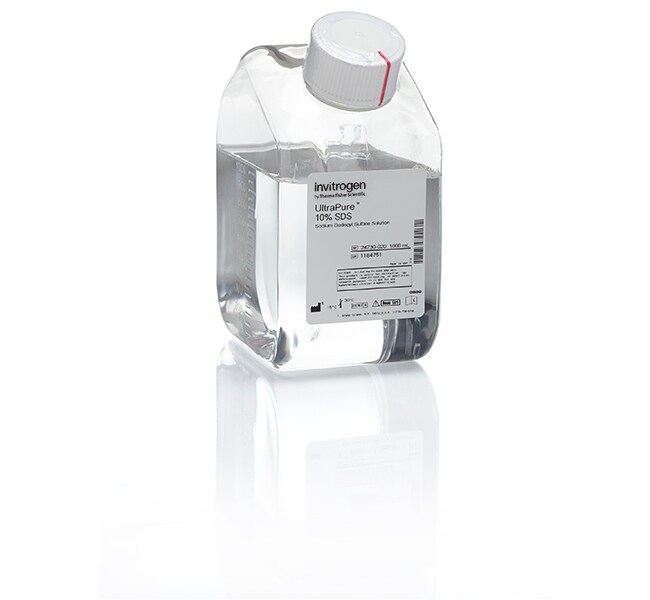
Solution SDS UltraPure™, 10 %
La solution SDS UltraPure™ à 10 % est une solution aqueuse prémélangée contenant 10 % de dodécylsulfate de sodium (SDS).Afficher plus
Have Questions?
Modifier l'affichage

| Référence | Quantité |
|---|---|
| 24730020 | 1 litre |
| 15553027 | 4 x 100 mL |
Référence 24730020
Prix (EUR)
184,65
Online Exclusive
215,00Économisez 30,35 (14%)
Each
Quantité:
1 litre
Prix (EUR)
184,65
Online Exclusive
215,00Économisez 30,35 (14%)
Each
La solution SDS UltraPure™ à 10 % est une solution aqueuse prémélangée contenant 10 % de dodécylsulfate de sodium (SDS). SDS est un dénaturant protéique utilisé dans l’électrophorèse sur gel de polyacrylamide pour définir le poids moléculaire. Elle est également utilisée pour dissocier les complexes acides nucléiques-protéines dans les protocoles d’extraction d’ADN, pour perturber les membranes cellulaires et pour préparer des solutions de préhybridation et d’hybridation La solution SDS UltraPure™ à 10 % est filtrée et prête à l’emploi.
Usage exclusivement réservé à la recherche. Ne pas utiliser pour des procédures de diagnostic.
Spécifications
Concentration0,1
À utiliser avec (application)Électrophorèse sur gel et transfert des acides nucléiques
FormeLiquide
Quantité1 litre
Type de réactifSDS
Conditions d’expéditionTempérature ambiante
Gamme de produitsUltraPure
Type de produitSolution SDS
Unit SizeEach
Contenu et stockage
1 flacon contenant 1 l de SDS ultra-pure à une concentration de 10 % (p/v). Conserver à température ambiante.
Foire aux questions (FAQ)
Why do solutions containing SDS form precipitates?
Citations et références (6)
Citations et références
Abstract
Diversity of human small intestinal Streptococcus and Veillonella populations.
Journal:FEMS Microbiol Ecol
PubMed ID:23614882
'Molecular and cultivation approaches were employed to study the phylogenetic richness and temporal dynamics of Streptococcus and Veillonella populations in the small intestine. Microbial profiling of human small intestinal samples collected from four ileostomy subjects at four time points displayed abundant populations of Streptococcus spp. most affiliated with S. salivarius, S. thermophilus,
Determine the effect of p53 on chemosensitivity.
Journal:Methods Mol Biol
PubMed ID:23150441
'The p53 tumor suppressor protein plays a central role in mediating the cellular response to a variety of stresses. Activation of p53 signaling will trigger cell cycle arrest or apoptosis in normal cells, depending on such factors as cell type and genetic context. The ability of a cell to circumvent
Visualization of fas-mediated death-inducing signaling complex formation by immunoprecipitation.
Journal:Methods Mol Biol
PubMed ID:23397387
The prototypical death receptor Fas (also known as CD95 or Apo-1) plays an essential role in the maintenance of lymphocyte homeostasis. Propagation of cell death through Fas relies on the formation of a multiprotein complex at the receptor level known as the death-inducing signaling complex (DISC). Here, we describe an
Collagen I confers gamma radiation resistance.
Journal:Appl Radiat Isot
PubMed ID:22705234
The effect of collagen on the response of somatomammotroph tumor cells (GH3) to gamma, radiation therapy was studied in vitro. After incubating confluent GH3 cell monolayers in a serum-free, maintaining medium, either with or without collagen, the monolayers were irradiated with 137Cs, gamma radiation. Collagen reduces cell mortality via ERK1/2
Microarray-based CGH and copy number analysis of FFPE samples.
Journal:Methods Mol Biol
PubMed ID:21370011
Over the past decade, utilization of microarray technology has flourished in biomedical research. It has evolved rapidly into a revolutionary tool that offers deeper insight into the molecular basis associated with complex diseases, especially in the field of cancer. Specifically, array-based Comparative Genomic Hybridization (aCGH) permits the detection of genome-wide