Search


Citations et références (1122)
Applied Biosystems™
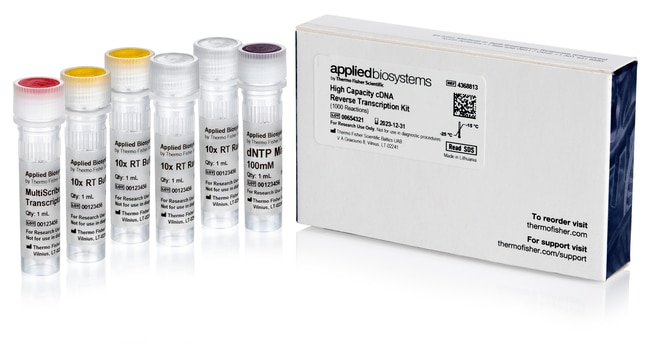
Kit haute capacité de transcription inverse d’ADNc
Le kit de transcription inverse d’ADNc haute capacité contient tous les composants nécessaires à la conversion quantitative de 2 µgAfficher plus
Have Questions?
Modifier l'affichage

| Référence | Comprend | Nbre de réactions |
|---|---|---|
| 4368813 | Kit only | 1 000 réactions |
| 4368814 | Kit only | 200 réactions |
| 4374966 | Kit with Rnase Inhibitor | 200 réactions |
| 4374967 | Kit with Rnase Inhibitor | 1 000 réactions |
Référence 4368813
Prix (EUR)
1 641,65
線上優惠
2 345,00Économisez 703,35 (30%)
Each
Comprend:
Kit only
Nbre de réactions:
1 000 réactions
Prix (EUR)
1 641,65
線上優惠
2 345,00Économisez 703,35 (30%)
Each
Le kit de transcription inverse d’ADNc haute capacité contient tous les composants nécessaires à la conversion quantitative de 2 µg d’ARN total maximum en ADNc premier brin, en une seule réaction de 20 µl. Le kit de transcription inverse d’ADNc haute capacité permet d’obtenir un ADNc premier brin de très bonne qualité de 0,02 à 2 µg d’ARN total. Les réactions peuvent être mises à l’échelle à hauteur de 100 µl pour générer 10 µg d’ADNc à partir d’une seule réaction. Les applications en aval incluent la PCR en temps réel, la PCR standard et les microréseaux. Le kit est idéal pour générer des archives d’ADNc.
Les caractéristiques de ce kit sont les suivantes :
• Amplification de cible linéaire pour la PCR en temps réel
• Rendements et précision supérieurs à ceux des autres kits de synthèse d’ADNc pour un coût bien inférieur
• Gamme dynamique 10 fois supérieure à celle des autres kits
Testé de manière approfondie avec une variété de modèles
La synthèse quantitative premier brin de toutes les espèces d’ARN est réalisée à l’aide d’amorces aléatoires. Le kit a été amplement testé avec une variété de modèles d’ARN, notamment les cibles riches en GC et en AU et les ARN exprimés en niveaux bas. L’ARNc peut aussi être efficacement généré à partir de transcriptions in vitro d’ADNc.
Les caractéristiques de ce kit sont les suivantes :
• Amplification de cible linéaire pour la PCR en temps réel
• Rendements et précision supérieurs à ceux des autres kits de synthèse d’ADNc pour un coût bien inférieur
• Gamme dynamique 10 fois supérieure à celle des autres kits
Testé de manière approfondie avec une variété de modèles
La synthèse quantitative premier brin de toutes les espèces d’ARN est réalisée à l’aide d’amorces aléatoires. Le kit a été amplement testé avec une variété de modèles d’ARN, notamment les cibles riches en GC et en AU et les ARN exprimés en niveaux bas. L’ARNc peut aussi être efficacement généré à partir de transcriptions in vitro d’ADNc.
Usage exclusivement réservé à la recherche. Ne pas utiliser pour des procédures de diagnostic.
Spécifications
Type de produit finalADNc premier brin
FormatKit
ComprendKit only
Nbre de réactions1 000 réactions
Quantité1 Ea.
Format de réactionComposants séparés
Type de réactifTranscription inverse
Transcriptase inverseMultiScribe
Activité de la ribonucléase HOui
Conditions d’expéditionNeige carbonique
Taille (produit final)7 kb
Matériau de départARN
TechniqueTranscription inverse
Concentration50 U/μl
À utiliser avec (application)Real Time PCR (qPCR), RT-PCR
Vitesse de réaction120 min
Unit SizeEach
Contenu et stockage
• 2 x 1 ml de tampon RT 10X
• 2 x 1 ml d’amorces aléatoires RT 10X
• 1 x 1 ml de mélange dNTP 25X (100 mM)
• 1 x 1 ml de transcriptase inverse MultiScribe (50 U/μl)
Conserver entre -15°C et -25°C.
• 2 x 1 ml d’amorces aléatoires RT 10X
• 1 x 1 ml de mélange dNTP 25X (100 mM)
• 1 x 1 ml de transcriptase inverse MultiScribe (50 U/μl)
Conserver entre -15°C et -25°C.
Foire aux questions (FAQ)
Which kit should I use for the reverse transcription step for TaqMan Pri-miRNA assays (Cat. No. 4427012)?
What is the concentration of the random primers in the High-Capacity cDNA Reverse Transcription Kit (Cat. no. 4368813)?
Is the 25X 100 mM dNTP Mix included in the High Capacity cDNA Reverse Transcription Kit (Cat. No. 4368813, 4368814) 100 mM each or 100 mM combined?
Citations et références (1122)
Citations et références
Abstract
Hyaluronan-CD44-ERK1/2 regulate human aortic smooth muscle cell motility during aging.
Journal:The Journal of biological chemistry
PubMed ID:18077444
Increased hepatobiliary clearance of unconjugated thyroxine determines DMP 904-induced alterations in thyroid hormone homeostasis in rats.
Journal:Toxicological sciences : an official journal of the Society of Toxicology
PubMed ID:15673846
4-(3-pentylamino)-2,7-dimethyl-8-(2-methyl-4-methoxyphenyl)-pyrazolo-[1,5-a]-pyri midine (DMP 904) is a potent and selective antagonist of corticotropin releasing factor receptor-1 (CRF1 receptor) with an efficacious anxiolytic profile in preclinical animal models. In subchronic toxicity studies in Sprague-Dawley rats, DMP 904 produced thyroid follicular cell hypertrophy and hyperplasia, and a low incidence of follicular cell
Somatic cell plasticity and Niemann-Pick type C2 protein: fibroblast activation.
Journal:J Biol Chem
PubMed ID:21084287
A growing body of evidence points toward activated fibroblasts, also known as myofibroblasts, as one of the leading mediators in several major human pathologies including proliferative fibrotic disorders, invasive tumor growth, rheumatoid arthritis, and atherosclerosis. Niemann-Pick Type C2 (NPC2) protein has been recently identified as a product of the second
TGF-beta regulates miR-206 and miR-29 to control myogenic differentiation through regulation of HDAC4.
Journal:J Biol Chem
PubMed ID:21324893
MicroRNAs (miRs) are emerging as prominent players in the regulation of many biological processes, including myogenic commitment and skeletal muscle formation. Members of the TGF-beta family can influence the proliferation and myogenic differentiation of cells, although it is presently not clear what role miRNAs play in the TGF-beta-mediated control of
Disordered macrophage cytokine secretion underlies impaired acute inflammation and bacterial clearance in Crohn's disease.
Journal:J Exp Med
PubMed ID:19652016
The cause of Crohn's disease (CD) remains poorly understood. Counterintuitively, these patients possess an impaired acute inflammatory response, which could result in delayed clearance of bacteria penetrating the lining of the bowel and predispose to granuloma formation and chronicity. We tested this hypothesis in human subjects by monitoring responses to