Search

Thermo Scientific™
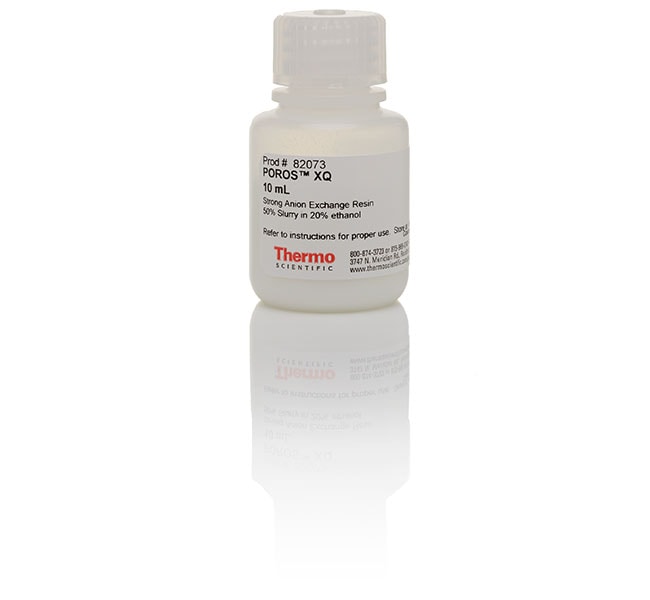
POROS™ XQ Strong Anion Exchange Resin
La résine dʼéchange dʼanions forts POROS™ XQ est une résine haute résolution, haute capacité de nouvelle génération, tolérante au sel,Afficher plus
Have Questions?
Modifier l'affichage

| Référence | Volume (métrique) |
|---|---|
| 82073 | 10 ml |
| 82074 | 50 ml |
Référence 82073
Prix (EUR)
263,00
Each
Volume (métrique):
10 ml
Prix (EUR)
263,00
Each
La résine dʼéchange dʼanions forts POROS™ XQ est une résine haute résolution, haute capacité de nouvelle génération, tolérante au sel, qui permet une capacité de liaison dynamique >140 mg/ml en présence de NaCl jusquʼà 6,6 mS/cm, tout en offrant des performances de séparation exceptionnelles. Amélioration majeure de la performance des échangeurs dʼanions traditionnels, la résine POROS XQ établit la norme pour la chromatographie échangeuse dʼanions forts dans les modes de fonctionnement à liaison et en éluant ou à flux continu.
Les caractéristiques de la résine POROS XQ comprennent :
• Capacité de liaison dynamique permettant de réduire la taille des colonnes, l’encombrement, l’utilisation de l’eau et du tampon et le cycle
• Haute résolution permettant d’améliorer le rendement et la pureté des produits, pour finalement optimiser le coût des marchandises pour la molécule produite
• Tolérance robuste au sel permettant une flexibilité accrue de la conception de traitement et une rationalisation du flux de traitement
• Faible pression de retour de fonctionnement et pression linéaire par rapport aux réponses de flux conduisant une évolutivité flexible
• Microbille polymérique rigide avec chimie de surface covalente pour une manipulation et un emballage plus faciles, et une stabilité physique et chimique supérieure permettant un procédé de purification en aval plus robuste
Capacité de liaison dynamique
La résine POROS XQ offre une capacité de liaison élevée de plus de 140 mg/ml à 5 % de percée, dans une large gamme de conditions de traitement, avec une capacité de liaison supérieure sur une large gamme de conditions de pH et de salinité. Une capacité de liaison dynamique plus élevée a été obtenue en optimisant la structure des pores de la microbille de base et la chimie de surface.
Haute résolution
Grâce à une taille de particules optimisée de 50 µm, la résine POROS XQ maintient la capacité de résolution supérieure des résines POROS, en surmontant les niveaux d’impuretés difficiles associés aux procédés de titration élevés. La résolution est constante sur un large éventail de débits d’exploitation linéaires.
Tolérance robuste au sel
La résine POROS XQ a une capacité protéique élevée et constante dans une large gamme de concentrations de sel jusqu’à 140 mg/mL à 50 mM de NaCl (conductivité 6,6 mS/cm). La capacité de charger des colonnes sous une conductivité plus élevée réduit ou aide à éliminer la dilution des flux d’alimentation des colonnes ou l’élimination des opérations unitaires, telles que la filtration de flux tangentiel.
Les caractéristiques de la résine POROS XQ comprennent :
• Capacité de liaison dynamique permettant de réduire la taille des colonnes, l’encombrement, l’utilisation de l’eau et du tampon et le cycle
• Haute résolution permettant d’améliorer le rendement et la pureté des produits, pour finalement optimiser le coût des marchandises pour la molécule produite
• Tolérance robuste au sel permettant une flexibilité accrue de la conception de traitement et une rationalisation du flux de traitement
• Faible pression de retour de fonctionnement et pression linéaire par rapport aux réponses de flux conduisant une évolutivité flexible
• Microbille polymérique rigide avec chimie de surface covalente pour une manipulation et un emballage plus faciles, et une stabilité physique et chimique supérieure permettant un procédé de purification en aval plus robuste
Capacité de liaison dynamique
La résine POROS XQ offre une capacité de liaison élevée de plus de 140 mg/ml à 5 % de percée, dans une large gamme de conditions de traitement, avec une capacité de liaison supérieure sur une large gamme de conditions de pH et de salinité. Une capacité de liaison dynamique plus élevée a été obtenue en optimisant la structure des pores de la microbille de base et la chimie de surface.
Haute résolution
Grâce à une taille de particules optimisée de 50 µm, la résine POROS XQ maintient la capacité de résolution supérieure des résines POROS, en surmontant les niveaux d’impuretés difficiles associés aux procédés de titration élevés. La résolution est constante sur un large éventail de débits d’exploitation linéaires.
Tolérance robuste au sel
La résine POROS XQ a une capacité protéique élevée et constante dans une large gamme de concentrations de sel jusqu’à 140 mg/mL à 50 mM de NaCl (conductivité 6,6 mS/cm). La capacité de charger des colonnes sous une conductivité plus élevée réduit ou aide à éliminer la dilution des flux d’alimentation des colonnes ou l’élimination des opérations unitaires, telles que la filtration de flux tangentiel.
Usage exclusivement réservé à la recherche. Ne pas utiliser pour des procédures de diagnostic.
Spécifications
À utiliser avec (application)Chromatographie échangeuse dʼanions forts
FormatMicrobille Poros
Gamme de produitsPOROS
Cible de purificationProtéine
Quantité10 mL
Conditions d’expéditionTempérature ambiante
Composants standardPolyéthylèneimine quaternisée
Phase stationnairePolyéthylèneimine quaternisée
Volume (métrique)10 ml
TypeRésine échangeuse dʼanions forts XQ
Unit SizeEach
Contenu et stockage
Conserver au réfrigérateur (2–8 °C).