Search
 Recherche par élément
 Recherche par structure

Thermo Scientific Chemicals
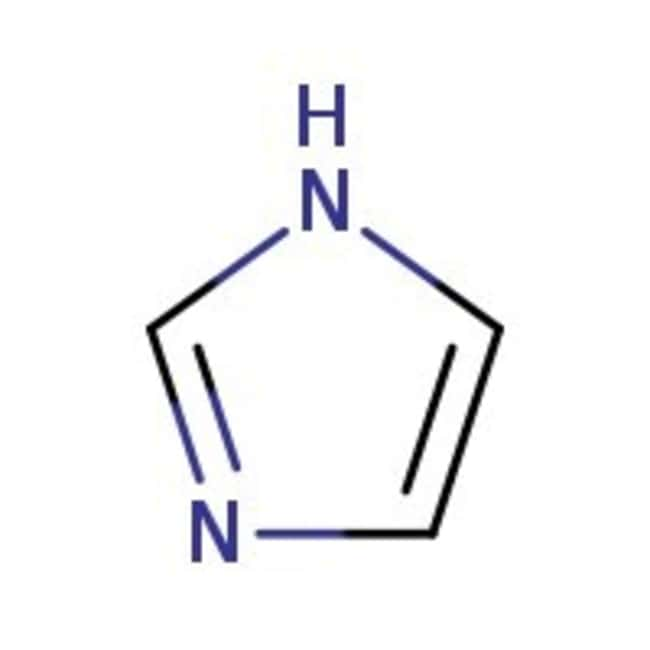
Imidazole, 99 %, Thermo Scientific Chemicals
CAS: 288-32-4 | C3H4N2 | 68.08 g/mol
Have Questions?
Modifier l'affichage


Référence A10221.22
également connu sous le numéro A10221-22
Prix (EUR)
28,70
Each
Quantité:
100 g
Prix (EUR)
28,70
Each
Identifiants chimiques
CAS288-32-4
IUPAC Name1H-imidazole
Molecular FormulaC3H4N2
InChI KeyRAXXELZNTBOGNW-UHFFFAOYSA-N
SMILESN1C=CN=C1
Voir plus
Spécifications Fiche de spécifications
Fiche de spécificationsCommentPurchased in the U.K. and in other countries
Water Content (Karl Fischer Titration)≤0.5%
Assay from Suppliers CofA≥98.5 to ≤101.5% (Acidimetric) (non-U.K. specification)
Appearance (Color)White to pale cream to pale yellow
FormCrystals or flakes or powder or crystalline flakes or crystalline powder
Voir plus
Imidazole is used as a buffer in the range of pH 6.2-7.8. It is also an histamine antagonist. It acts as a chelator and forms complexes with various divalent cations. It is used as a corrosion inhibitor on certain transition metals such as copper. Its derivatives, like polybenzimidazole (PBI), act as fire retardants. It finds application in photography and electronics. Imidazole salts are used as ionic liquids and precursors to stable carbenes. Imidazole derivatives like ketoconazole, miconazole and clotrimazole are involved in the treatment of various systemic fungal infections. It is a part of the theophylline molecule, present in tea leaves and coffee beans, which stimulates the central nervous system.
This Thermo Scientific Chemicals brand product was originally part of the Alfa Aesar product portfolio. Some documentation and label information may refer to the legacy brand. The original Alfa Aesar product / item code or SKU reference has not changed as a part of the brand transition to Thermo Scientific Chemicals.
Applications
L’imidazole est utilisé comme tampon dans la plage de pH 6,2-7,8. Il s’agit également d’un antagoniste de l’histamine. Il agit comme agent chélateur et forme des complexes avec divers cations bivalents. Il est utilisé comme inhibiteur de la corrosion pour certains métaux de transition tel que le cuivre. Ses dérivés, comme le polybenzimidazole (PBI), agissent comme des agents ignifuges. Il a diverses applications en photographie et en électronique. Les sels d’imidazole sont utilisés comme liquides ioniques et précurseurs des carbènes stables. Les dérivés d’imidazole comme le kétoconazole, le miconazole et le clotrimazole sont impliqués dans le traitement de diverses infections fongiques systémiques. C’est un constituant de la théophylline, une molécule présente dans les feuilles de thé et les grains de café, qui stimule le système nerveux central.
Solubilité
Miscible avec l’eau, l’éthanol, l’éther, l’acétone, le chloroforme, la pyridine et le méthanol. Légèrement miscible avec le benzène et l’éther de pétrole.
Remarques
Incompatible avec les acides, les anhydrides d’acides et les agents oxydants forts.
L’imidazole est utilisé comme tampon dans la plage de pH 6,2-7,8. Il s’agit également d’un antagoniste de l’histamine. Il agit comme agent chélateur et forme des complexes avec divers cations bivalents. Il est utilisé comme inhibiteur de la corrosion pour certains métaux de transition tel que le cuivre. Ses dérivés, comme le polybenzimidazole (PBI), agissent comme des agents ignifuges. Il a diverses applications en photographie et en électronique. Les sels d’imidazole sont utilisés comme liquides ioniques et précurseurs des carbènes stables. Les dérivés d’imidazole comme le kétoconazole, le miconazole et le clotrimazole sont impliqués dans le traitement de diverses infections fongiques systémiques. C’est un constituant de la théophylline, une molécule présente dans les feuilles de thé et les grains de café, qui stimule le système nerveux central.
Solubilité
Miscible avec l’eau, l’éthanol, l’éther, l’acétone, le chloroforme, la pyridine et le méthanol. Légèrement miscible avec le benzène et l’éther de pétrole.
Remarques
Incompatible avec les acides, les anhydrides d’acides et les agents oxydants forts.
RUO – Research Use Only
Références générales :
- Catalyseur nucléophile pour de nombreuses réactions d’acylation et de silylation, comparez 4-(Diméthyle amino) pyridine, A13016.
- Pour une utilisation dans : la silylation des 1,3-dicétones, voir Hexaméthyl disilazane, Une introduction de 15139; des groupes TBDMS et TBPD ; voir : tert-Butyle diméthyle chlorosilane, A13064 et tert-Butyle diphényle chlorosilane, A12721, respectivement.
- En association avec la triphénylphosphine et l’iode, les diols vicinaux sont convertis en alcènes : Synthèse, 469 (1979), et alcools aux iodures d’alkyle : Synthé. Commun., 20, 1473 (1990).
- Avec 2 moles d’un halogénure d’aroyle, on obtient, après hydrolyse, d’excellents rendements de 2-aroylimidazoles : Synthèse 675 (1978).
- Sankar, M. ; Ajithkumar, T. G. ; Sankar, G. ; Manikandan, P. Supported imidazole as heterogeneous catalyst for the synthesis of cyclic carbonates from epoxides and CO 2. Catal. Commun. 2015, 59, 201-205.
- Hart, K. R. ; Sottos, N. R. ; White, S. R. Repeatable self-healing of an epoxy matrix using imidazole initiated polymerization. Polymère 2015, 67, 174-184.