Search
 Recherche par élément
 Recherche par structure


Thermo Scientific Chemicals
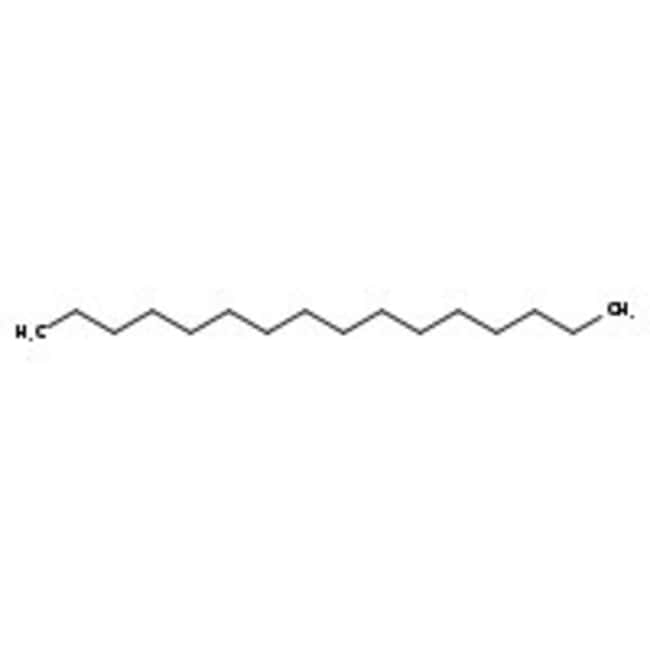
N-hexadécane, 99 %, Thermo Scientific Chemicals
CAS: 544-76-3 | C16H34 | 226.448 g/mol
Have Questions?
Modifier l'affichage


Référence A10322.AE
également connu sous le numéro A10322-AE
Prix (EUR)
49,80
Each
Quantité:
100 mL
Prix (EUR)
49,80
Each
Identifiants chimiques
CAS544-76-3
IUPAC Namehexadecane
Molecular FormulaC16H34
InChI KeyDCAYPVUWAIABOU-UHFFFAOYSA-N
SMILESCCCCCCCCCCCCCCCC
Voir plus
Spécifications Fiche de spécifications
Fiche de spécificationsAppearance (Color)Clear colorless
Assay (GC)≥98.5%
CommentMaterial sourced in the U.S. and in other countries
Identification (FTIR)Conforms (non-U.S. sourced material)
FormFused solid or clear liquid as melt
Voir plus
Hexadecane is use in the recovery of valuable amines by means of distillation from aqueous alkanolamine solutions, which are extensively used in the gas-processing industries.1
1Abdi, M. A.; Meisen, A. Mutual Solubility of Hexadecane with Diethanolamine and with Bis(hydroxyethyl)piperazine. J. Chem. Eng. Data 1998, 43 (2), 138-142.
n-Hexadecane serves as a reference for other fuel mixtures and is assigned cetane number of 100; used as shorthand for cetane number, an indicator of the combustion speed of diesel fuel. Hexadecane is used in the preparation of emulsions; also used as a substrate for the production of biosurfactants. n-Hexadecane has been found useful in the identification of the wheat seed protein CM3 as a highly active emulsifier. Superamphiphobicity on polymers can be studied with hexadecane immersion tests. Shape-stabilized phase change material (SSPCM), prepared using hexadecane as a PCM, into xGnP as a supporting material, has been demonstrated to have the potential to be used in developing building materials with improved thermal energy storage charecteristics.
This Thermo Scientific Chemicals brand product was originally part of the Alfa Aesar product portfolio. Some documentation and label information may refer to the legacy brand. The original Alfa Aesar product / item code or SKU reference has not changed as a part of the brand transition to Thermo Scientific Chemicals.
Applications
Lʼhexadécane est utilisé dans la récupération dʼamines précieuses par distillation à partir de solutions aqueuses dʼalcanolamine, qui sont largement utilisées dans les industries de traitement du gaz.1
1Abdi, M. A. ; Meisen, A. Mutual Solubility of Hexadecane with Diethanolamine and with Bis(hydroxyethyl)piperazine. J. Chem. Eng. Data 1998, 43 (2), 138-142.Lʼhexadécane N sert de référence pour dʼautres mélanges de carburant et se voit attribuer le numéro de cétane de 100 ; utilisé comme raccourci pour le numéro de cétane, un indicateur de la vitesse de combustion du carburant diesel. Lʼhexadécane est utilisé dans la préparation dʼémulsions ; également utilisé comme substrat pour la production de biosurfactants. Le N-hexadécane a été trouvé utile dans lʼidentification de la protéine CM3 de semence de blé comme émulsifiant hautement actif. La superamphiphobicité sur les polymères peut être étudiée à lʼaide de tests dʼimmersion en hexadécane. Il a été démontré que le matériau de changement de phase stabilisé en forme (SSPCM), préparé à lʼaide de lʼhexadécane comme PCM, en xGnP comme matériau de support, pouvait être utilisé dans le développement de matériaux de construction avec une amélioration de lʼarchitecture de stockage dʼénergie thermique.
Remarques
Stable. Le cétane peut sʼenflammer très facilement sous compression. Incompatible avec les agents oxydants forts.
Lʼhexadécane est utilisé dans la récupération dʼamines précieuses par distillation à partir de solutions aqueuses dʼalcanolamine, qui sont largement utilisées dans les industries de traitement du gaz.1
1Abdi, M. A. ; Meisen, A. Mutual Solubility of Hexadecane with Diethanolamine and with Bis(hydroxyethyl)piperazine. J. Chem. Eng. Data 1998, 43 (2), 138-142.Lʼhexadécane N sert de référence pour dʼautres mélanges de carburant et se voit attribuer le numéro de cétane de 100 ; utilisé comme raccourci pour le numéro de cétane, un indicateur de la vitesse de combustion du carburant diesel. Lʼhexadécane est utilisé dans la préparation dʼémulsions ; également utilisé comme substrat pour la production de biosurfactants. Le N-hexadécane a été trouvé utile dans lʼidentification de la protéine CM3 de semence de blé comme émulsifiant hautement actif. La superamphiphobicité sur les polymères peut être étudiée à lʼaide de tests dʼimmersion en hexadécane. Il a été démontré que le matériau de changement de phase stabilisé en forme (SSPCM), préparé à lʼaide de lʼhexadécane comme PCM, en xGnP comme matériau de support, pouvait être utilisé dans le développement de matériaux de construction avec une amélioration de lʼarchitecture de stockage dʼénergie thermique.
Remarques
Stable. Le cétane peut sʼenflammer très facilement sous compression. Incompatible avec les agents oxydants forts.
RUO – Research Use Only
Références générales :
- Pullabhotla, V. S. R. R. ; Southway, C. ; Jonnalagadda, S. B. Oxydation du n-hexadécane avec des zéolites microporeuses et de l’ozone chargées/ancrées à l’uranyle. Catal. Commun. 2008, 9 (9), 1902-1912.
- Iori Shimada, I. ; Imai, R. ; Hayasaki, Y. ; Fukunaga, H. ; Takahashi, N. ; Takatsuka, T. Augmentation de la valeur d’octane lors du craquage catalytique de n-hexadécane avec ajout de zéolite de type structural BEA. Catalyseurs 2015, 5, 703-717.
- Kim, S. ; Chang, S. J. ; Chung, O. ; Jeong, S. G. ; Kim, S. Caractéristiques thermiques du mortier contenant un hexadécane/SSPCM xGnP et comportements de stockage d’énergie des enveloppes intégrées à des composites de stockage thermique améliorés pour des bâtiments écoénergétiques. Construction énergétique. 2014, 70, 472-479.