Search
 Recherche par élément
 Recherche par structure


Thermo Scientific Chemicals
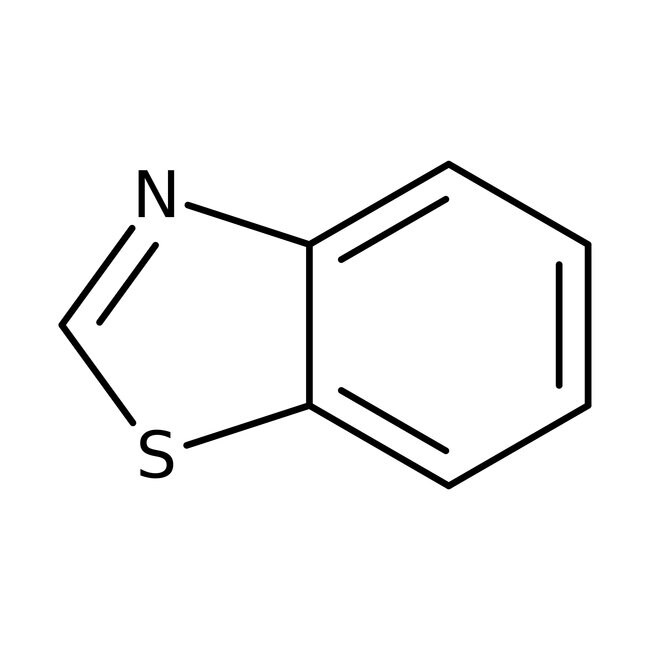
Benzothiazole, 97 %, Thermo Scientific Chemicals
CAS: 95-16-9 | C7H5NS | 135.184 g/mol
Have Questions?
Modifier l'affichage


Référence A10380.0B
également connu sous le numéro A10380-0B
Prix (EUR)
133,00
Each
Quantité:
1000 g
Prix (EUR)
133,00
Each
Identifiants chimiques
CAS95-16-9
IUPAC Name1,3-benzothiazole
Molecular FormulaC7H5NS
InChI KeyIOJUPLGTWVMSFF-UHFFFAOYSA-N
SMILESS1C=NC2=CC=CC=C12
Voir plus
Spécifications Fiche de spécifications
Fiche de spécificationsAppearance (Color)Clear colorless to dark yellow to yellow to dark brown to brown
Assay (GC)≥96.0%
Identification (FTIR)Conforms
Refractive Index1.6405-1.6455 @ 20?C
FormLiquid
This Thermo Scientific Chemicals brand product was originally part of the Alfa Aesar product portfolio. Some documentation and label information may refer to the legacy brand. The original Alfa Aesar product / item code or SKU reference has not changed as a part of the brand transition to Thermo Scientific Chemicals.
Suitable for battery materials development.
Applications
Il s’agit d’un équivalent carbonyle intéressant qui réagit avec les aldéhydes ou les cétones pour générer des composés α-hydroxy-carbonyle. Le benzothiazole est utilisé comme intermédiaire chimique dans la synthèse organique. C’est un précurseur d’accélérateurs du caoutchouc et un composant de colorants cyanine. Il est également utilisé comme substance aromatisante. Il a été utilisé comme agent antimicrobien dans les semelles de chaussures pour athlètes. Il est également utilisé comme arôme, agent antimicrobien et composant de colorants cyanine. Ses dérivés sont utilisés comme accélérateurs du caoutchouc.
Solubilité
Légèrement soluble dans l’eau. Soluble dans l’alcool et le disulfure de carbone
Remarques
Conserver à l’abri des oxydants. Gardez le récipient bien fermé et placez-le dans un endroit frais, sec et bien ventilé.
Il s’agit d’un équivalent carbonyle intéressant qui réagit avec les aldéhydes ou les cétones pour générer des composés α-hydroxy-carbonyle. Le benzothiazole est utilisé comme intermédiaire chimique dans la synthèse organique. C’est un précurseur d’accélérateurs du caoutchouc et un composant de colorants cyanine. Il est également utilisé comme substance aromatisante. Il a été utilisé comme agent antimicrobien dans les semelles de chaussures pour athlètes. Il est également utilisé comme arôme, agent antimicrobien et composant de colorants cyanine. Ses dérivés sont utilisés comme accélérateurs du caoutchouc.
Solubilité
Légèrement soluble dans l’eau. Soluble dans l’alcool et le disulfure de carbone
Remarques
Conserver à l’abri des oxydants. Gardez le récipient bien fermé et placez-le dans un endroit frais, sec et bien ventilé.
RUO – Research Use Only
Références générales :
- Nawrocki ST, et al. Comparative aquatic toxicity evaluation of 2-(thiocyanomethylthio)benzothiazole and selected degradation products using Ceriodaphnia dubia. Arch. Environ. Contam. Toxicol.,2005,48 (3), 344-350.
- Asimakopoulos AG, et al. Occurrence and removal efficiencies of benzotriazoles and benzothiazoles in a wastewater treatment plant in Greece. The Science of the total environment.,2013,452-453163-171.
- n-BuLi gives the 2-lithio-derivative, stable below -50°, which behaves as a formyl anion equivalent, reacting with aldehydes and ketones. The derived alcohols have been transformed into various useful products, e.g. ɑ-hydroxy ketones: Tetrahedron Lett., 5, 9, 13, (1978); Bull. Chem. Soc. Jpn., 61, 3637 (1988):
- Le dérivé lithio peut également être acylé avec des esters, lactones, amides ou nitriles. Dans ces applications, le benzothiazole serait supérieur au 1,3-dithiane, plus connu sous le nom de synthon d’anion formyle.
- Voir aussi 2-(Trimethyl silyl) benzothiazole, L11625, et 2-(Trimethyl silyl) thiazole, B21903.
- La réaction du dérivé lithio à basse température avec le PCl3 donne, comme produit principal, le 2,2'-bibenzothiazole au lieu de la phosphine tertiaire attendue : Hétérocycles, 30, 347 (1990). Le POCl3 ou le SOCl2 favorisent également la réaction de couplage symétrique : Heteroatom. Chem, 5, 409 (1994).