Search
 Recherche par élément
 Recherche par structure


Thermo Scientific Chemicals
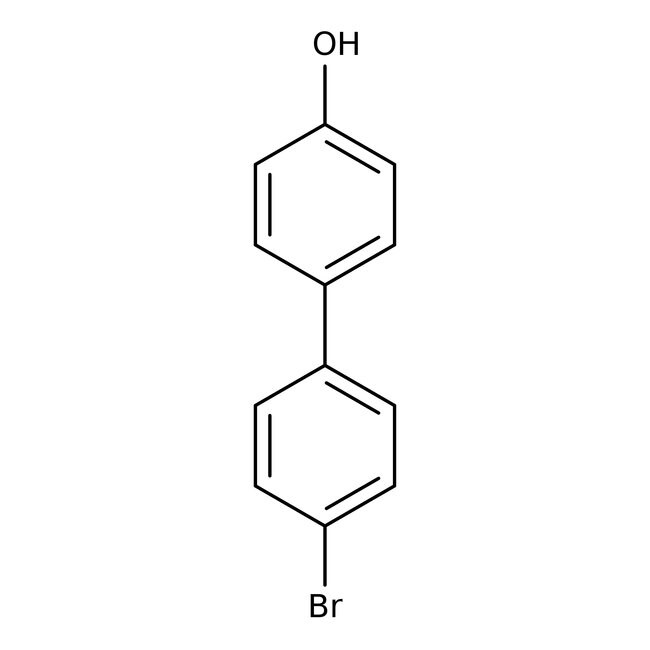
4-Bromo-4’-hydroxybiphényle, 98 %, Thermo Scientific Chemicals
CAS: 29558-77-8 | C12H9BrO | 249.107 g/mol
Have Questions?
Modifier l'affichage


Référence A10819.22
également connu sous le numéro A10819-22
Prix (EUR)
774,00
Each
Quantité:
100 g
Prix (EUR)
774,00
Each
Identifiants chimiques
CAS29558-77-8
IUPAC Name4'-bromo-[1,1'-biphenyl]-4-ol
Molecular FormulaC12H9BrO
InChI KeyARUBXNBYMCVENE-UHFFFAOYSA-N
SMILESOC1=CC=C(C=C1)C1=CC=C(Br)C=C1
Voir plus
Spécifications Fiche de spécifications
Fiche de spécificationsAppearance (Color)White to cream
FormPowder
Assay (Silylated GC)≥97.5%
Melting Point (clear melt)164.0-170.0°C
A biphenyl starting material. 4-Bromo-(1,1-biphenyl)-4-ol is a useful intermediate. Vinylation of 4-bromo-4-hydroxybiphenyl and ethyl acrylate using Pd (OAc) 2/PPh 3 catalyst was studied. Ethyl 4-(4-hydroxyphenyl) cinnamate was formed as the vinylation product, while, 4-hydroxybiphenyl and ethyl cinnamate were formed as side products. Preparation of 4-cyano-4'-hydroxybiphenyl This was prepared from 4-bromo-4'-benzenesulphonyloxybiphenyl by first hydrolysing it to 4-bromo-4-hydroxybiphenyl using sodium hydroxide dissolved in a mixture of water and dioxan. The syntheses of the Nanocomposite dendrimers based on cyclic phosphazene cores: Amorphous materials, were accomplished by following a modified literature procedure by reacting phosphonitrilic chloride trimer with 4-bromophenol or 4-bromo-4-hydroxybiphenyl, respectively, in the presence of K 2 CO 3 in tetrahydrofuran (THF).
This Thermo Scientific Chemicals brand product was originally part of the Alfa Aesar product portfolio. Some documentation and label information may refer to the legacy brand. The original Alfa Aesar product / item code or SKU reference has not changed as a part of the brand transition to Thermo Scientific Chemicals.
Applications
Un produit de départ de biphényle. Le 4′-bromo-(1,1′-biphényl)-4-ol est un intermédiaire utile. La vinylation du 4-bromo-4′-hydroxybiphényl et de l’acrylate d’éthyle à l’aide du cataclyseur Pd (Oac) 2/Pph 3 a été étudié. Le cinnamate d’éthyle 4-(4′-hydroxyphényl) se forme en tant que produit de vinylation, tandis que le 4-hydroxybiphényle et le cinnamate d’éthyle se forment en tant que produits secondaires. Préparation du 4-cyano-4′-hydroxybiphényl Ce composé a été préparé à partir de 4-bromo-4′-benzènesulphonyloxybiphényl en l’hydrolysant d’abord en 4-bromo-4-hydroxybiphényl à l’aide d’hydroxyde de sodium dissous dans un mélange d’eau et de dioxan. Les synthèses des Nanocomposites dendrimères basées sur des noyaux de phosphazènes cycliques : Les produits amorphes ont été réalisés en suivant une procédure de littérature modifiée en réagissant le trimère du chlorure phosphonitrile avec du 4-bromophénol ou du 4-bromo-4′-hydroxybiphényl, respectivement, en présence de K 2 CO 3 dans le tétrahydrofurane (THF).
Solubilité
Soluble dans l’eau (en partie) et dans le méthanol.
Remarques
Stockez-le dans un endroit frais. Garder le récipient bien fermé dans un endroit sec et bien ventilé. Conserver à l’écart des agents oxydants forts.
Un produit de départ de biphényle. Le 4′-bromo-(1,1′-biphényl)-4-ol est un intermédiaire utile. La vinylation du 4-bromo-4′-hydroxybiphényl et de l’acrylate d’éthyle à l’aide du cataclyseur Pd (Oac) 2/Pph 3 a été étudié. Le cinnamate d’éthyle 4-(4′-hydroxyphényl) se forme en tant que produit de vinylation, tandis que le 4-hydroxybiphényle et le cinnamate d’éthyle se forment en tant que produits secondaires. Préparation du 4-cyano-4′-hydroxybiphényl Ce composé a été préparé à partir de 4-bromo-4′-benzènesulphonyloxybiphényl en l’hydrolysant d’abord en 4-bromo-4-hydroxybiphényl à l’aide d’hydroxyde de sodium dissous dans un mélange d’eau et de dioxan. Les synthèses des Nanocomposites dendrimères basées sur des noyaux de phosphazènes cycliques : Les produits amorphes ont été réalisés en suivant une procédure de littérature modifiée en réagissant le trimère du chlorure phosphonitrile avec du 4-bromophénol ou du 4-bromo-4′-hydroxybiphényl, respectivement, en présence de K 2 CO 3 dans le tétrahydrofurane (THF).
Solubilité
Soluble dans l’eau (en partie) et dans le méthanol.
Remarques
Stockez-le dans un endroit frais. Garder le récipient bien fermé dans un endroit sec et bien ventilé. Conserver à l’écart des agents oxydants forts.
RUO – Research Use Only
Références générales :
- Ashutosh Anant Kelkara ; Taka-aki Hanaoka ; Yoshihiro Kubota ; Yoshihiro Sugi. Palladium catalyzed vinylation of 4-bromo-4'-hydroxybiphenyl. Journal of Molecular Catalysis. 1994, 88 (2), L113-L116.
- Sierra Rayne ; Michael G. Ikonomou ; MacMurray D. Whale. Anaerobic microbial and photochemical degradation of 4,4'-dibromodiphenyl ether. Water Research. 2003, 37(3), 551-560.