Search
 Recherche par élément
 Recherche par structure


Thermo Scientific Chemicals
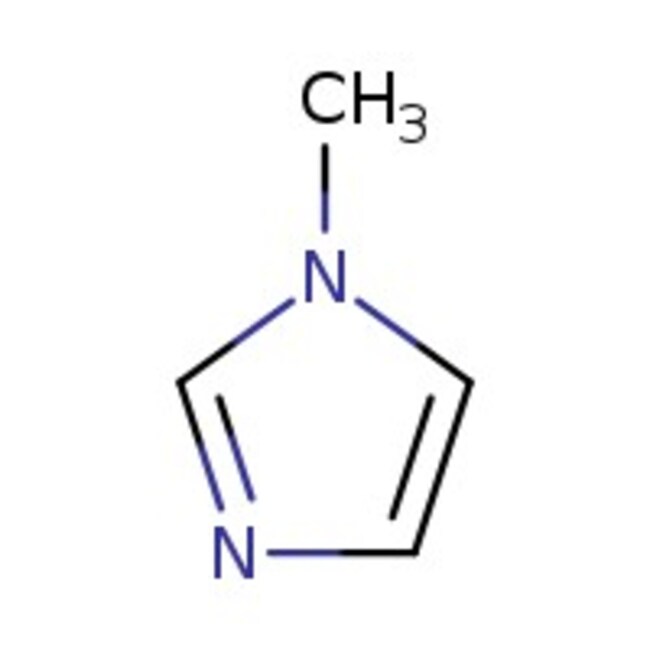
1-Méthylimidazole, 99 %, Thermo Scientific Chemicals
CAS: 616-47-7 | C4H6N2 | 82.11 g/mol
Have Questions?
Modifier l'affichage


Référence A12575.36
également connu sous le numéro A12575-36
Prix (EUR)
146,00
Each
Quantité:
500 g
Prix (EUR)
146,00
Each
Identifiants chimiques
CAS616-47-7
IUPAC Name1-methyl-1H-imidazole
Molecular FormulaC4H6N2
InChI KeyMCTWTZJPVLRJOU-UHFFFAOYSA-N
SMILESCN1C=CN=C1
Voir plus
Spécifications Fiche de spécifications
Fiche de spécificationsAssay (GC)≥98.5%
CommentPurchased in the U.S. and in other countries
Appearance (Color)Clear colorless to yellow
FormLiquid
Identification (FTIR)Conforms (non-U.S. specification)
Voir plus
1-Methylimidazole is used as a precursor for the synthesis of pyrrole-imidazole polyamides, ionic liquids such as 1-butyl-3-methylimidazolium hexafluorophosphate. It is actively involved in removing acid during the production of diethoxyphenylphosphine. It is used as an intermediate in organic synthesis.
This Thermo Scientific Chemicals brand product was originally part of the Alfa Aesar product portfolio. Some documentation and label information may refer to the legacy brand. The original Alfa Aesar product / item code or SKU reference has not changed as a part of the brand transition to Thermo Scientific Chemicals.
Applications
Le 1-méthylimidazole est utilisé comme précurseur pour la synthèse de polyamides de pyrrole-imidazole, de liquides ioniques tels que l’hexafluorophosphate de 1-butyl-3-méthylimidazolium. Il participe activement à l’élimination des acides pendant la production de diéthoxyphénylphosphine. Il est utilisé comme intermédiaire dans la synthèse organique.
Solubilité
Miscible à l’eau.
Remarques
Incompatible avec le dioxyde de carbone et les agents oxydants forts.
Le 1-méthylimidazole est utilisé comme précurseur pour la synthèse de polyamides de pyrrole-imidazole, de liquides ioniques tels que l’hexafluorophosphate de 1-butyl-3-méthylimidazolium. Il participe activement à l’élimination des acides pendant la production de diéthoxyphénylphosphine. Il est utilisé comme intermédiaire dans la synthèse organique.
Solubilité
Miscible à l’eau.
Remarques
Incompatible avec le dioxyde de carbone et les agents oxydants forts.
RUO – Research Use Only
Références générales :
- Base utile pour le couplage de peptides, etc. Voir, par exemple : J. Chem. Soc., Chem. Commun, 2223 , (1995 ). Pour les réactifs peptidiques, voir l’annexe 6 .
- Subit une lithiation en position 2. La réaction du dérivé de Li avec les cétones suivie d’une déshydratation avec l’anhydride acétique est une bonne voie vers les 2-alkylidéneimidazoles : Synthèse 78 (1990). De même, la réaction avec le benzonitrile donne le dérivé de 2-benzoyle, dont le groupe carbonyle subit la méthylénation de Wittig : Synthé. Commun., 20, 321 (1990).
- Réagit avec les chlorures acides, notamment les chloroformates, pour donner des sels de N-acylimidazolium, qui sont des réactifs utiles pour l’acylation, par exemple, des acides aminés : Bull. Soc. Chim. Fr., 1021 (1973).
- Zhang, Y. ; Yin, S. C. ; Lu, J. M. N-Heterocyclic carbene-palladium(II)-1-methylimidazole complex catalyzed allyl-aryl coupling of allylic alcohols with arylboronic acids in neat water. Tetrahedron 2015, 71 (4), 544-549.
- Guan, J. T. ; Song, X. M. ; Zhang, Z. Y. ; Wei, B. M. ; Dai, Z. Q. Catalytic activity of 1-methylimidazole-based phosphine ligands in the palladium-catalyzed Suzuki coupling reaction. Appl. Organomet. Chem. 2015, 29 (2), 87-89.