Search
 Recherche par élément
 Recherche par structure


Thermo Scientific Chemicals
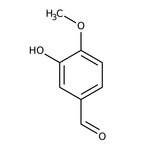
3-hydroxy-4-méthoxybenzaldéhyde, 98 %, Thermo Scientific Chemicals
CAS: 621-59-0 | C8H8O3 | 152.149 g/mol
Have Questions?
Modifier l'affichage


Référence A12866.06
également connu sous le numéro A12866-06
Prix (EUR)
21,70
Each
Quantité:
5 g
Prix (EUR)
21,70
Each
Identifiants chimiques
CAS621-59-0
IUPAC Name3-hydroxy-4-methoxybenzaldehyde
Molecular FormulaC8H8O3
InChI KeyJVTZFYYHCGSXJV-UHFFFAOYSA-N
SMILESCOC1=CC=C(C=O)C=C1O
Voir plus
Spécifications Fiche de spécifications
Fiche de spécificationsFormCrystals or powder or crystalline powder
Melting Point (clear melt)111.0-117.0°C
Assay (GC)≥97.5%
Appearance (Color)White to cream to gray to pale brown
3-Hydroxy-4-methoxybenzaldehyde acts as a precursor for the stereoselective synthesis of the anticancer drug (Z)-combretastatin A-4 and glycitein. It also used as an important raw material for the preparation of morphine. Further, it is involved in the preparation of Schiff- bases by reacting with furan-2-carboxylic acid hydrazide and thiophene-2-carboxylic acid hydrazide. In addition to this, it is used to prepare (Z)-2-(3-hydroxy-4-methoxybenzylidene)-1-azabicyclo[2.2.2]octan-3-one by reacting with with1-azabicyclo[2.2.2]octan-3-one.
This Thermo Scientific Chemicals brand product was originally part of the Alfa Aesar product portfolio. Some documentation and label information may refer to the legacy brand. The original Alfa Aesar product / item code or SKU reference has not changed as a part of the brand transition to Thermo Scientific Chemicals.
Applications
Le 3-hydroxy-4-méthoxybenzaldéhyde agit comme précurseur pour la synthèse stéréosélective du médicament anticancéreux (Z)-combrétastatine A-4 et de la glycitéine. Il a également servi de matière première importante pour la préparation de la morphine. De plus, il participe à la préparation des bases de Schiff en réagissant avec l’hydrazide d’acide furan-2-carboxylique et l’hydrazide d’acide thiophène-2-carboxylique. Il est également utilisé pour préparer le (Z)-2-(3-hydroxy-4-méthoxybenzylidène)-1-azabicyclo[2.2.2]octan-3-one en réagissant avec le 1-azabicyclo[2.2.2]octan-3-one.
Solubilité
Soluble dans l’acétone et le méthanol.
Remarques
Sensible à l’air. Stocker dans un endroit frais. Incompatible avec les agents oxydants forts et les bases fortes.
Le 3-hydroxy-4-méthoxybenzaldéhyde agit comme précurseur pour la synthèse stéréosélective du médicament anticancéreux (Z)-combrétastatine A-4 et de la glycitéine. Il a également servi de matière première importante pour la préparation de la morphine. De plus, il participe à la préparation des bases de Schiff en réagissant avec l’hydrazide d’acide furan-2-carboxylique et l’hydrazide d’acide thiophène-2-carboxylique. Il est également utilisé pour préparer le (Z)-2-(3-hydroxy-4-méthoxybenzylidène)-1-azabicyclo[2.2.2]octan-3-one en réagissant avec le 1-azabicyclo[2.2.2]octan-3-one.
Solubilité
Soluble dans l’acétone et le méthanol.
Remarques
Sensible à l’air. Stocker dans un endroit frais. Incompatible avec les agents oxydants forts et les bases fortes.
RUO – Research Use Only
Références générales :
- Aggarwal, R. L. ; Di Cesca, S. ; Farrar, L. W. ; Shabshelowitz, A. ; Jeys, T. H. Détection sensible et identification des particules d’aérosols d’isovanilline au niveau de concentration massique pg/cm3 à l’aide de la spectroscopie Raman. Aerosol Sci. Tech. 2015, 49 (9), 753-756.
- Vusovich, O. V. ; Lapin, I. N. ; Svetlichnyi, V. A. ; Sul’timova, N. B. ; Tchaikovskaya, O. N. Comparaison de la photolyse de la vanilline et de l’isovanilline dans les solutions aqueuses. Russ. Phys. J. 2014, 56 (11), 1287-1291.