Search
 Recherche par élément
 Recherche par structure

.png-150.jpg)

Thermo Scientific Chemicals
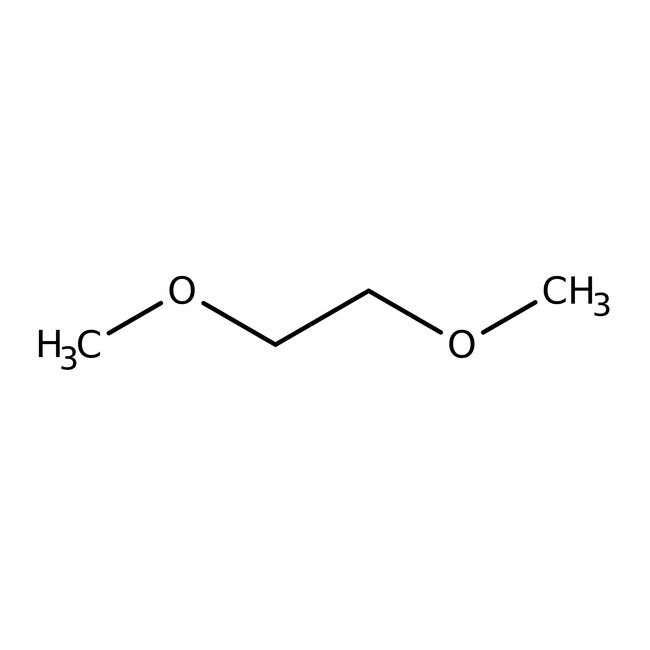
1,2-Diméthoxyéthane, 99+ %, stab. avec BHT, Thermo Scientific Chemicals
CAS: 110-71-4 | C4H10O2 | 90.122 g/mol
Have Questions?
Modifier l'affichage


Identifiants chimiques
CAS110-71-4
IUPAC Name1,2-dimethoxyethane
Molecular FormulaC4H10O2
InChI KeyXTHFKEDIFFGKHM-UHFFFAOYSA-N
SMILESCOCCOC
Voir plus
Spécifications Fiche de spécifications
Fiche de spécificationsAppearance (Color)Clear colorless
Assay (GC)≥99.0%
Identification (FTIR)Conforms
Refractive Index1.3785-1.3815 @ 20?C
FormLiquid
Voir plus
1,2-Dimethoxyethane is widely used as a solvent for electrolyte of lithium batteries, polysilicones, oligo- and polysaccharides. It plays an important role in Grignard reactions, Suzuki reactions and Stille couplings in organometallic chemistry and in pharmaceutical synthesis. It is a higher boiling point solvent and is used as an alternative to diethyl ether and tetrahydrofuran. It is used for the etching of synthetic polymers like polytetrafluoroethylene and other fluoropolymers with alkali metal dispersions.
This Thermo Scientific Chemicals brand product was originally part of the Alfa Aesar product portfolio. Some documentation and label information may refer to the legacy brand. The original Alfa Aesar product / item code or SKU reference has not changed as a part of the brand transition to Thermo Scientific Chemicals.
Applications
Le 1,2-diméthoxyéthane est largement utilisé comme solvant pour l’électrolyte des batteries au lithium, des polysilicones, des oligo- et des polysaccharides. Il joue un rôle important dans les réactions de Grignard, les couplages de Suzuki et Stille dans la chimie organométallique et dans la synthèse pharmaceutique. Il s’agit d’un solvant à point d’ébullition plus élevé et il est utilisé comme alternative à l’éther diéthylique et au tétrahydrofurane. Il est utilisé pour la gravure de polymères synthétiques comme le polytétrafluoroéthylène et d’autres fluoropolymères avec dispersions de métaux alcalins.
Solubilité
Miscible à l’eau, au méthanol, à l’éthanol, à l’éther diéthylique, à l’acétone, au tétrahydrofurane, au benzène et au toluène.
Remarques
Conserver à l’écart de toute flamme ou source d’étincelles. Garder le récipient bien fermé dans un endroit sec et bien ventilé. Incompatible avec les agents oxydants forts. Il peut être oxydé dans l’air pour former des peroxydes.
Le 1,2-diméthoxyéthane est largement utilisé comme solvant pour l’électrolyte des batteries au lithium, des polysilicones, des oligo- et des polysaccharides. Il joue un rôle important dans les réactions de Grignard, les couplages de Suzuki et Stille dans la chimie organométallique et dans la synthèse pharmaceutique. Il s’agit d’un solvant à point d’ébullition plus élevé et il est utilisé comme alternative à l’éther diéthylique et au tétrahydrofurane. Il est utilisé pour la gravure de polymères synthétiques comme le polytétrafluoroéthylène et d’autres fluoropolymères avec dispersions de métaux alcalins.
Solubilité
Miscible à l’eau, au méthanol, à l’éthanol, à l’éther diéthylique, à l’acétone, au tétrahydrofurane, au benzène et au toluène.
Remarques
Conserver à l’écart de toute flamme ou source d’étincelles. Garder le récipient bien fermé dans un endroit sec et bien ventilé. Incompatible avec les agents oxydants forts. Il peut être oxydé dans l’air pour former des peroxydes.
RUO – Research Use Only
Références générales :
- Solvant pour les lithiations et les réductions d’hydrures métalliques.
- Solvant recommandé pour la réaction de Schmidt des cétones avec de l’acide hydrazoïque, évitant les risques potentiels signalés avec les solvants chlorés les plus courants, en particulier le chloroforme. L’acide hydrazoïque est généré in situ à partir de NaN3 et d’acide méthanesulfonique : Tétraèdres, 52, 1609 (1996).
- Che, P. ; Lu, F. ; Si, X. ; Xu, J. Catalytic etherification of hydroxyl compounds to methyl ethers with 1,2-dimethoxyéthane. RSC Adv. 2015, 5 (31), 24139-24143.
- Monreal, M. J. ; Thomson, R. K. ; Scott, B. L. ; Kiplinger, J. L. Enhancing the synthetic efficacy of thorium tetrachloride bis(1,2-dimethoxyethane) with added 1,2-dimethoxyethane : Preparation of metallocene thorium dichlorides. Inorg. Chem. Commun. 2014, 46, 51-53.