Search
 Recherche par élément
 Recherche par structure


Thermo Scientific Chemicals
Nickel (II) acétate tétrahydraté, 98+ %, Thermo Scientific Chemicals
CAS: 6018-89-9 | C4H14NiO8 | 248.84 g/mol
Have Questions?
Modifier l'affichage


Référence A13026.0E
également connu sous le numéro A13026-0E
Prix (EUR)
202,30
Online Exclusive
238,00Économisez 35,70 (15%)
Each
Quantité:
2500 g
Prix (EUR)
202,30
Online Exclusive
238,00Économisez 35,70 (15%)
Each
Identifiants chimiques
CAS6018-89-9
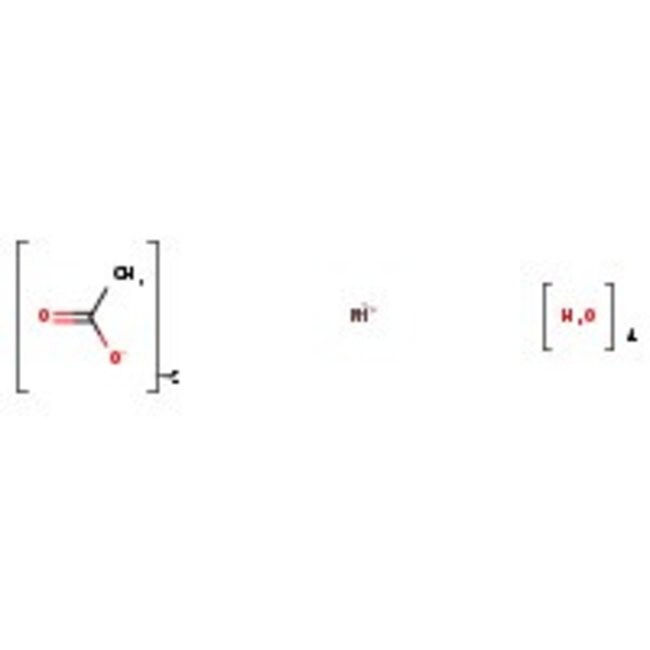
IUPAC Namenickel(2+) diacetate tetrahydrate
Molecular FormulaC4H14NiO8
InChI KeyOINIXPNQKAZCRL-UHFFFAOYSA-L
SMILESO.O.O.O.[Ni++].CC([O-])=O.CC([O-])=O
Voir plus
Spécifications Fiche de spécifications
Fiche de spécificationsAppearance (Color)Green
FormCrystals or powder or crystalline powder
Assay (unspecified)≥98.0 to ≤102.0% (based on elemental Ni)
Complexometric TitrationNickel Ni: 23.1-24.05%
Nickel(II) acetate tetrahydrate is used in electroplating. It is also used in the preparation of polynuclear-nickel polyoxotungstate cluster compounds, which are used in designing molecular magnets. Further, it is used as a catalyst and mordant for dyeing textiles, as a sealant for anodized aluminum and to make other nickel compounds.
This Thermo Scientific Chemicals brand product was originally part of the Alfa Aesar product portfolio. Some documentation and label information may refer to the legacy brand. The original Alfa Aesar product / item code or SKU reference has not changed as a part of the brand transition to Thermo Scientific Chemicals.
Applications
Le tétrahydrate d’acétate de nickel(II) est utilisé dans l’électroplastie. Il est également utilisé dans la préparation de composés polynucléaires en polynickel polyoxotungstate, qui sont utilisés dans la conception d’aimants moléculaires. De plus, il est utilisé comme catalyseur et mordant pour la teinture des textiles, comme produit d’étanchéité pour l’aluminium anodisé et pour la fabrication d’autres composés du nickel.
Solubilité
Soluble dans l’eau et le méthanol. Insoluble dans l’éther diéthylique et le n-octanol.
Remarques
Hygroscopique. Incompatible avec les agents oxydants, les acides forts et les bases fortes.
Le tétrahydrate d’acétate de nickel(II) est utilisé dans l’électroplastie. Il est également utilisé dans la préparation de composés polynucléaires en polynickel polyoxotungstate, qui sont utilisés dans la conception d’aimants moléculaires. De plus, il est utilisé comme catalyseur et mordant pour la teinture des textiles, comme produit d’étanchéité pour l’aluminium anodisé et pour la fabrication d’autres composés du nickel.
Solubilité
Soluble dans l’eau et le méthanol. Insoluble dans l’éther diéthylique et le n-octanol.
Remarques
Hygroscopique. Incompatible avec les agents oxydants, les acides forts et les bases fortes.
RUO – Research Use Only
Références générales :
- En association avec NaH et le dérivé Na du 3-Hydroxy-1-méthylpipéridine, L10829, peut être utilisé pour la désulfuration des thioéthers, montrant une augmentation spectaculaire du taux par rapport à d’autres systèmes : Tetrahedron Lett., 39, 8987 (1998).
- Das, M. ; Harms, K. ; Ghosh, B. N. ; Rissanen, K. ; Chattopadhyay, S. Bis(μ-tetrazolato-NN') bridged dinuclear nickel(II) Schiff base complexes: Tandem synthesis, structure and self assembly. Polyhedron 2015, 87, 286-292.
- Sivakumar, P. ; Nayak, P. K. ; Markovsky, B. ; Aurbach, D. ; Gedanken, A. Sonochemical synthesis of LiNi0,5Mn1,5O4 and its electrochemical performance as a cathode material for 5V Li-ion batteries. Ultrason. Sonochem. 2015, 26, 332-339.