Search
 Recherche par élément
 Recherche par structure


Thermo Scientific Chemicals
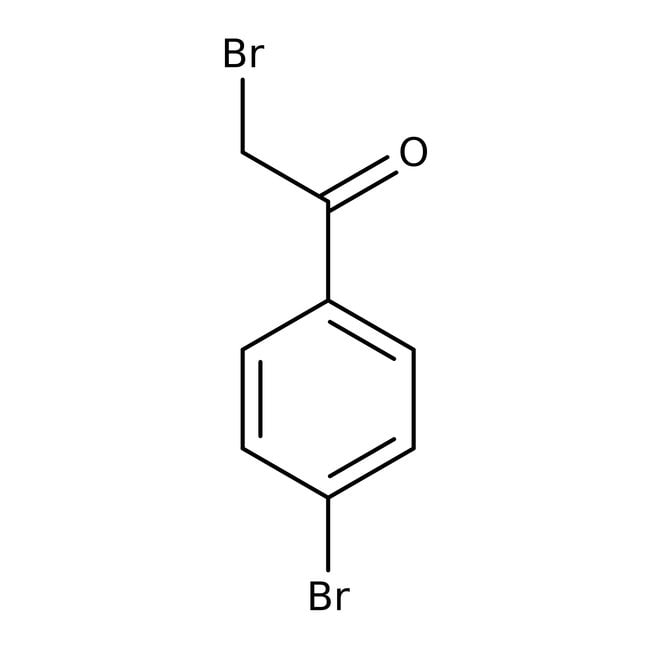
2,4’-Dibromoacétophénone, 98+ %, Thermo Scientific Chemicals
CAS: 99-73-0 | C8H6Br2O | 277.943 g/mol
Have Questions?
Modifier l'affichage


Référence A13687.14
également connu sous le numéro A13687-14
Prix (EUR)
71,50
Each
Quantité:
25 g
Prix (EUR)
71,50
Each
Identifiants chimiques
CAS99-73-0
IUPAC Name2-bromo-1-(4-bromophenyl)ethan-1-one
Molecular FormulaC8H6Br2O
InChI KeyFKJSFKCZZIXQIP-UHFFFAOYSA-N
SMILESBrCC(=O)C1=CC=C(Br)C=C1
Voir plus
Spécifications Fiche de spécifications
Fiche de spécificationsFormCrystals or powder or crystalline powder
Assay (GC)≥98.0%
Identification (FTIR)Conforms
Melting Point (clear melt)108.0-114.0?C
Appearance (Color)White to pale cream
2,4'-Dibromoacetophenone is used as a reagent for analysis of fatty acids by HPLC as 4-bromophenacyl esters, for use in the protection of phenols and carboxylic acids. It undergoes condensation reactions with aldehydes in the presence of SnCl2 or SmI3 to afford α,β-unsaturated ketones. It is also useful in the esterification of carboxylic acids.
This Thermo Scientific Chemicals brand product was originally part of the Alfa Aesar product portfolio. Some documentation and label information may refer to the legacy brand. The original Alfa Aesar product / item code or SKU reference has not changed as a part of the brand transition to Thermo Scientific Chemicals.
Applications
La 2,4′-dibromoacétophénone est utilisée comme réactif pour l’analyse des acides gras par HPLC sous forme d’esters 4-bromophénacyliques, pour une utilisation dans la protection des phénols et des acides carboxyliques. Elle subit des réactions de condensation avec des aldéhydes en présence de SnCl2 ou SmI3 pour fournir des cétones α,β-insaturées. Elle est également utile dans l’estérification des acides carboxyliques.
Solubilité
Soluble dans le diméthylsulfoxyde (5 mg/ml), le méthanol (20 mg/ml), le toluène et l’éthanol. Insoluble dans l’eau.
Remarques
Conserver le récipient bien fermé. Conserver à l’état réfrigéré. Incompatible avec les bases et les agents oxydants.
La 2,4′-dibromoacétophénone est utilisée comme réactif pour l’analyse des acides gras par HPLC sous forme d’esters 4-bromophénacyliques, pour une utilisation dans la protection des phénols et des acides carboxyliques. Elle subit des réactions de condensation avec des aldéhydes en présence de SnCl2 ou SmI3 pour fournir des cétones α,β-insaturées. Elle est également utile dans l’estérification des acides carboxyliques.
Solubilité
Soluble dans le diméthylsulfoxyde (5 mg/ml), le méthanol (20 mg/ml), le toluène et l’éthanol. Insoluble dans l’eau.
Remarques
Conserver le récipient bien fermé. Conserver à l’état réfrigéré. Incompatible avec les bases et les agents oxydants.
RUO – Research Use Only
Références générales :
- K. T. Potts. ; D. R. Choudhury. ; T. R. Westby. Bridgehead nitrogen systems. X. Cycloadditions with thiazolium N-ylides. J. Org. Chem. 1976, 41 (2), 187-191.
- Derrick L. J. Clive. ; Pierre L. Beaulieu. Dehalogenation of .alpha.-chloro and .alpha.-bromo ketones. Use of sodium O,O-diethyl phosphorotelluroate. J. Org. Chem. 1982, 47 (6), 1124-1126.
- Reagent for analysis of fatty acids by HPLC as 4-bromophenacyl esters: Anal. Chem., 47, 1797, (1975).
- For use in the protection of phenols and carboxylic acids, see: Tétraèdres Lett. 343 , (1970 ).
- L’O-méthyl oxyme a été utilisé pour les pyridines N-alkylées. Les produits peuvent être cyclisés avec de la triéthylamine pour donner des imidazo[1,2-a]pyridines à haut rendement : Synthèse 927 (1996).