Search
 Recherche par élément
 Recherche par structure


Thermo Scientific Chemicals
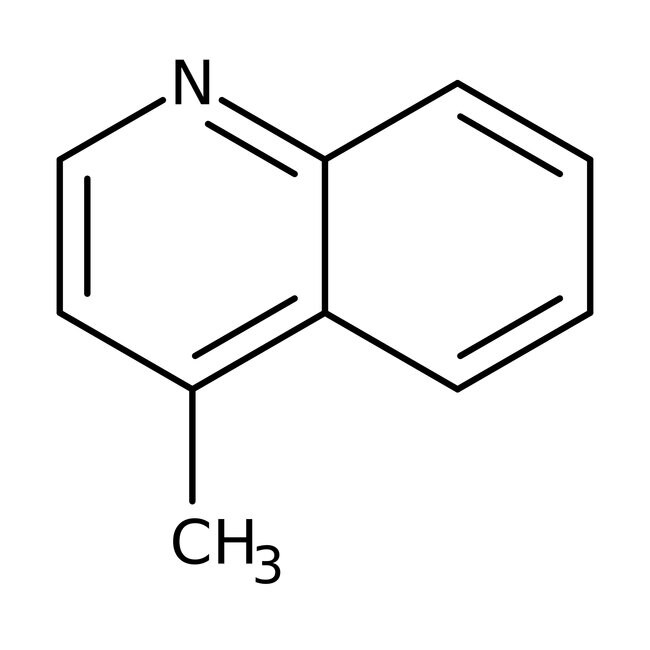
Lépidine, 98 %, Thermo Scientific Chemicals
CAS: 491-35-0 | C10H9N | 143.189 g/mol
Have Questions?
Modifier l'affichage


Référence A14040.09
également connu sous le numéro A14040-09
Prix (EUR)
37,10
Each
Quantité:
10 g
Prix (EUR)
37,10
Each
Identifiants chimiques
CAS491-35-0
IUPAC Name4-methylquinoline
Molecular FormulaC10H9N
InChI KeyMUDSDYNRBDKLGK-UHFFFAOYSA-N
SMILESCC1=C2C=CC=CC2=NC=C1
Voir plus
Spécifications Fiche de spécifications
Fiche de spécificationsRefractive Index1.6155-1.6205 @ 20?C
FormLiquid
Assay (GC)≥96.0%
Identification (FTIR)Conforms
Appearance (Color)Clear colorless to yellow
Lepidine is used in the preparation of certain dyes.
This Thermo Scientific Chemicals brand product was originally part of the Alfa Aesar product portfolio. Some documentation and label information may refer to the legacy brand. The original Alfa Aesar product / item code or SKU reference has not changed as a part of the brand transition to Thermo Scientific Chemicals.
Applications
La lépidine est utilisée dans la préparation de certains colorants.
Solubilité
Légèrement soluble dans l’eau.
Remarques
Sensible à la lumière. Incompatible avec les agents oxydants. Incompatible avec les agents oxydants.
La lépidine est utilisée dans la préparation de certains colorants.
Solubilité
Légèrement soluble dans l’eau.
Remarques
Sensible à la lumière. Incompatible avec les agents oxydants. Incompatible avec les agents oxydants.
RUO – Research Use Only
Références générales :
- Justin Thomas ; Marappan Velusamy ; Jiann T.Lin ; Chin-Hsiung Chien ; Yu-Tao ; Yuh S.Wen ; Ya-Hui Hu ; Pi-Tou. Efficient red-emitting cyclometalated iridium(III) complexes containing lepidine-based ligands. Inorg. Chem. 2005, 44,(16), 5677-5685
- Martin J.Weiss ; Charles R.Hauser. L‘acylation et la carbéthoxylation de la quinaldine, de la lépidine et de α-picoline à l‘aide d‘amide de sodium ou d‘amide de potassium. J. Am. Chem. Soc. 1949, 71,(6), 2023-2026.
- La lépidine et les composés similaires peuvent être alkylés à la position 2 par les radicaux libres générés par l‘action de l‘hydropéroxyde de t-butyle et d‘un sel de Fe(II) sur un iodure d‘alkyle primaire ou secondaire : ACTA Chem. Scand., 43, 995 (1989). De même, la 2-formylation peut être obtenue avec un rendement élevé en utilisant 1,3,5-trioxane en présence de TFA, de t-BuOOH et de FeSO4 dans l‘acétonitrile : J. Org. Chem, 51, 536 (1986).