Search
 Recherche par élément
 Recherche par structure


Thermo Scientific Chemicals
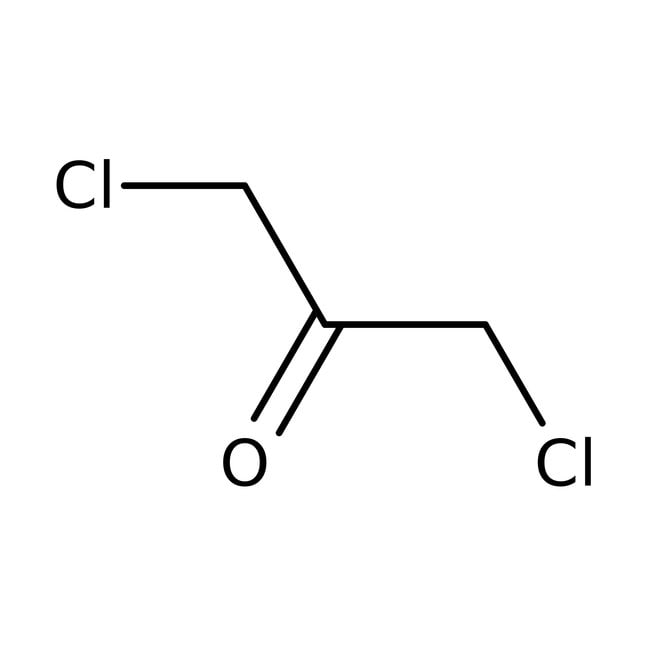
1,3-Dichloroacétone, 96 %, Thermo Scientific Chemicals
CAS: 534-07-6 | C3H4Cl2O | 126.96 g/mol
Have Questions?
Modifier l'affichage


Référence A14149.14
également connu sous le numéro A14149-14
Prix (EUR)
38,70
Each
Quantité:
25 g
Prix (EUR)
38,70
Each
Identifiants chimiques
CAS534-07-6
IUPAC Name1,3-dichloropropan-2-one
Molecular FormulaC3H4Cl2O
InChI KeySUNMBRGCANLOEG-UHFFFAOYSA-N
SMILESClCC(=O)CCl
Voir plus
Spécifications Fiche de spécifications
Fiche de spécificationsAppearance (Color)White to pale brown
FormCrystals or powder or crystalline powder or lumps or fused solid
Assay (GC)≥95.0%
Melting Point (clear melt)35.0-47.0?C
1,3-Dichloroacetone is used in the synthesis of citric acid. It is used as a solvent and as an intermediate in organic synthesis. Further, it serves as an acceptor substrate in the cross-aldol reaction with donor substrates such as acetone, cyclopentanone and cyclohexanone. It is also used in the preparation of an active pharmaceutical ingredient, famotidine.
This Thermo Scientific Chemicals brand product was originally part of the Alfa Aesar product portfolio. Some documentation and label information may refer to the legacy brand. The original Alfa Aesar product / item code or SKU reference has not changed as a part of the brand transition to Thermo Scientific Chemicals.
Applications
La 1,3-dichloroacétone est utilisée dans la synthèse de l’acide citrique. Elle est utilisée comme solvant et comme intermédiaire dans la synthèse organique. Elle sert également de substrat accepteur dans la réaction aldole croisée avec des substrats donneurs tels que l’acétone, la cyclopentanone et la cyclohexanone. Elle est également utilisée dans la préparation d’un principe pharmaceutique actif, la famotidine.
Solubilité
Soluble dans l’eau, l’éthanol et l’éther diéthylique.
Remarques
Hygroscopique. Stocker dans un endroit frais. Incompatible avec les agents oxydants forts, les bases fortes et les agents réducteurs.
La 1,3-dichloroacétone est utilisée dans la synthèse de l’acide citrique. Elle est utilisée comme solvant et comme intermédiaire dans la synthèse organique. Elle sert également de substrat accepteur dans la réaction aldole croisée avec des substrats donneurs tels que l’acétone, la cyclopentanone et la cyclohexanone. Elle est également utilisée dans la préparation d’un principe pharmaceutique actif, la famotidine.
Solubilité
Soluble dans l’eau, l’éthanol et l’éther diéthylique.
Remarques
Hygroscopique. Stocker dans un endroit frais. Incompatible avec les agents oxydants forts, les bases fortes et les agents réducteurs.
RUO – Research Use Only
Références générales :
- La réaction consécutive avec un réactif de Grignard et un métal Li conduit à des cyclopropanols monosubstitués, qui se réarrangent sur la thermolyse en éthylcétones : Synthesis, 647 (1983):
- La cyclisation peut également être induite par des radicaux éthyles, générés à partir du bromure d’éthylmagnésium et du FeCl3. Cette méthode s’applique uniquement aux 1-arylcyclopropanols : J. Org. Chem.,29 ,2813 (1964) ;43 ,3602 (1978) ; Org. Synthé. Coll., 5, 1058 (1973).
- La formation de l’acétal suivie d’un traitement par NaNH2 fournit une voie vers les cyclopropénones : Tétraèdres, 48, 2045 (1992).
- Serrano, M. ; Silva, M. ; Gallego, M. Determination of 14 haloketones in treated water using solid-phase microextraction and gas chromatography-mass spectrometry. J. Chromatogr. A 2015, 1407, 208-215.
- Deng, J. ; Chen, K. ; Yao, Z. ; Lin, J. ; Wei, D. Efficient synthesis of optically active halogenated aryl alcohols at high substrate load using a recombinant carbonyl reductase from Gluconobacter oxydans. J. Mol. Catal. B : Enzym. 2015, 118, 1-7.