Search
 Recherche par élément
 Recherche par structure

Thermo Scientific Chemicals
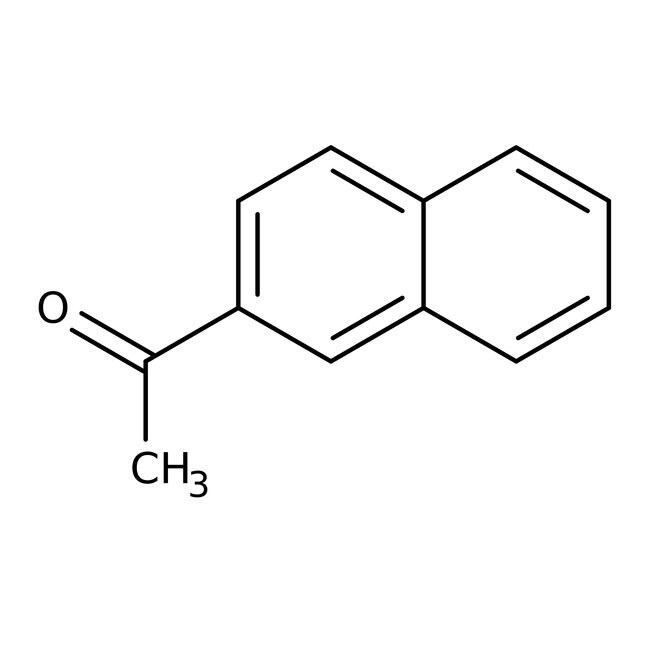
2-Acétylnaphtalène, 99 %, Thermo Scientific Chemicals
CAS: 93-08-3 | C12H10O | 170.211 g/mol
Have Questions?
Modifier l'affichage


Référence A14793.30
également connu sous le numéro A14793-30
Prix (EUR)
70,30
Each
Quantité:
250 g
Prix (EUR)
70,30
Each
Identifiants chimiques
CAS93-08-3
IUPAC Name1-(naphthalen-2-yl)ethan-1-one
Molecular FormulaC12H10O
InChI KeyXSAYZAUNJMRRIR-UHFFFAOYSA-N
SMILESCC(=O)C1=CC=C2C=CC=CC2=C1
Voir plus
Spécifications Fiche de spécifications
Fiche de spécificationsAppearance (Color)White to pale yellow
FormCrystals or powder or crystalline powder or lumps or chunks
Assay (GC)≥98.5%
Identification (FTIR)Conforms
Melting Point (clear melt)50.0-57.0?C
2-Acetylnaphthalene is used as a flavoring agent in food. It serves as an intermediate in the preparation of piperidinyl pyrazoles as potent DNA gyrase inhibitors. Further, it is used in air care products, cleaning and furnishing care products. In addition to this, it is used in the synthesis of aromatic enone and dienone analogues of curcumin as angiogenesis inhibitors.
This Thermo Scientific Chemicals brand product was originally part of the Alfa Aesar product portfolio. Some documentation and label information may refer to the legacy brand. The original Alfa Aesar product / item code or SKU reference has not changed as a part of the brand transition to Thermo Scientific Chemicals.
Applications
Le 2-Acétylnaphtalène est utilisé comme aromatisant dans les aliments. Il sert d’intermédiaire dans la préparation de pyrazoles pipéridinyle comme puissants inhibiteurs de l’ADN gyrase. De plus, il est utilisé dans les produits d’assainissement de l’air, de nettoyage et d’entretien du mobilier. En outre, il est employé dans la synthèse d’analogues aromatiques de l’énone et de la diénone de la curcumine comme inhibiteurs de l’angiogenèse.
Solubilité
Soluble dans l’éthanol, l’acétone et l’éther. Insoluble dans l’eau.
Remarques
Incompatible avec les agents oxydants forts, les bases fortes et les agents réducteurs puissants.
Le 2-Acétylnaphtalène est utilisé comme aromatisant dans les aliments. Il sert d’intermédiaire dans la préparation de pyrazoles pipéridinyle comme puissants inhibiteurs de l’ADN gyrase. De plus, il est utilisé dans les produits d’assainissement de l’air, de nettoyage et d’entretien du mobilier. En outre, il est employé dans la synthèse d’analogues aromatiques de l’énone et de la diénone de la curcumine comme inhibiteurs de l’angiogenèse.
Solubilité
Soluble dans l’éthanol, l’acétone et l’éther. Insoluble dans l’eau.
Remarques
Incompatible avec les agents oxydants forts, les bases fortes et les agents réducteurs puissants.
RUO – Research Use Only
Références générales :
- Zhang, Z.; Xie, C.; Tan, X.; Song, G.; Wen, L.; Gao, H.; Ma, C. I2-catalyzed one-pot synthesis of pyrrolo[1,2-a]quinoxaline and imidazo[1,5-a]quinoxaline derivatives via sp3 and sp2 C-H cross-dehydrogenative coupling. Org. Chem. Front. 2015, 2 (8), 942-946.
- Vivekanand, T.; Sandhya, T.; Vinoth, P.; Nagarajan, S.; Maheswari, C. U.; Sridharan, V. N-(2-Aminobenzylidene)-4-methylanilines-stable and cheap alternate for 2-aminobenzaldehydes: concise synthesis of 3-unsubstituted-2-aroylindoles. Tetrahedron Lett. 2015, 56 (38), 5291-5294.