Search


Citations et références (2)
Invitrogen™
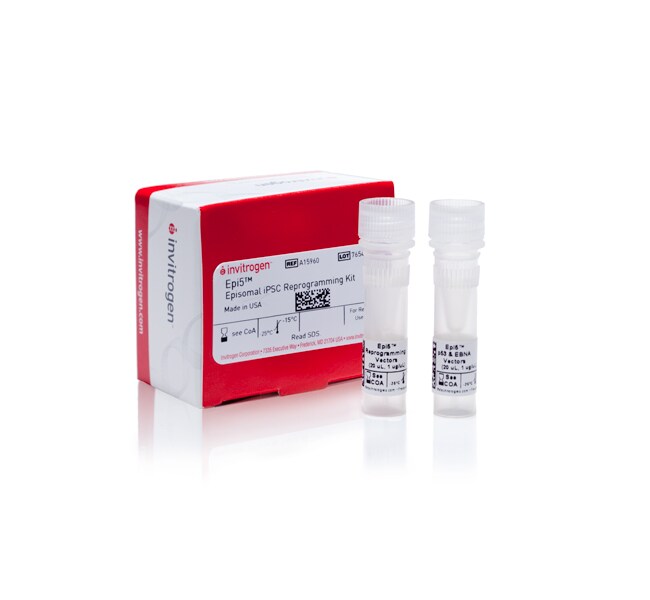
Epi5™ Episomal iPSC Reprogramming Kit
Le kit de reprogrammation de CSPi épisomiques Epi5™ offre un ensemble facile à utiliser et très efficace de 5 vecteursAfficher plus
| Référence | Quantité |
|---|---|
| A15960 | 1 kit |
Référence A15960
Prix (EUR)
1 442,00
Each
Quantité:
1 kit
Prix (EUR)
1 442,00
Each
Le kit de reprogrammation de CSPi épisomiques Epi5™ offre un ensemble facile à utiliser et très efficace de 5 vecteurs épisomiques conçus par le Dr Okita au laboratoire du professeur Yamanaka au Centre de recherche et d’application cellulaires SPi (CiRa) de l’Université de Kyoto. Ce système produit des cellules souches pluripotentes induites (CSPi) humaines exemptes de transgènes et de virus dont l’efficacité varie de 0,04 % à 0,3 %, selon le type de cellule à reprogrammer.
Les caractéristiques du kit de reprogrammation de CSPi épisomique Epi5™ sont les suivantes :
• Facile à utiliser et très efficace : aucun besoin de petites molécules lors de la reprogrammation et la suppression de p53 ajoutée offrent une meilleure génération de CSPi (1).
• Utilisable pour toutes les étapes de votre recherche de CSPi : la reprogrammation exempte de transgènes et de virus permet une utilisation de la recherche fondamentale à la recherche préclinique.
• Flexibilité dans les systèmes de milieu : peut être utilisé dans des systèmes de milieux avec ou sans apport nourricier.
Création de CSPi exemptes de transgènes et de virus
Les vecteurs épisomiques sont un système bien décrit pour produire des CSPi exemptes de virus et de transgènes, fournissant une source de CSPi pour toutes les étapes de votre recherche sur les cellules souches pluripotentes. D’autres méthodes de reprogrammation, telles que les lentivirus, contiennent des transgènes qui peuvent s’intégrer dans le génome de l’hôte, perturbant potentiellement le génome ou entraînant des résultats imprévisibles.
En tant que vecteurs oriP/EBNA1, ces vecteurs épisomiques contiennent 5 facteurs de reprogrammation (Oct4, Sox2, Lin28, Klf4 et L-Myc) et ne répliquent les valeurs extra-chromosomiques qu’une seule fois par cycle cellulaire. À ce taux de réplication, les épisomes sont perdus à un taux d’environ 5 % par génération cellulaire. Ce système montre une génération de CSPi améliorée grâce à la suppression de p53. L’inclusion de L-Myc s’est montrée plus puissante et plus spécifique que celle de c-Myc pendant la génération de CSPi humaine (1).
Système facile à utiliser
Ce kit de 2 flacons fournit le système optimal pour la reprogrammation de vecteurs épisomiques et élimine le besoin d’utiliser de petites molécules dans le milieu de reprogrammation. Les vecteurs épisomiques sont introduits dans la cellule par électroporation. Nous recommandons l’utilisation du système de transfection Neon™ pour l’électroporation, qui permet une flexibilité du volume et donc du nombre de cellules nécessaires à la reprogrammation.
Flexibilité dans la sélection des systèmes de milieu
Le kit de reprogrammation de CSPi épisomiques Epi5™ peut être utilisé avec plusieurs types de cellules et systèmes de milieux. Les protocoles pour les fibroblastes et les cellules sanguines CD34+ sont disponibles dans la reprogrammation avec ou sans apport nourricier.
1. Okita K, Matsumara Y, Sato Y, et al. A more efficient method to generate integration free human iPS cells. Nature Methods 8, 409-412, 2011.
Les caractéristiques du kit de reprogrammation de CSPi épisomique Epi5™ sont les suivantes :
• Facile à utiliser et très efficace : aucun besoin de petites molécules lors de la reprogrammation et la suppression de p53 ajoutée offrent une meilleure génération de CSPi (1).
• Utilisable pour toutes les étapes de votre recherche de CSPi : la reprogrammation exempte de transgènes et de virus permet une utilisation de la recherche fondamentale à la recherche préclinique.
• Flexibilité dans les systèmes de milieu : peut être utilisé dans des systèmes de milieux avec ou sans apport nourricier.
Création de CSPi exemptes de transgènes et de virus
Les vecteurs épisomiques sont un système bien décrit pour produire des CSPi exemptes de virus et de transgènes, fournissant une source de CSPi pour toutes les étapes de votre recherche sur les cellules souches pluripotentes. D’autres méthodes de reprogrammation, telles que les lentivirus, contiennent des transgènes qui peuvent s’intégrer dans le génome de l’hôte, perturbant potentiellement le génome ou entraînant des résultats imprévisibles.
En tant que vecteurs oriP/EBNA1, ces vecteurs épisomiques contiennent 5 facteurs de reprogrammation (Oct4, Sox2, Lin28, Klf4 et L-Myc) et ne répliquent les valeurs extra-chromosomiques qu’une seule fois par cycle cellulaire. À ce taux de réplication, les épisomes sont perdus à un taux d’environ 5 % par génération cellulaire. Ce système montre une génération de CSPi améliorée grâce à la suppression de p53. L’inclusion de L-Myc s’est montrée plus puissante et plus spécifique que celle de c-Myc pendant la génération de CSPi humaine (1).
Système facile à utiliser
Ce kit de 2 flacons fournit le système optimal pour la reprogrammation de vecteurs épisomiques et élimine le besoin d’utiliser de petites molécules dans le milieu de reprogrammation. Les vecteurs épisomiques sont introduits dans la cellule par électroporation. Nous recommandons l’utilisation du système de transfection Neon™ pour l’électroporation, qui permet une flexibilité du volume et donc du nombre de cellules nécessaires à la reprogrammation.
Flexibilité dans la sélection des systèmes de milieu
Le kit de reprogrammation de CSPi épisomiques Epi5™ peut être utilisé avec plusieurs types de cellules et systèmes de milieux. Les protocoles pour les fibroblastes et les cellules sanguines CD34+ sont disponibles dans la reprogrammation avec ou sans apport nourricier.
1. Okita K, Matsumara Y, Sato Y, et al. A more efficient method to generate integration free human iPS cells. Nature Methods 8, 409-412, 2011.
Usage exclusivement réservé à la recherche. Ne pas utiliser pour des procédures de diagnostic.
Spécifications
Méthode de clonageNéant
Type de livraisonTransfection
À utiliser avec (application)Engineering et reprogrammation des cellules souches
À utiliser avec (équipement)Électroporateur, système de transfection Neon
Principales fonctionsel
Gamme de produitsEpi5
Type de produitKit de reprogrammation de CSPi épisomiques
AccélérateurCAG
Marqueur de protéineNéant
Quantité1 kit
Origine de la réplicationOrigine pUC
Gène rapporteurAucun
Agent de sélection (eucaryotique)Aucun
VecteurOriP EBNA
Unit SizeEach
Contenu et stockage
2 tubes. Stocker entre -5 et -20°C.
Foire aux questions (FAQ)
Can I use pen/strep or other antibiotics for episomal reprogramming of cells?
Can I reprogram mouse cells with the Epi5 Episomal iPSC Reprograming Kit (Cat. No. A15960)?
When generating iPSCs using the Epi5 Episomal iPSC Reprogramming Kit (Cat. No. A15960), how confluent should my cells be on the day of transfection?
How many reprogramming experiments can I perform with the Epi5 Episomal iPSC Reprogramming Kit (Cat. No. A15960)?
Which kits do you offer for stem cell reprogramming?
Citations et références (2)
Citations et références
Abstract
An optogenetic approach for assessing formation of neuronal connections in a co-culture system.
Journal:
PubMed ID:25742527
'Here we describe a protocol to generate a co-culture consisting of 2 different neuronal populations. Induced pluripotent stem cells (iPSCs) are reprogrammed from human fibroblasts using episomal vectors. Colonies of iPSCs can be observed 30 days after initiation of fibroblast reprogramming. Pluripotent colonies are manually picked and grown in neural
Generation of human iPSCs from cells of fibroblastic and epithelial origin by means of the oriP/EBNA-1 episomal reprogramming system.
Journal:
PubMed ID:26088261
The prospect of therapeutic applications of the induced pluripotent stem cells (iPSCs) is based on their ability to generate virtually any cell type present in human body. Generation of iPSCs from somatic cells has opened up new possibilities to investigate stem cell biology, to better understand pathophysiology of human diseases,