Search
 Recherche par élément
 Recherche par structure

Thermo Scientific Chemicals
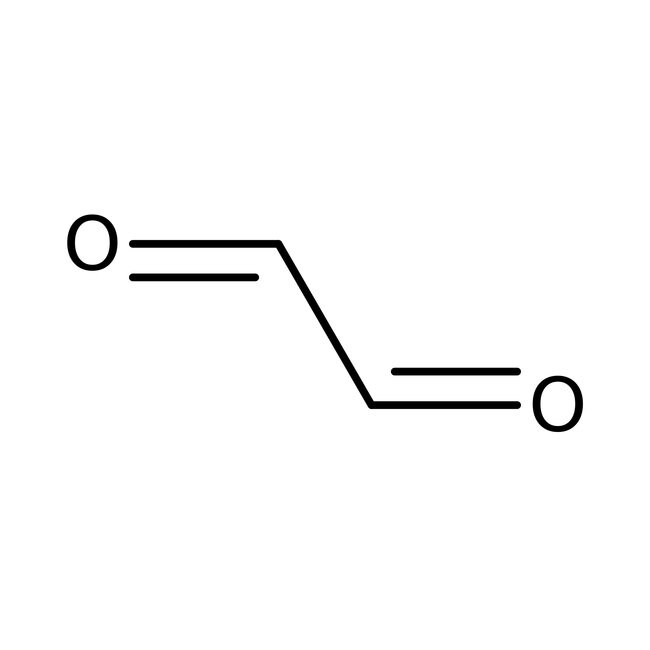
Glyoxal, 40 % p/p solution aqueuse, Thermo Scientific Chemicals
CAS: 107-22-2 | C2H2O2 | 58.036 g/mol
Have Questions?
Modifier l'affichage


Prix (EUR)
332,00
Each
Identifiants chimiques
CAS107-22-2
IUPAC Nameoxaldehyde
Molecular FormulaC2H2O2
InChI KeyLEQAOMBKQFMDFZ-UHFFFAOYSA-N
SMILESO=CC=O
Voir plus
Spécifications Fiche de spécifications
Fiche de spécificationsFormLiquid
Appearance (Color)Clear colorless
Assay (unspecified)≥39.5 to ≤40.5%
Identification (FTIR)Conforms
Glyoxal is used to prepare 4,5-dihydroxy-2-imidazolidinone by condensation with urea. It finds application in leather tanning process, textile finishes and paper coatings. It is an important building block in the synthesis of imidazoles. It acts as a solubilizer and cross-linking agent in polymer chemistry. Further, it is used as a fixative for histology to preserve cells in order to examine under a microscope.
This Thermo Scientific Chemicals brand product was originally part of the Alfa Aesar product portfolio. Some documentation and label information may refer to the legacy brand. The original Alfa Aesar product / item code or SKU reference has not changed as a part of the brand transition to Thermo Scientific Chemicals.
Applications
Le glyoxal est utilisé pour préparer la 4,5-dihydroxy-2-imidazolidinone par condensation avec l’urée. Il est utilisé dans le procédé de tannage du cuir, les finitions textiles et les revêtements en papier. C’est un important bloc de construction dans la synthèse des imidazoles. Il agit comme solubilisateur et agent réticulé dans la chimie des polymères. De plus, il est utilisé comme fixateur pour l’histologie afin de préserver les cellules pour les examiner sous un microscope.
Solubilité
Miscible à l’eau, au méthanol et au diméthylsulfoxyde.
Remarques
Sensible à l’humidité et à la chaleur. Incompatible avec les agents oxydants forts, les agents réducteurs puissants, l’oxygène, les peroxydes, les amides, les amines, les matières contenant de l’hydroxy, l’acide nitrique et les aldéhydes.
Le glyoxal est utilisé pour préparer la 4,5-dihydroxy-2-imidazolidinone par condensation avec l’urée. Il est utilisé dans le procédé de tannage du cuir, les finitions textiles et les revêtements en papier. C’est un important bloc de construction dans la synthèse des imidazoles. Il agit comme solubilisateur et agent réticulé dans la chimie des polymères. De plus, il est utilisé comme fixateur pour l’histologie afin de préserver les cellules pour les examiner sous un microscope.
Solubilité
Miscible à l’eau, au méthanol et au diméthylsulfoxyde.
Remarques
Sensible à l’humidité et à la chaleur. Incompatible avec les agents oxydants forts, les agents réducteurs puissants, l’oxygène, les peroxydes, les amides, les amines, les matières contenant de l’hydroxy, l’acide nitrique et les aldéhydes.
RUO – Research Use Only
Références générales :
- Pour une utilisation dans l’hydrolyse chimiosélective des amides en présence d’esters, voir Chlorure de cuivre(II) dihydraté, A16064.
- Pour une utilisation dans la synthèse de dicétones bicycliques, voir Acétone-1,3-dicarboxylate de diméthyle, A14969.
- Kurten, T. ; Elm, J. ; Prisle, N. L. ; Mikkelsen, K. V. ; Kampf, C. J. ; Waxman, E. M. ; Volkamer, R. Computational Study of the Effect of Glyoxal-Sulfate Clustering on the Henry’s Law Coefficient of Glyoxal. J. Phys. Chem. A 2015, 119 (19), 4509-4514.
- Lawson, S. J. ; Selleck, P. W. ; Galbally, I. E. ; Keywood, M. D. ; Harvey, M. J. ; Lerot, C. ; Helmig, D. ; Ristovski, Z. Seasonal in situ observations of glyoxal and methylglyoxal over the temperate oceans of the Southern Hemisphere. Atmos. Chem. Phys. 2015, 15 (1), 223-240.