Search
 Recherche par élément
 Recherche par structure

Thermo Scientific Chemicals
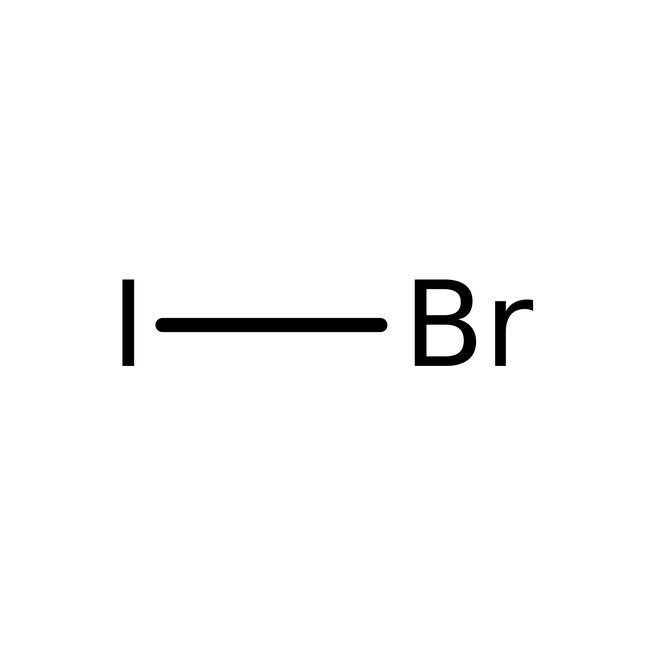
Monobromure d’iode, 98 %, Thermo Scientific Chemicals
CAS: 7789-33-5 | BrI | 206.81 g/mol
Have Questions?
Modifier l'affichage


Prix (EUR)
34,10
Each
Identifiants chimiques
CAS7789-33-5
IUPAC Nameiodobromane
Molecular FormulaBrI
InChI KeyCBEQRNSPHCCXSH-UHFFFAOYSA-N
SMILESBrI
Voir plus
Spécifications Fiche de spécifications
Fiche de spécificationsAppearance (Color)Black or grey or purple-blue
FormFused or crystalline solid
Assay (Iodometric Titration)≥97.5 to ≤102.5% (UK-sourced material)
Assay from Supplier's CofA≥97.5% (US-sourced material)
CommentMaterial sourced in UK and US
Voir plus
Iodine monobromide is used as an electrophile employed in a new synthetic approach to polyketide structural units. It is also used in iodometry and serves as a source of I+. It is a powerful iodinating agent used in organic synthesis as well as involved in the synthesis of radioiodinated fatty acids for heart imaging.
This Thermo Scientific Chemicals brand product was originally part of the Alfa Aesar product portfolio. Some documentation and label information may refer to the legacy brand. The original Alfa Aesar product / item code or SKU reference has not changed as a part of the brand transition to Thermo Scientific Chemicals.
Applications
Le monobromide d’iode est utilisé comme électrophile dans une nouvelle approche synthétique des unités structurales des polycétides. Il est également utilisé dans l’iodométrie et est une source de I+. Il s’agit d’un puissant agent iodé utilisé dans la synthèse organique, ainsi que dans la synthèse d’acides gras radioiodés pour l’imagerie cardiaque.
Solubilité
Soluble dans l’eau, l’alcool, l’éther, le disulfure de carbone et l’acide acétique glacial.
Remarques
Sensible à l’air, à la lumière et à l’humidité. Stockez-le dans un endroit frais. Gardez le récipient hermétiquement fermé dans un endroit sec et bien ventilé. Incompatible avec les alcools, le phosphore, le sodium, les oxydes de sodium et le potassium.
Le monobromide d’iode est utilisé comme électrophile dans une nouvelle approche synthétique des unités structurales des polycétides. Il est également utilisé dans l’iodométrie et est une source de I+. Il s’agit d’un puissant agent iodé utilisé dans la synthèse organique, ainsi que dans la synthèse d’acides gras radioiodés pour l’imagerie cardiaque.
Solubilité
Soluble dans l’eau, l’alcool, l’éther, le disulfure de carbone et l’acide acétique glacial.
Remarques
Sensible à l’air, à la lumière et à l’humidité. Stockez-le dans un endroit frais. Gardez le récipient hermétiquement fermé dans un endroit sec et bien ventilé. Incompatible avec les alcools, le phosphore, le sodium, les oxydes de sodium et le potassium.
RUO – Research Use Only
Références générales :
- Agent de bromation sélectif considéré comme intermédiaire de la puissance électrophile entre le brome et l’iode : J. Chem. Soc., 1509 (1939) ; J. Am. Chem. Soc., 60, 256 (1938) ; Chem. Commun, 849 , (1968 ).
- On a également constaté que la diastéréosélectivité est plus élevée que l’iode dans la cyclisation de certains carbonates homoallyliques : Tetrahedron Lett., 33, 6439 (1992).
- Réactif pour une déprotection sélective et légère des éthers TBDMS dans les glucides et les nucléosides : Synlett 311 , (1999 ).
- Khalil, A. ; Ishita, K. ; Ali, T. ; Tiwari, R. ; Riachy, R. ; Toppino, A. ; Tjarks, W. Iodine Monochloride Facilitated Deglycosylation, Anomerization, and Isomerization of 3-Substituted Thymidine Analogues. Nucleosides Nucleotides Nucleic Acids 2014, 33 (12), 786-799.
- Janas, D.; Herman, A. P.; Boncel, S.; Koziol, K. K. Iodine monochloride as a powerful enhancer of electrical conductivity of carbon nanotube wires. Carbon 2014, 73, 225-233.