Search
 Recherche par élément
 Recherche par structure

.png-150.jpg)


Thermo Scientific Chemicals
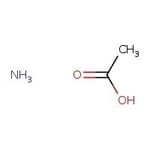
Acétate d’ammonium, 97 %, Thermo Scientific Chemicals
CAS: 631-61-8 | C2H7NO2 | 77.083 g/mol
Have Questions?
Modifier l'affichage


Référence A16343.30
également connu sous le numéro A16343-30
Prix (EUR)
26,50
Each
Quantité:
250 g
Prix (EUR)
26,50
Each
Identifiants chimiques
CAS631-61-8
IUPAC Nameammonium acetate
Molecular FormulaC2H7NO2
InChI KeyUSFZMSVCRYTOJT-UHFFFAOYSA-N
SMILES[NH4+].CC([O-])=O
Voir plus
Spécifications Fiche de spécifications
Fiche de spécificationsFormCrystals or powder or crystalline powder
Identification (FTIR)Conforms
Assay from Supplier's CofAAmmonia as ammonium acetate: ≥96.0% to ≤104.0%
Water Content (Karl Fischer Titration)≤5.0%
Appearance (Color)White
Ammonium acetate is widely utilized as a catalyst in the Knoevenagel condensation. It is the primary source of ammonia in the Borch reaction in organic synthesis. It is used with distilled water to make a protein precipitating reagent. It acts as a buffer for electrospray ionization (ESI) mass spectrometry of proteins and other molecules and as mobile phases for high performance liquid chromatography (HPLC). Sometimes, it is used as a biodegradable de-icing agent and an acidity regulator in food additives.
This Thermo Scientific Chemicals brand product was originally part of the Alfa Aesar product portfolio. Some documentation and label information may refer to the legacy brand. The original Alfa Aesar product / item code or SKU reference has not changed as a part of the brand transition to Thermo Scientific Chemicals.
Applications
L’acétate d’ammonium est largement utilisé comme catalyseur dans la condensation de Knoevenagel. C’est la principale source d’ammoniac dans la réaction de Borch en synthèse organique. Il est utilisé avec de l’eau distillée pour fabriquer un réactif précipitant des protéines. Il agit comme un tampon pour la spectrométrie de masse par ionisation par électrospray (ESI) des protéines et d’autres molécules et comme phase mobile pour la chromatographie en phase liquide à haute performance (HPLC). Parfois, il est utilisé comme agent de déglaçage biodégradable et comme régulateur d’acidité dans les additifs alimentaires.
Solubilité
Soluble dans l’eau, le méthanol, l’acétone et l’ammoniac liquide.
Remarques
Hygroscopique. Incompatible avec les agents oxydants forts et les acides forts.
L’acétate d’ammonium est largement utilisé comme catalyseur dans la condensation de Knoevenagel. C’est la principale source d’ammoniac dans la réaction de Borch en synthèse organique. Il est utilisé avec de l’eau distillée pour fabriquer un réactif précipitant des protéines. Il agit comme un tampon pour la spectrométrie de masse par ionisation par électrospray (ESI) des protéines et d’autres molécules et comme phase mobile pour la chromatographie en phase liquide à haute performance (HPLC). Parfois, il est utilisé comme agent de déglaçage biodégradable et comme régulateur d’acidité dans les additifs alimentaires.
Solubilité
Soluble dans l’eau, le méthanol, l’acétone et l’ammoniac liquide.
Remarques
Hygroscopique. Incompatible avec les agents oxydants forts et les acides forts.
RUO – Research Use Only
Références générales :
- Xia, S. ; Zhang, H. Density Functional Theory Study of Selective Deacylation of Aromatic Acetate in the Presence of Aliphatic Acetate under Ammonium Acetate Mediated Conditions. J. Org. Chem. 2014, 79 (13), 6135-6142.
- Zhang, J. ; Yao, J. ; Liu, J. ; Xue, S. ; Li, Y. ; Wang, C. Four-component reaction between naphthols, substituted β-nitrostyrenes, substituted benzaldehydes and ammonium acetate in water-PEG-400: an approach to construct polysubstituted naphthofuranamines. RSC Adv. 2015, 5 (60), 48580-48585.