Search



Citations et références (222)
Invitrogen™
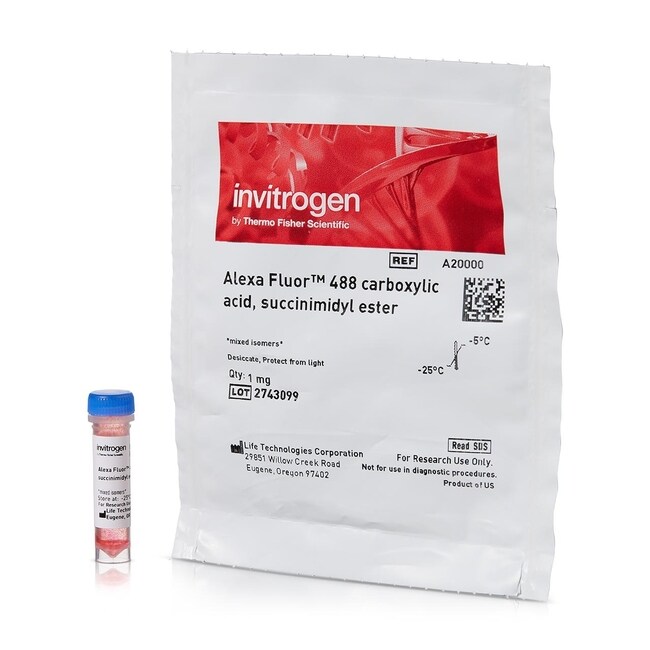
Ester NHS Alexa Fluor™ 488 (ester succinimidyle)
Alexa Fluor™ 488 est un colorant brillant, vert fluorescent, avec un niveau d’excitation parfaitement adapté à la ligne laser deAfficher plus
Have Questions?
Modifier l'affichage

| Référence | Quantité |
|---|---|
| A20000 | 1 mg |
| A20100 | 5 mg |
Référence A20000
Prix (EUR)
463,65
Online exclusive
618,00Économisez 154,35 (25%)
Each
Quantité:
1 mg
Prix (EUR)
463,65
Online exclusive
618,00Économisez 154,35 (25%)
Each
Alexa Fluor™ 488 est un colorant brillant, vert fluorescent, avec un niveau d’excitation parfaitement adapté à la ligne laser de 488 nm. Utilisé pour une génération de signal stable en imagerie et en cytométrie en flux, le colorant Alexa Fluor™ 488 est hydrosoluble et insensible au pH de pH 4 à pH 10. Outre les formulations de colorants réactifs, nous proposons un colorant Alexa Fluor™ 488 conjugué à une variété d’anticorps, de peptides, de protéines, de traceurs et de substrats d’amplification optimisés pour le marquage et la détection cellulaires (en savoir plus).
L’ester NHS (ou succinimidyl ester) d’Alexa Fluor™ 488 est l’outil le plus populaire pour conjuguer le colorant à une protéine ou à un anticorps. Les esters NHS peuvent être utilisés pour marquer des amines primaires (R-NH2) de protéines, d’oligonucléotides modifiés par des amines et d’autres molécules contenant des amines. Le conjugué Alexa Fluor™ qui en résulte présente une plus grande fluorescence et une meilleure photostabilité que les conjugués d’autres fluorophores spectralement similaires.
Pour plus d’informations sur cet ester AlexaFluor™ NHS :
marquage du fluorophore : Colorant Alexa Fluor™ 488
Groupe réactif : Ester NHS
Réactivité : Amines primaires sur des protéines et des ligands, oligonucléotides modifiés par des amines
Ex/Em du conjugué : 494/517 nm
Coefficient d’extinction : 73 000 cm-1M-1
Colorants spectralement similaires : FITC, Oregon Green 488
Poids moléculaire : 643.4
Réaction de conjugaison typique
Vous pouvez conjuguer des réactifs amino-réactifs avec pratiquement n’importe quelle protéine ou peptide (le protocole fourni est optimisé pour des anticorps IgG). Vous pouvez adapter la taille de la réaction à n’importe quelle quantité de protéine, mais la concentration de la protéine doit être d’au moins 2 mg/ml pour des résultats optimaux. Nous vous recommandons d’essayer trois degrés différents de marquage, à l’aide de trois rapports molaires différents entre le réactif et la protéine.
L’ester NHS Alexa Fluor™ est typiquement dissolu dans du diméthylformamide (DMF) ou du diméthylsulfoxyde (DMSO) anhydre de haute qualité (D12345), et la réaction est effectuée dans un tampon de bicarbonate de sodium de 0,1–0,2 M, de pH 8,3 et à température ambiante pendant 1 heure. Étant donné que le pKa de l’amine terminale est inférieur à celui du groupe amino de lysine epsilon, vous pouvez obtenir un marquage plus sélectif du terminus d’amine en utilisant un tampon plus proche du pH neutre.
Purification de conjugués
Les anticorps marqués sont généralement séparés du colorant Alexa Fluor™ libre à l’aide d’une colonne de filtration sur gel, telle que Sephadex™ G-25, Biogel™ P-30 ou équivalent. Pour des protéines beaucoup plus grandes ou plus petites, sélectionnez un milieu de filtration sur gel ayant un seuil de poids moléculaire approprié ou purifiez par dialyse. Nous proposons plusieurs kits de purification optimisés pour différentes quantités de conjugués d’anticorps :
kit de purification de conjugués d’anticorps pour 0,5 à 1 mg (A33086)
kit de purification de conjugués d’anticorps pour 20 à 50 µg (A33087)
kit de purification de conjugués d’anticorps pour 50 à 100 µg (A33088)
En savoir plus sur le marquage des protéines et des anticorps
Nous offrons une large sélection de kits de marquage d’anticorps et de protéines de Molecular Probes™ pour convenir à votre produit de départ et à votre configuration expérimentale. Consultez nos kits de marquage d’anticorps ou utilisez notre outil de sélection de chimie de marquage pour d’autres choix. Pour en savoir plus sur nos kits de marquage, lisez Kits de marquage des protéines et des acides nucléiques, section 1.2 dans le manuel Molecular Probes™.
Nous vous préparerons un conjugué sur mesure
Si vous ne trouvez pas ce que vous cherchez dans notre catalogue en ligne, nous vous préparerons un conjugué d’anticorps ou de protéines sur mesure. Notre service de conjugaison personnalisé est efficace et confidentiel, et nous croyons en la qualité de notre travail. Nous sommes certifiés ISO 9001:2000.
L’ester NHS (ou succinimidyl ester) d’Alexa Fluor™ 488 est l’outil le plus populaire pour conjuguer le colorant à une protéine ou à un anticorps. Les esters NHS peuvent être utilisés pour marquer des amines primaires (R-NH2) de protéines, d’oligonucléotides modifiés par des amines et d’autres molécules contenant des amines. Le conjugué Alexa Fluor™ qui en résulte présente une plus grande fluorescence et une meilleure photostabilité que les conjugués d’autres fluorophores spectralement similaires.
Pour plus d’informations sur cet ester AlexaFluor™ NHS :
marquage du fluorophore : Colorant Alexa Fluor™ 488
Groupe réactif : Ester NHS
Réactivité : Amines primaires sur des protéines et des ligands, oligonucléotides modifiés par des amines
Ex/Em du conjugué : 494/517 nm
Coefficient d’extinction : 73 000 cm-1M-1
Colorants spectralement similaires : FITC, Oregon Green 488
Poids moléculaire : 643.4
Réaction de conjugaison typique
Vous pouvez conjuguer des réactifs amino-réactifs avec pratiquement n’importe quelle protéine ou peptide (le protocole fourni est optimisé pour des anticorps IgG). Vous pouvez adapter la taille de la réaction à n’importe quelle quantité de protéine, mais la concentration de la protéine doit être d’au moins 2 mg/ml pour des résultats optimaux. Nous vous recommandons d’essayer trois degrés différents de marquage, à l’aide de trois rapports molaires différents entre le réactif et la protéine.
L’ester NHS Alexa Fluor™ est typiquement dissolu dans du diméthylformamide (DMF) ou du diméthylsulfoxyde (DMSO) anhydre de haute qualité (D12345), et la réaction est effectuée dans un tampon de bicarbonate de sodium de 0,1–0,2 M, de pH 8,3 et à température ambiante pendant 1 heure. Étant donné que le pKa de l’amine terminale est inférieur à celui du groupe amino de lysine epsilon, vous pouvez obtenir un marquage plus sélectif du terminus d’amine en utilisant un tampon plus proche du pH neutre.
Purification de conjugués
Les anticorps marqués sont généralement séparés du colorant Alexa Fluor™ libre à l’aide d’une colonne de filtration sur gel, telle que Sephadex™ G-25, Biogel™ P-30 ou équivalent. Pour des protéines beaucoup plus grandes ou plus petites, sélectionnez un milieu de filtration sur gel ayant un seuil de poids moléculaire approprié ou purifiez par dialyse. Nous proposons plusieurs kits de purification optimisés pour différentes quantités de conjugués d’anticorps :
kit de purification de conjugués d’anticorps pour 0,5 à 1 mg (A33086)
kit de purification de conjugués d’anticorps pour 20 à 50 µg (A33087)
kit de purification de conjugués d’anticorps pour 50 à 100 µg (A33088)
En savoir plus sur le marquage des protéines et des anticorps
Nous offrons une large sélection de kits de marquage d’anticorps et de protéines de Molecular Probes™ pour convenir à votre produit de départ et à votre configuration expérimentale. Consultez nos kits de marquage d’anticorps ou utilisez notre outil de sélection de chimie de marquage pour d’autres choix. Pour en savoir plus sur nos kits de marquage, lisez Kits de marquage des protéines et des acides nucléiques, section 1.2 dans le manuel Molecular Probes™.
Nous vous préparerons un conjugué sur mesure
Si vous ne trouvez pas ce que vous cherchez dans notre catalogue en ligne, nous vous préparerons un conjugué d’anticorps ou de protéines sur mesure. Notre service de conjugaison personnalisé est efficace et confidentiel, et nous croyons en la qualité de notre travail. Nous sommes certifiés ISO 9001:2000.
Usage exclusivement réservé à la recherche. Ne pas utiliser pour des procédures de diagnostic.
Spécifications
Réactivité chimiqueAmine
Émission517 nm
Excitation494 nm
Marqueur ou colorantAlexa Fluor™ 488
Type de produitColorant
Quantité1 mg
Groupement de réactifsEster actif, ester de succinimidyle
Conditions d’expéditionTempérature ambiante
Type d’étiquetteColorants Alexa Fluor
Gamme de produitsAlexa Fluor
Unit SizeEach
Contenu et stockage
Conserver au congélateur (-5 à -30°C) à l’abri de la lumière.
Foire aux questions (FAQ)
I am labeling a protein with Alexa Fluor 488 SDP ester. The manual recommends using a sodium bicarbonate buffer at pH 8.3. Can I use a different buffer instead?
I am not going to use all of my Alexa Fluor succinimidyl ester reactive dye. Can I just make it up in DMSO and store aliquots at -20 degrees C?
What are the signal intensity differences between Alexa Fluor 350 dye and Alexa Fluor 488 dye?
Citations et références (222)
Citations et références
Abstract
Inducer-modulated cooperative binding of the tetrameric CggR repressor to operator DNA.
Journal:Biophysical journal
PubMed ID:17293407
The central glycolytic genes repressor (CggR) controls the transcription of the gapA operon encoding five key glycolytic enzymes in Bacillus subtilis. CggR recognizes a unique DNA target sequence comprising two direct repeats and fructose-1,6-bisphosphate (FBP) is the inducer that negatively controls this interaction. We present here analytical ultracentrifugation and fluorescence
Activity of human IgG and IgA subclasses in immune defense against Neisseria meningitidis serogroup B.
Journal:Journal of immunology (Baltimore, Md. : 1950)
PubMed ID:11342648
Single dose intranasal administration of retinal autoantigen generates a rapid accumulation and cell activation in draining lymph node and spleen: implications for tolerance therapy.
Journal:Br J Ophthalmol
PubMed ID:11466262
BACKGROUND/AIMS: A single intranasal delivery of retinal autoantigen suppresses effectively experimental autoimmune uveoretinitis (EAU). To further unravel underlying mechanisms the authors wished to determine, firstly, the kinetics of antigen delivery and, secondly, the early cellular responses involved in the initial stages of nasal mucosal tolerance induction. METHODS: Flow cytometry, cell
Reconstituted syntaxin1a/SNAP25 interacts with negatively charged lipids as measured by lateral diffusion in planar supported bilayers.
Journal:Biophys J
PubMed ID:11423412
According to the soluble N-ethylmaleimide-sensitive factor (NSF)-attachment protein (SNAP) receptor hypothesis (SNARE hypothesis), interactions between target SNAREs and vesicle SNAREs (t- and v-SNAREs) are required for membrane fusion in intracellular vesicle transport and exocytosis. The precise role of the SNAREs in tethering, docking, and fusion is still disputed. Biophysical measurements
Tubulin equilibrium unfolding followed by time-resolved fluorescence and fluorescence correlation spectroscopy.
Journal:Protein Sci
PubMed ID:14691224
The pathway for the in vitro equilibrium unfolding of the tubulin heterodimer by guanidinium chloride (GdmCl) has been studied using several spectroscopic techniques, specifically circular dichroism (CD), two-photon Fluorescence Correlation Spectroscopy (FCS), and time-resolved fluorescence, including lifetime and dynamic polarization. The results show that tubulin unfolding is characterized by distinct