Search


Citations et références (7)
Invitrogen™
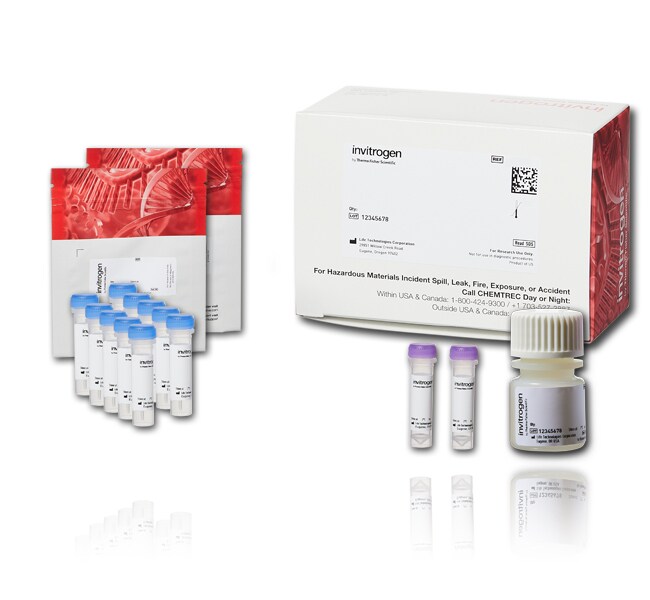
ARES™ Alexa Fluor™ 488 DNA Labeling Kit
Le kit de marquage d’ADN ARES™ Alexa Fluor™ fournit une méthode polyvalente en deux étapes pour le marquage de l’ADNAfficher plus
| Référence | Quantité |
|---|---|
| A21665 | 1 kit |
Référence A21665
Prix (EUR)
862,00
Each
Quantité:
1 kit
Prix (EUR)
862,00
Each
Le kit de marquage d’ADN ARES™ Alexa Fluor™ fournit une méthode polyvalente en deux étapes pour le marquage de l’ADN avec nos colorants Alexa Fluor™. Dans la première étape, un nucléotide modifié par des amines est incorporé à l’ADN en utilisant des méthodes de marquage enzymatique classiques. Dans la deuxième étape, l’ADN modifié par l’amine est marqué chimiquement à l’aide de notre colorant exclusif Alexa Fluor™ 488 réactif à l’amine. Les sondes marquées peuvent être utilisées pour l’hybridation in situ par fluorescence (FISH) et les techniques microarray. Nous proposons des kits de marquage de l’ADN Alexa Fluor™ ARES™ en cinq couleurs fluorescentes, et chaque kit fournit des réactifs suffisants pour 5 à 10 réactions de marquage de 1 à 5 µg d’ADN chacune.
Spécifications du kit de marquage Alexa Fluor™ ARES™ :
• Coloration (Ex / Em) : Alexa Fluor™ 488 (492 / 520 nm)
• Permet un marquage plus uniforme et plus cohérent que les techniques d’incorporation enzymatique des nucléotides marqués
• Produit généralement un colorant par 12 à 20 bases
• Optimal pour FISH et biopuces
Marquage plus uniforme avec les kits de marquage ARES™
Les kits de marquage ARES™ Alexa Fluor™ utilisent une technologie de marquage en deux étapes : translation de coupure pour incorporer enzymatiquement un nucléotide modifié par des amines (AminoAllyl dUTP), suivie d’un marquage chimique avec les colorants Alexa Fluor™. Cette méthode permet d’obtenir l’uniformité et la cohérence du marquage, chose complexe avec l’incorporation enzymatique conventionnelle de nucléotides marqués.
Nous proposons également cette technologie de marquage en deux étapes dans nos kits d’ADN FISH Tag™ et kits d’ARN FISH Tag™ qui offrent une solution complète de flux de travail pour les applications FISH, y compris tous les réactifs pour la synthèse de sondes, le marquage, la purification et un réactif anti-décoloration pour aider à protéger le signal lors de la microscopie par fluorescence.
Plus d’options pour le marquage des acides nucléiques
Pour examiner diverses options de marquage des acides nucléiques (y compris l’ADN et l’ARN FISH), consultez la section Marquage des oligonucléotides et des acides nucléiques—section 8.2 du Manuel sur les sondes moléculaires™.
Pour usage à des fins de recherche uniquement. Non utilisé à des fins thérapeutiques ou diagnostiques humaines ou animales.
Spécifications du kit de marquage Alexa Fluor™ ARES™ :
• Coloration (Ex / Em) : Alexa Fluor™ 488 (492 / 520 nm)
• Permet un marquage plus uniforme et plus cohérent que les techniques d’incorporation enzymatique des nucléotides marqués
• Produit généralement un colorant par 12 à 20 bases
• Optimal pour FISH et biopuces
Marquage plus uniforme avec les kits de marquage ARES™
Les kits de marquage ARES™ Alexa Fluor™ utilisent une technologie de marquage en deux étapes : translation de coupure pour incorporer enzymatiquement un nucléotide modifié par des amines (AminoAllyl dUTP), suivie d’un marquage chimique avec les colorants Alexa Fluor™. Cette méthode permet d’obtenir l’uniformité et la cohérence du marquage, chose complexe avec l’incorporation enzymatique conventionnelle de nucléotides marqués.
Nous proposons également cette technologie de marquage en deux étapes dans nos kits d’ADN FISH Tag™ et kits d’ARN FISH Tag™ qui offrent une solution complète de flux de travail pour les applications FISH, y compris tous les réactifs pour la synthèse de sondes, le marquage, la purification et un réactif anti-décoloration pour aider à protéger le signal lors de la microscopie par fluorescence.
Plus d’options pour le marquage des acides nucléiques
Pour examiner diverses options de marquage des acides nucléiques (y compris l’ADN et l’ARN FISH), consultez la section Marquage des oligonucléotides et des acides nucléiques—section 8.2 du Manuel sur les sondes moléculaires™.
Pour usage à des fins de recherche uniquement. Non utilisé à des fins thérapeutiques ou diagnostiques humaines ou animales.
Usage exclusivement réservé à la recherche. Ne pas utiliser pour des procédures de diagnostic.
Spécifications
Comprend l’étiquette ou le colorantOui
Méthode d’étiquetageMarquage indirect
Gamme de produitsARES, Alexa Fluor
Type de produitKit de marquage d’ADN
Quantité1 kit
Conditions d’expéditionTempérature ambiante
Méthode de détectionFluorescence
Type de produit finalSondes (ADN marqué), ADNc (marqué)
FormatKit
Labeling TargetADN (général), ADNc
Marqueur ou colorantAlexa Fluor™ 488
Unit SizeEach
Contenu et stockage
Conservez au congélateur (entre -5 et -30°C) à l’abri de la lumière.
Foire aux questions (FAQ)
My purified RNA comes from multiple sources, but I am getting variable efficiency of labeling with the same ARES kit. What can cause this?
Could you make an ARES Alexa Fluor 633 DNA Labeling Kit? This would be a good fit with my 633 nm laser.
How stable is the ARES-labeled DNA to high temperature?
Can probes labeled using the ARES Alexa Fluor DNA Labeling Kits be stored for later use?
How do the Alexa Fluor dyes used in the ARES Alexa Fluor DNA Labeling Kits compare to Cy dyes for fluorescence intensity at different labeling ratios?
Citations et références (7)
Citations et références
Abstract
Mitochondrial nucleoids maintain genetic autonomy but allow for functional complementation.
Journal:J Cell Biol
PubMed ID:18573913
'Mitochondrial DNA (mtDNA) is packaged into DNA-protein assemblies called nucleoids, but the mode of mtDNA propagation via the nucleoid remains controversial. Two mechanisms have been proposed: nucleoids may consistently maintain their mtDNA content faithfully, or nucleoids may exchange mtDNAs dynamically. To test these models directly, two cell lines were fused,
SCFSlimb ubiquitin ligase suppresses condensin II-mediated nuclear reorganization by degrading Cap-H2.
Journal:J Cell Biol
PubMed ID:23530065
Condensin complexes play vital roles in chromosome condensation during mitosis and meiosis. Condensin II uniquely localizes to chromatin throughout the cell cycle and, in addition to its mitotic duties, modulates chromosome organization and gene expression during interphase. Mitotic condensin activity is regulated by phosphorylation, but mechanisms that regulate condensin II
Cell cycle dependent morphology changes and associated mitochondrial DNA redistribution in mitochondria of human cell lines.
Journal:Mitochondrion
PubMed ID:16120295
Mitochondria of osteosarcoma cells (143B) in culture have variable morphologies, classified according to the shape and size of the organelle as reticular, fragmented or intermediate. Synchronization and release from G0 has shown that the morphology of mitochondria oscillates between the reticular and fragmented state in a cell cycle dependent manner.
Rapid analysis of mitochondrial DNA depletion by fluorescence in situ hybridization and immunocytochemistry: potential strategies for HIV therapeutic monitoring.
Journal:J Histochem Cytochem
PubMed ID:15258176
Nucleoside reverse transcriptase inhibitors (NRTIs) have been a mainstay in the treatment of human immunodeficiency virus since the introduction of azidothymidine (AZT) in 1987. However, none of the current therapies can completely eradicate the virus, necessitating long-term use of anti-retroviral drugs to prevent viral re-growth. One of the side effects
DNA microarray analysis of the hyperthermophilic archaeon Pyrococcus furiosus: evidence for anNew type of sulfur-reducing enzyme complex.
Journal:J Bacteriol
PubMed ID:11717259
DNA microarrays were constructed by using 271 open reading frame (ORFs) from the genome of the archaeon Pyrococcus furiosus. They were used to investigate the effects of elemental sulfur (S(primary)) on the levels of gene expression in cells grown at 95 degrees C with maltose as the carbon source. The