Search


Citations et références (77)
Invitrogen™
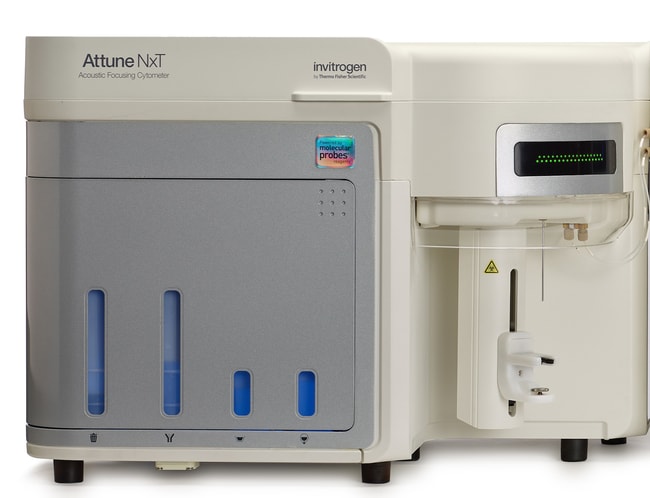
Cytomètre en flux Attune™ NxT, bleu/jaune
Le cytomètre en flux Attune NxT 2020 offre des fonctionnalités étendues pour faire avancer vos recherches. Conçues et développées pourAfficher plus
| Référence | Quantité |
|---|---|
| A24861 | 1 de chaque |
Référence A24861
Prix (EUR)
-
Quantité:
1 de chaque
Le cytomètre en flux Attune NxT 2020 offre des fonctionnalités étendues pour faire avancer vos recherches. Conçues et développées pour éliminer les barrières courantes associées à la cytométrie en flux, les capacités évolutives du cytomètre en flux Attune NxT offrent des options de configuration optique adaptables pour que vous puissiez tirer le meilleur parti de votre analyse multicolore.
• Nouvel échantillonneur automatique CytKick et CytKick Max—plus d’efficacité pour les dosages à haut débit
• Nouveau logiciel conforme 21 CFR partie 11 pour les laboratoires réglementés sur le système d’exploitation Windows 10
• Flux de travaux amélioré pour exécuter le protocole et la gestion des paramètres des instruments
Flux rapide
La combinaison innovante de technologie de focalisation acoustique associée à une focalisation hydrodynamique traditionnelle permet d’obtenir des vitesses d’acquisition jusqu’à 10 fois plus élevées que les autres cytomètres en flux. Cette technologie réduit le temps nécessaire pour obtenir des résultats.
• Véritablement 35 000 événements/s (taux de coïncidence de +10 %)
• Vitesse électronique maximale de 65 000 événements/s
• Analysez plus rapidement que jamais de petits échantillons ou des échantillons limités
• Exécutez efficacement des dosages traditionnellement longs
Le cytomètre en flux Attune NxT est idéal pour les études d’immunophénotypage et de signalisation, l’analyse du cycle cellulaire, la détection d’événements rares, l’analyse des cellules souches, les études sur le cancer et l’apoptose, les dosages microbiologiques, etc.
Adapté à votre laboratoire d’aujourd’hui et de demain
La conception modulaire de l’instrument offre la flexibilité nécessaire pour répondre aux besoins futurs en matière de capacités grâce à une grande variété d’options de mise à niveau. Achetez ce dont vous avez besoin maintenant et effectuez facilement une mise à niveau ultérieurement. L’instrument occupe un minimum d’espace sur la paillasse, permettant même une utilisation dans une hotte de culture cellulaire.
•Flexibilité : 1 à 4 lasers, 14 couleurs et 16 paramètres
• Mise à niveau sur site : choisissez d’ajouter des lasers supplémentaires lorsque vous le décidez
• Filtres passe-bande personnalisables pour des choix de fluorochrome étendu
Affinez vos données
Le cytomètre en flux Attune NxT exécute facilement la plupart des échantillons, y compris les cardiomyocytes. Le système est conçu avec un système entraîné par seringue résistant aux chocs pour pousser l’échantillon avec une force pouvant atteindre 75 psi.
• Flexibilité dans les concentrations d’échantillons et les types d’échantillons
• Élimination des étapes fastidieuses de concentration avec le kit de filtres sans lavage, sans lyse
• Analyse d’échantillons dilués, y compris le CSF, les cellules souches, la moelle osseuse de souris, le sang de souris et les cytoponctions
• Acquisition d’un volume élevé d’échantillons en un minimum de temps
• Nouvel échantillonneur automatique CytKick et CytKick Max—plus d’efficacité pour les dosages à haut débit
• Nouveau logiciel conforme 21 CFR partie 11 pour les laboratoires réglementés sur le système d’exploitation Windows 10
• Flux de travaux amélioré pour exécuter le protocole et la gestion des paramètres des instruments
Flux rapide
La combinaison innovante de technologie de focalisation acoustique associée à une focalisation hydrodynamique traditionnelle permet d’obtenir des vitesses d’acquisition jusqu’à 10 fois plus élevées que les autres cytomètres en flux. Cette technologie réduit le temps nécessaire pour obtenir des résultats.
• Véritablement 35 000 événements/s (taux de coïncidence de +10 %)
• Vitesse électronique maximale de 65 000 événements/s
• Analysez plus rapidement que jamais de petits échantillons ou des échantillons limités
• Exécutez efficacement des dosages traditionnellement longs
Le cytomètre en flux Attune NxT est idéal pour les études d’immunophénotypage et de signalisation, l’analyse du cycle cellulaire, la détection d’événements rares, l’analyse des cellules souches, les études sur le cancer et l’apoptose, les dosages microbiologiques, etc.
Adapté à votre laboratoire d’aujourd’hui et de demain
La conception modulaire de l’instrument offre la flexibilité nécessaire pour répondre aux besoins futurs en matière de capacités grâce à une grande variété d’options de mise à niveau. Achetez ce dont vous avez besoin maintenant et effectuez facilement une mise à niveau ultérieurement. L’instrument occupe un minimum d’espace sur la paillasse, permettant même une utilisation dans une hotte de culture cellulaire.
•Flexibilité : 1 à 4 lasers, 14 couleurs et 16 paramètres
• Mise à niveau sur site : choisissez d’ajouter des lasers supplémentaires lorsque vous le décidez
• Filtres passe-bande personnalisables pour des choix de fluorochrome étendu
Affinez vos données
Le cytomètre en flux Attune NxT exécute facilement la plupart des échantillons, y compris les cardiomyocytes. Le système est conçu avec un système entraîné par seringue résistant aux chocs pour pousser l’échantillon avec une force pouvant atteindre 75 psi.
• Flexibilité dans les concentrations d’échantillons et les types d’échantillons
• Élimination des étapes fastidieuses de concentration avec le kit de filtres sans lavage, sans lyse
• Analyse d’échantillons dilués, y compris le CSF, les cellules souches, la moelle osseuse de souris, le sang de souris et les cytoponctions
• Acquisition d’un volume élevé d’échantillons en un minimum de temps
Usage exclusivement réservé à la recherche. Ne pas utiliser pour des procédures de diagnostic.
Spécifications
À utiliser avec (équipement)Cytomètre de concentration acoustique Attune™ NxT
FormatTube(s)
Fréquence50/60 Hz
Caractéristiques du laserLaser d’excitation bleu (488 nm), laser jaune (561 nm)
Gamme de produitsAttune
Quantité1 de chaque
Conditions d’expéditionTempérature ambiante
Unit SizeEach
Contenu et stockage
• Cytomètre en flux Attune NxT
• Ordinateur mini-tour Windows 10 64 bits avec logiciel Attune Cytometric
• Cordon d’alimentation avec adaptateurs
• Câble USB
• Solution d’arrêt Attune
• Solution de lavage Attune
• Liquide de focalisation Attune
• Solution de nettoyage de cellule d’écoulement Attune NxT
• Microbilles de suivi des performances Attune
• Carte aide-mémoire
• Ordinateur mini-tour Windows 10 64 bits avec logiciel Attune Cytometric
• Cordon d’alimentation avec adaptateurs
• Câble USB
• Solution d’arrêt Attune
• Solution de lavage Attune
• Liquide de focalisation Attune
• Solution de nettoyage de cellule d’écoulement Attune NxT
• Microbilles de suivi des performances Attune
• Carte aide-mémoire
Foire aux questions (FAQ)
My Attune NxT Flow Cytometer performance test keeps failing. What steps can I take to minimize the number of failed performance tests?
Can I use the Attune Nxt Flow Cytometer to detect bacteria?
Of all the Attune NxT filters you offer, I don't see one that matches our application. Can I use a filter other than what you offer?
With the Attune Nxt Flow Cytometer, if I wish to only start with a single laser, can I expand to more lasers and channels?
What makes the Attune Nxt Flow Cytometer better than standard flow cytometers?
Citations et références (77)
Citations et références
Abstract
Shifting the paradigm: the putative mitochondrial protein ABCB6 resides in the lysosomes of cells and in the plasma membrane of erythrocytes.
Journal:PLoS One
PubMed ID:22655043
ABCB6, a member of the adenosine triphosphate-binding cassette (ABC) transporter family, has been proposed to be responsible for the mitochondrial uptake of porphyrins. Here we show that ABCB6 is a glycoprotein present in the membrane of mature erythrocytes and in exosomes released from reticulocytes during the final steps of erythroid
Molecular integrity and global gene expression of breast and lung cancer stem cells under long-term storage and recovery.
Journal:Cell Tissue Bank
PubMed ID:22592563
'Cryopreservation is a common procedure widely used in biological and clinical sciences. Similar protocols are also applied in preserving cancer stem cells, a field with high promises and challenges. Specific cell surface membrane proteins are considered to be biomarkers of cancer stem cells and they may play a critical role
CD44 is a negative cell surface marker for pluripotent stem cell identification during human fibroblast reprogramming.
Journal:
PubMed ID:24416407
'Induced pluripotent stem cells (iPSCs) are promising tools for disease research and cell therapy. One of the critical steps in establishing iPSC lines is the early identification of fully reprogrammed colonies among unreprogrammed fibroblasts and partially reprogrammed intermediates. Currently, colony morphology and pluripotent stem cell surface markers are used to
Enhanced dispersibility and cellular transmembrane capability of single-wall carbon nanotubes by polycyclic organic compounds as chaperon.
Journal:Nanoscale
PubMed ID:22628008
'The common aggregation of single-wall carbon nanotube (SWCNT) in solution is the critical obstacle to elucidate their unique physico-chemical characteristics and biological properties. Therefore, it is very important to overcome this barrier through manipulation of the weak interaction of small molecules with nanotube surface limited interface. A highly dispersed SWCNT
CD86 is an activation receptor for NK cell cytotoxicity against tumor cells.
Journal:
PubMed ID:24349559
'CTLA4Ig has been successfully used in the clinic for suppression of T cell activation. However, patients treated with CTLA4Ig experienced reduced incidence of tumors than predicted, but the underlying mechanism remains unknown. In this paper, we showed that brief administration of CTLA4Ig significantly reduced tumor metastasis and prolonged the survival