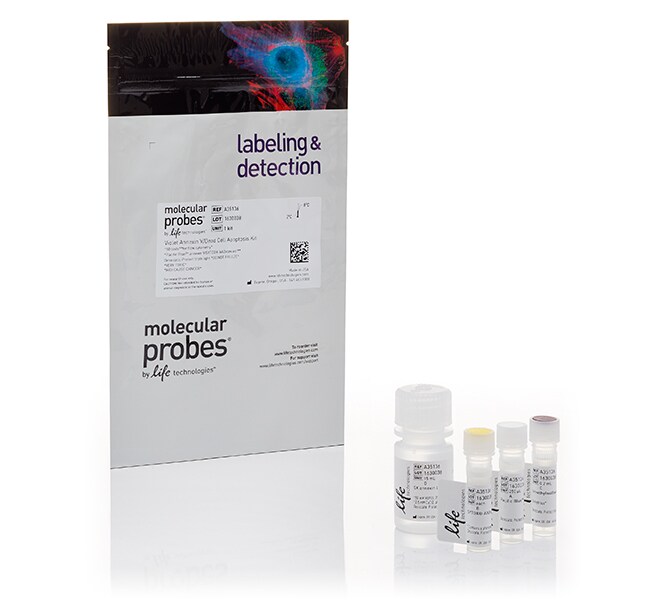
Pacific Blue™ Annexin V/SYTOX™ AADvanced™ Apoptosis Kit, for flow cytometry
Invitrogen™

Pacific Blue™ Annexin V/SYTOX™ AADvanced™ Apoptosis Kit, for flow cytometry

Ce produit détecte l’externalisation de la phosphatidylsérine dans les cellules apoptotiques à l’aide d’annexine V recombinante conjuguée au colorant violetAfficher plus
Have Questions?
RéférenceQuantité
A351361 kit
Référence A35136
Prix (EUR)
524,00
Each
Quantité:
1 kit
Prix (EUR)
524,00
Each
Ce produit détecte l’externalisation de la phosphatidylsérine dans les cellules apoptotiques à l’aide d’annexine V recombinante conjuguée au colorant violet fluorescent Pacific Blue™ et dans les cellules mortes à l’aide de colorant SYTOX™ AADvanced™. Après avoir coloré une population cellulaire avec du Pacific Blue™, de l’annexine V et du SYTOX™ AADvanced™, les cellules apoptotiques présentent une fluorescence violette, les cellules mortes une fluorescence rouge et les cellules vivantes une fluorescence faible ou nulle. Ces populations sont facilement distinguées par un cytomètre en flux avec les lignes de 405 nm et 488 nm pour l’excitation. Il y a très peu de chevauchement spectral entre les deux colorants, ce qui ne nécessite alors qu’une très légère compensation. Chaque kit contient suffisamment de réactifs pour environ 50 tests de cytométrie en flux.

Consultez un guide de sélection pour tous les dosages d’apoptose pour la cytométrie en flux.
Usage exclusivement réservé à la recherche. Ne pas utiliser pour des procédures de diagnostic.
Spécifications
Excitation / émissionPacific Blue™ : 415⁄455, SYTOX™ AADvanced™ : 546 / 647
Faisceaux laser du cytomètre en flux405, 488
À utiliser avec (application)Cytométrie en flux
À utiliser avec (équipement)Cytomètre en flux
Nbre de réactions50
Type de produitKit d’apoptose
Quantité1 kit
Conditions d’expéditionGlace humide
ConjuguéColoration pour cellules mortes Pacific Blue™, SYTOX™ AADvanced™
FormatTube
Unit SizeEach
Contenu et stockage
Contient 1 flacon d’annexine V, conjugué Pacific Blue™ (250 µl), 1 flacon de coloration de cellules mortes SYTOX™ AADvanced™ et 1 bouteille de tampon de liaison à l’annexine (solution 5X, 15 ml) et 1 flacon de DMSO (100 µl).

Conserver au réfrigérateur (2–8°C) et à l’abri de la lumière.

Foire aux questions (FAQ)

I want to study apoptosis using an Annexin V conjugate, but with adherent cells via microscopy instead of flow cytometry. Can this be done?

It has been done, but we don‘t recommend it. Both healthy cells and apoptotic cells possess phosphatidylserine on the cell surface, which can be detected with Annexin V, but apoptotic cells have significantly more of it. You can easily tell the difference between these two populations with flow cytometry, because flow cytometers are more sensitive and have a higher throughput. But with a microscope, you cannot always tell the difference, especially for adherent cells. Instead, for microscopy, we recommend a different technique, such as detecting caspases with CellEvent Caspase Detection Reagents.

Find additional tips, troubleshooting help, and resources within our Cell Analysis Support Center.

I trypsinized my adherent cells and labeled with annexin V, and now my flow data is showing a high percentage of apoptotic cells even for control, untreated cells. What is the problem?

Trypsinization or mechanical scraping of cells temporarily disrupts the plasma membrane, allowing annexin V to bind phosphatidylserine on the cytoplasmic surface of the cell membrane and thus leading to false positive staining. Allow the cells to recover for about 30 minutes in optimal cell culture conditions and medium after trypsinizing/scraping so that they can recover their membrane integrity before staining. For lightly adherent cell lines, such as HeLa and NIH 3T3, another option is to use non-enzyme treatments like Gibco Cell Dissociation Buffer (Cat. No. 13151014).

Find additional tips, troubleshooting help, and resources within our Cell Analysis Support Center.

Can I detect annexin V staining in an imaging assay?

Annexin V staining is not typically used in imaging experiments; it is a better reagent for flow cytometry analysis. All cells will stain to some extent, so it can be difficult to distinguish a relatively bright annexin V-stained cell from a dimmer non-apoptotic cell. Caspase activation, detected using our CellEvent Caspase 3/7 or Image-iT LIVE Caspase detection kits, is a better method for detecting apoptosis in an imaging assay.

Find additional tips, troubleshooting help, and resources within our Cell Analysis Support Center.

When should I stain adherent cells with annexin V for flow cytometric analysis? Before or after I trypsinize them?

Trypsinize first and then allow the cells to recover about 30 minutes in optimal cell culture conditions and medium before staining with annexin V conjugates. Trypsinization or mechanical scraping of cells temporarily disrupts the plasma membrane, allowing for annexin V to bind phosphatidylserine on the cytoplasmic surface of the cell membrane and thus leading to false positive staining. For lightly adherent cell lines such as HeLa and NIH 3T3, you could use a less harsh (non-enzymatic) dissociation product like Gibco Cell Dissociation Buffer (Cat. No. 13151014).

Find additional tips, troubleshooting help, and resources within our Cell Analysis Support Center.

Can I fix my cells after annexin V staining?

Yes, this is possible. We have established protocols for annexin V staining combined with intracellular staining of lymphocytes that can be found here. The most important step is to leave some binding buffer in the suspension when fixation is started. Compared to staining of live cells, the intensity of the annexin V signal may be somewhat reduced.