Search
 Recherche par élément
 Recherche par structure

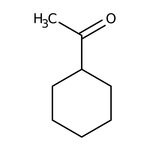

Thermo Scientific Chemicals
Cyclohexyl méthyle cétone, 95 %, Thermo Scientific Chemicals
CAS: 823-76-7 | C8H14O | 126.199 g/mol
Have Questions?
Modifier l'affichage


Référence B21000.22
également connu sous le numéro B21000-22
Prix (EUR)
394,00
Each
Quantité:
100 g
Prix (EUR)
394,00
Each
Identifiants chimiques
CAS823-76-7
IUPAC Name1-cyclohexylethan-1-one
Molecular FormulaC8H14O
InChI KeyRIFKADJTWUGDOV-UHFFFAOYSA-N
SMILESCC(=O)C1CCCCC1
Voir plus
Spécifications Fiche de spécifications
Fiche de spécificationsAppearance (Color)Clear colorless to pale yellow
FormLiquid
Identification (FTIR)Conforms
Refractive Index1.4480-1.4540 @ 20?C
Assay (GC)≥94.0%
It can be used to produce acetoxycyclohexane. It is also used as a pharmaceutical intermediate.
This Thermo Scientific Chemicals brand product was originally part of the Alfa Aesar product portfolio. Some documentation and label information may refer to the legacy brand. The original Alfa Aesar product / item code or SKU reference has not changed as a part of the brand transition to Thermo Scientific Chemicals.
Applications
Il peut être utilisé pour produire de l’acétoxycyclohexane. Il est également utilisé comme intermédiaire pharmaceutique.
Solubilité
Non miscible ou difficile à mélanger dans l’eau.
Remarques
Conserver à l’écart des agents oxydants et des bases. Gardez le récipient bien fermé et placez-le dans un endroit frais, sec et bien ventilé.
Il peut être utilisé pour produire de l’acétoxycyclohexane. Il est également utilisé comme intermédiaire pharmaceutique.
Solubilité
Non miscible ou difficile à mélanger dans l’eau.
Remarques
Conserver à l’écart des agents oxydants et des bases. Gardez le récipient bien fermé et placez-le dans un endroit frais, sec et bien ventilé.
RUO – Research Use Only
Références générales :
- Bach RD. Rôle de la catalyse acide dans la réaction de Baeyer-Villiger. Une étude théorique.J Org Chem.201277(16), 6801-15.
- Thomas M. Bare et Harbert O. House. Cétones méthyliques d’acides carboxyliques : Cyclohexyl Méthyl cétone.Org. Synthé.
- La monobromation de cétones non symétriques à l’atome de carbone moins substitué dans le méthanol donne des résultats qui parallèles à la bromation de l’acétal correspondant et, dans ce cas, résulte en une réaction exclusive au groupe méthyle : Org. Synthé. Coll., 6, 193 (1988).